
The announcement of the extant 1.5-litre Formula 1 had drawn a volley of catcalls and bread buns. The best of British was gathered to celebrate the breakthrough 1958 world titles of Mike Hawthorn, Vanwall, and (in Formula 2) Cooper. Then the RAC’s Pat Gregory rose to his feet, cleared his throat, and killed the party mood.
In contrast, the news that this limit was to be doubled, as of 1 January 1966, caused zero furore – perhaps because this November 1963 decision was taken on the day of JFK’s assassination.
The word was that the British constructors’ request for a three-litre limit had been proffered as an opening gambit, but that the Paris-based Commission Sportive Internationale caught them off guard by agreeing forthwith.
“An excess of power? Wonderful! I thought it was going to be terrific: more speed, more acceleration, more wheelspin, more noise” Jackie Stewart
“I was excited by it,” said the late John Surtees years later. “Immediately, there was talk of a brand-new engine at Ferrari. But generally, it was welcomed across the board.”
Jackie Stewart concurs: “An excess of power? Wonderful! I thought it was going to be terrific: more speed, more acceleration, more wheelspin, more noise. At BRM, there was talk of huge revs and 500-plus bhp. I was convinced.”
But talk was cheap for monastic Jack Brabham. Necessarily parsimonious, too, he sought cheap torque. Having rejected the Japanese Prince V8 due to its fragile wet liners, he flew to LA in March 1964 to view a liner-less aluminium block from a 3.5-litre Buick V8.
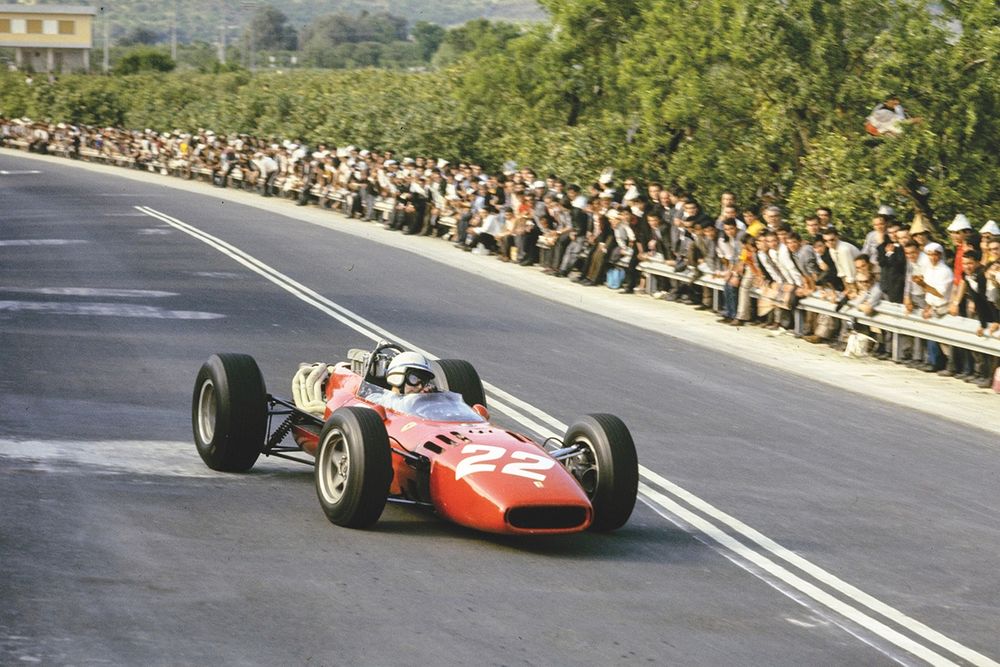
Ferrari’s new three-litre V12 powered Surtees to Syracuse GP victory
Photo by: LAT Images via Getty Images
There, he was informed of a sister unit, with an extra head stud, created at huge expense for a since-abandoned Oldsmobile project. They cost Brabham £11 each. This would be his building block of consecutive drivers’ and constructors’ world championships.
Much work, however, needed to be done. The base F85 unit featured overhead valves operated by willowy pushrods, actuated by a camshaft in the centre of the vee. It did not smack of a high-revving competition engine. Enter Melbourne’s Replacement Parts Company.
Founded in the 1920s, to do as its name suggests, Repco boasted manufacturing and technical agreements with car manufacturers in America and Europe by the 1950s. Brabham had courted and promoted it – by deeds not words – ever since.
Repco’s board was not entirely on board with increasing its motorsport involvement, but chief engineer Frank Hallam talked it around
It had helped with his world title-winning Coopers from 1959-60, and provided him with the Surbiton warehouse that was the first home of Motor Racing Developments, the company he founded in conjunction with designer Ron Tauranac. Repco’s board was not entirely on board with increasing its motorsport involvement, but chief engineer Frank Hallam talked it around – and put Phil Irving, the legendary Australian motorcycle designer, on the case.
“We set Phil up in a Croydon flat,” explained Tauranac, who died in 2020. “He’d start mid-morning and work deep into the night, smoking non-stop. I had no problem with him, but he had his own ideas and wouldn’t always stick to the pre-arranged plan. Hallam had to come to England to get the project back on track.”
The first prototype, a 2.5-litre on carburettors, ran in March 1965, which was too late for that year’s Tasman Cup, but in plenty of time for what Brabham always considered its primary purpose: F1’s ‘Return to Power’.
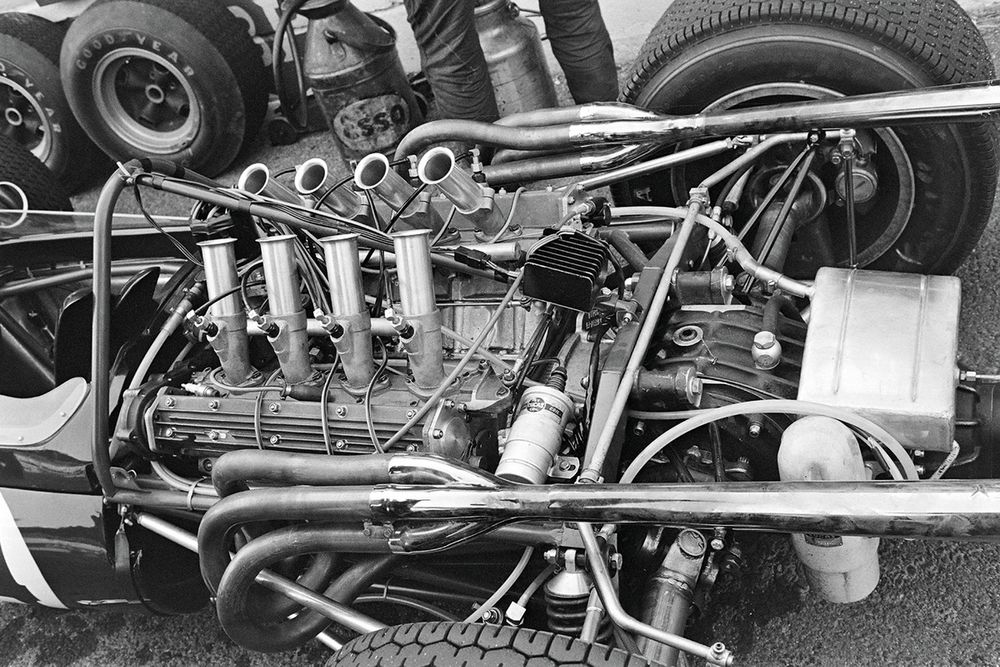
Repco engine’s win at Reims was the first of a run of four victories
Photo by: Autocar / LAT Images via Getty Images
It retained Irving’s mirrored cylinder heads – a method of easing the spares situation – with wedge-shaped combustion chambers, and two parallel valves operated by a chain-driven single overhead camshaft per bank. Its Laystall flat-plane crankshaft was lightened and balanced; its Daimler V8 conrods cost £7 a throw: and a 3/16in diaphragm vitally stiffened its bottom end.
Entitled 620 – the hundreds referred to the block, and the tens to the heads – this 90-degree unit generated 285bhp at 8000rpm on Lucas indirect fuel injection. Just as importantly, it was frugal (7mpg), light (330lb), and compact (21in across the heads).
Bolted into a tubular spaceframe originally intended for Coventry Climax’s no-show 1.5-litre flat-16 of 1965, Brabham’s BT19 ‘Old Nail’ was the only three-litre on the grid for South Africa’s non-championship Grand Prix of 1966: on New Year’s Day! He led comfortably from pole position, setting fastest lap.
“Ferrari wasn’t exactly bursting at the seams with money. They claimed 360bhp for it. It was more like 290” John Surtees
Then the fuel metering unit jammed and popped its drive belt 11 laps from home. A water leak would halt him after fewer than two laps of May’s Syracuse GP. A brooding Brabham had to watch as Surtees topped out a Ferrari 1-2 in its new three-litre.
“Yes, but I was having to row it along like hell,” said Surtees. That tuneful 60-degree twin-spark V12 could be dated back to the marque’s 1947 birth. “Ferrari wasn’t exactly bursting at the seams with money. They claimed 360bhp for it. It was more like 290. Our car was heavy, too. It didn’t set the world alight.”
And nor would it at Silverstone’s International Trophy a fortnight later, when Brabham’s nimbler machine put the 312 to the sword. “I told them that there was no point taking it to Monaco,” continued Surtees. “I wanted to use our 2.4-litre V6.”
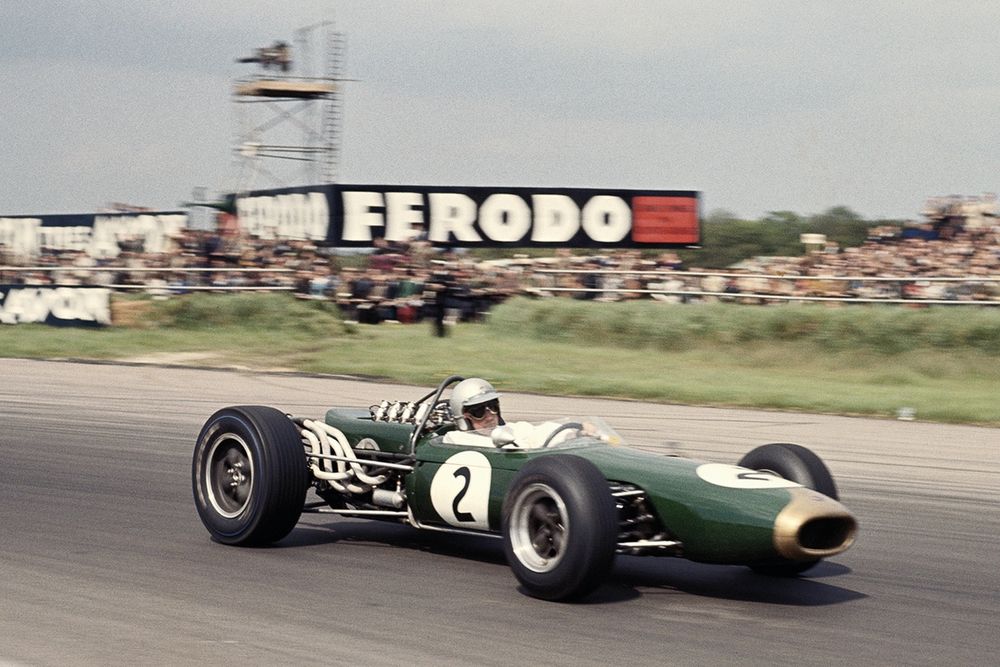
Pole, fastest lap and the race win went Brabham’s way at Silverstone’s International Trophy
Photo by: Central Press / Getty Images
Neither Surtees nor Brabham would win around the houses in the championship opener. Coerced into driving the three-litre, Surtees’s prediction of a brief lead before inevitable gearbox failure came to pass after 14 laps. Brabham’s gearbox lasted only a few minutes more. Stewart won in a two-litre BRM, and Lorenzo Bandini was second in the Ferrari denied to Surtees.
“Luckily, it was a bit wet at Spa, and things worked out OK,” recounted Surtees, who died in 2017. “Because there weren’t many slow corners, I could keep up the momentum, so that weight was not such a major factor.”
A cautious Brabham finished fourth, two laps behind the victorious Ferrari, having survived a lurid spin in the opening-lap cloudburst.
“We had more control with Repco than with Climax. The latter’s engines used to appear at our door. We’d drop one in a car, run it, and, if it broke, take it out and send it back” Hywel Absalom
“At the beginning of 1966, I didn’t think that we had a winning combination,” says Hywel Absalom, Brabham’s 23-year-old ‘Welsh Pom’ number two mechanic. “The Repco kept knocking cam followers out, and there were lots of other little problems with it. Jack was in a quandary about reverting to a Climax.
“But actually, we had more control with Repco than with Climax. The latter’s engines used to appear at our door. We’d drop one in a car, run it, and, if it broke, take it out and send it back. Repco’s arrived as complete units in packing cases, but it was us who stripped and rebuilt them.”
The mechanic charged with solving those “little problems” was Bob Ilich, a 25-year-old from Perth: “One day, Jack said, ‘Flying engines back and forth from Australia isn’t going to work.’ So, along with Jimmy Potton, a very experienced English mechanic who had worked for Aston Martin, I helped strip the first engine. Then, and I don’t know why, Jimmy left, and Jack asked me, ‘Did you watch how he pulled that engine to bits?’ I replied, ‘No, not really.’
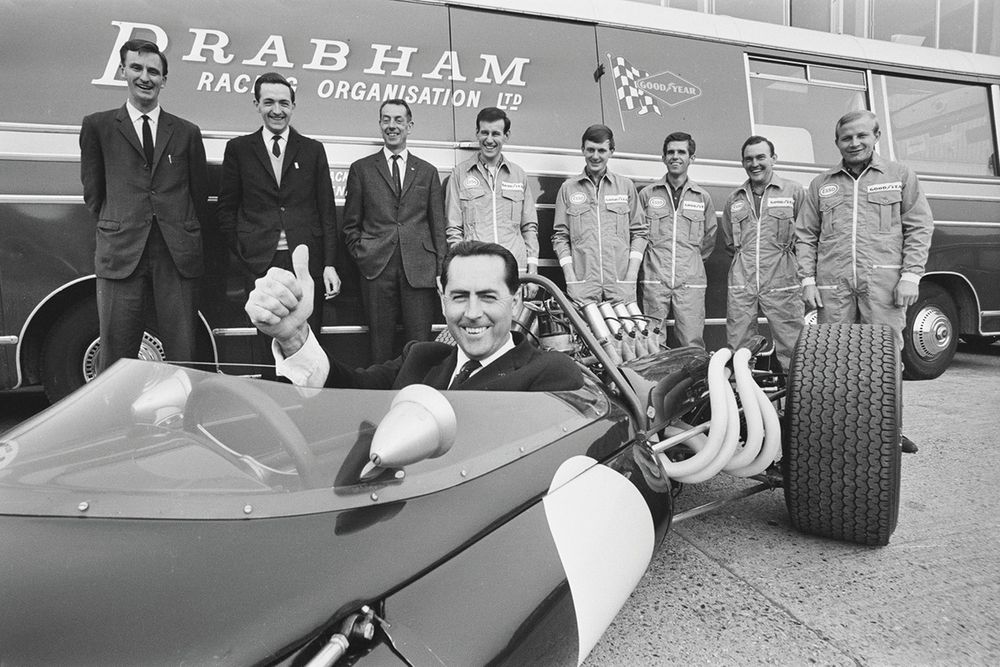
Brabham with Phil Kerr, John Judd, Ron Tauranac, Cary Taylor, Hywel Absalom, John Muller, Roy Billington and Bob Ilich
Photo by: Victor Blackman / Getty Images
“But I’d worked on truck engines back home. So, I put it back together, and put it into Jack’s BT19. It wouldn’t go. The battery was flat. When it did start, we’d flooded it: flames shot about 10 metres from the exhausts.
“Anyway, it went to Reims – and won. I did the engines from thereon. Our biggest problem had been trying to do R&D while going racing. We didn’t know how long our engines would last or what would break. A new one would arrive at the airport. Sometimes they were all right. Sometimes they were no good at all.
“So, we decided that if we didn’t rebuild them, we didn’t race them. They eventually became bomb-proof. But I was buggered! Black around the eyes from working day and night.”
That French GP victory – the first by a car with its driver’s name on its nose – started a sequence of four consecutive GP wins that put Brabham in the box seat for the world title
That French GP victory – the first by a car with its driver’s name on its nose – started a sequence of four consecutive GP wins that put Brabham in the box seat for the world title. He had just turned 40.
Surtees was also in the midst of new beginnings. Feeling underappreciated at Ferrari, he had switched to Cooper. Its Italian 60-degree twin-spark V12 could be traced back only 10 years. Revived at the behest of Maserati’s charming British concessionaire, Mario Tozzi-Condivi, whose Chipstead Motor Group now owned Cooper Car Company, Tipo 9 was said to give 360bhp at 9200rpm, but looked terrifyingly complex and bulky in the bulbous T81.
Surtees: “The Ferraris had more top-end speed, but that Cooper was actually a nice little handler, and I was quicker through the sweeping first part of the Reims circuit. Then I picked up a tow from one of them, and split them on the front row. I led off the line, too, and thought, ‘I’m in with a chance here.’ Suddenly, one of the fuel pumps packed up and left me high and dry. The Maser wasn’t startling, but it did a good job.
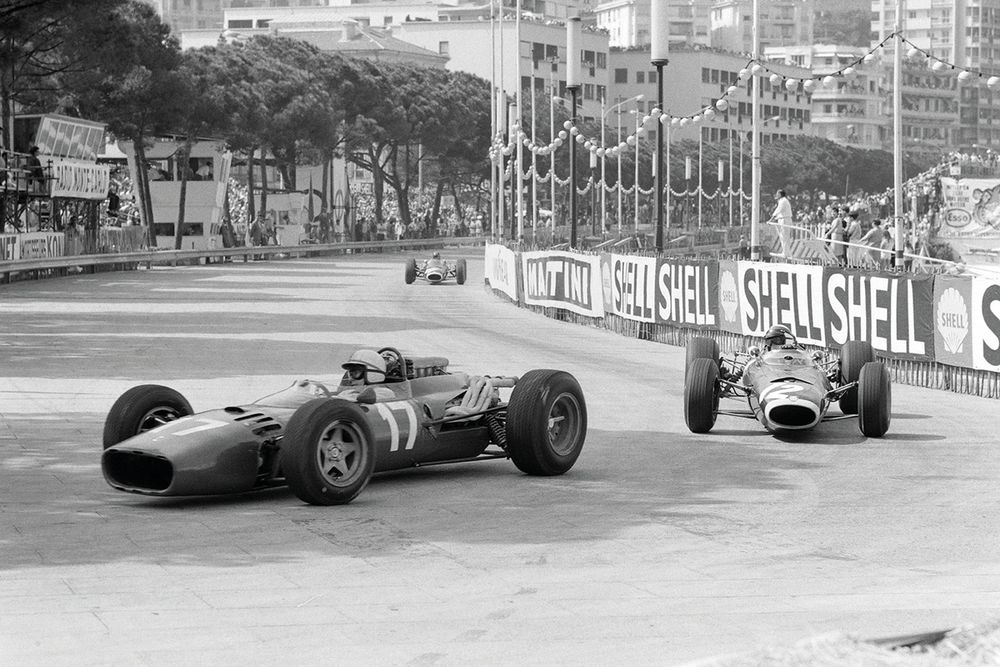
It turned out that Surtees was right not wanting to run the three-litre at Monaco
Photo by: Rainer Schlegelmilch / Getty Images
“With all due respect to Jack, who did a wonderful job, only by some bad luck did I manage not to win the championship. I was in a position to win at the Nurburgring, when I lost two gears. I was right with them at Monza, when a bag tank ruptured. And I was in the lead battle in America, sitting on the tail of Lorenzo Bandini’s Ferrari, able to cope quite nicely, when Lotus’s Peter Arundell came out of the pits and collected me.”
Surtees’s consummate win at the Mexico City finale came too late. Brabham, his Repco now giving 310bhp, had secured the driver’s title at Monza, despite retiring due to an oil leak.
“I flew home with Jack,” recalled Tauranac. “When we landed at Fairoaks Airport, there was a crowd of journalists there. I asked Jack what it was all about. He replied that they probably wanted to interview us about winning the world championship. That was the first time I was aware of it. I had been so focused on each event that I hadn’t taken in the bigger picture.”
“My driving had gone stale, but, with Repco behind me, I was fired up. I’d had confidence in the project from the start” Jack Brabham
This ‘husband-and-wife’ pair were not bosom buddies, and often marched to their own states of tune. Brabham could see the financial sense of having an order book full of satisfied customers, but often chafed at his works team’s resultant wait of expectation.
“After beating Ferrari [at Silverstone], my sights had definitely been on the championship,” he reckoned. “My driving had gone stale, but, with Repco behind me, I was fired up. I’d had confidence in the project from the start – I never actually fell out with Ron – but we had to make sure that the F1 side was going to work.”
Tauranac: “At the end of 1963, our first full year of F1, Jack had said that he would like to run his own team: Brabham Racing Organisation. The idea was to become a customer of Motor Racing Developments and pay £3000 per car. After three seasons of no direct involvement, no feedback, and no money for development, I had lost interest in F1.
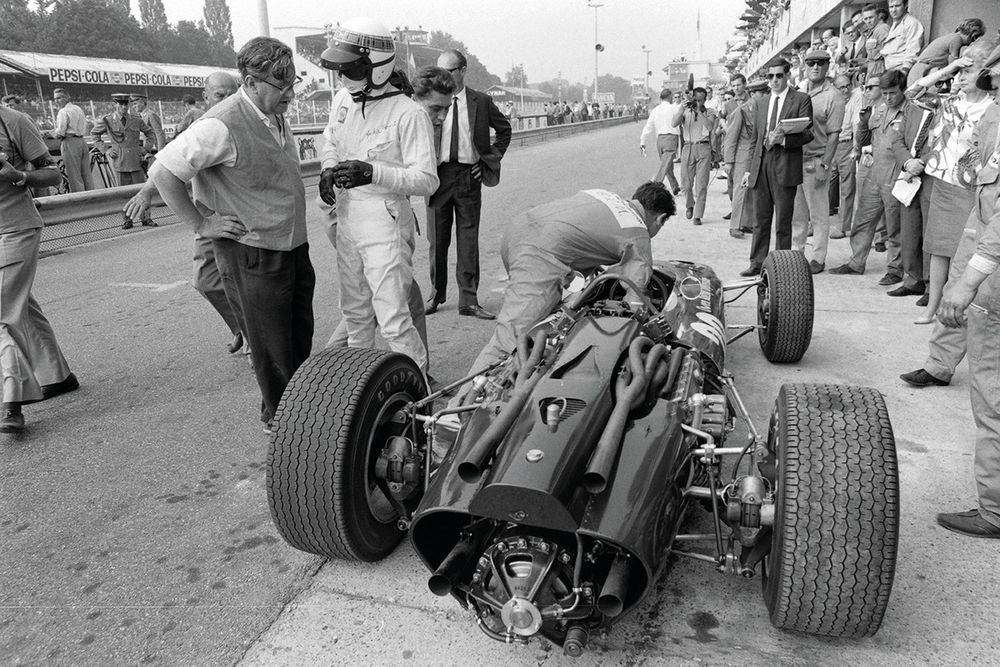
Stewart admits he had been naive about the reality of the complex BRM H16
Photo by: Rainer Schlegelmilch / Getty Images
“That’s why, at the end of 1965, I said that I didn’t wish to build any more. This cleared the air. A new agreement was drawn up, and I played a much bigger part from 1966. Jack and I had the partnership back the way we originally planned it.”
Ferrari scored a 1-2 that day at Monza, its performance boosted by three-valve heads. “They had been in the wind when I left,” said Surtees. “But they were in such confusion that I didn’t know what they’d do. Someone made a decision and decided to salvage something.”
‘Something’ that was beyond BRM’s complex H16 engine. First seen rumbling around Monaco, it finally made its race debut at the Italian GP: Stewart and team-mate Graham Hill both retired, as they would at Watkins Glen and Mexico City.
“I hadn’t considered that more also meant more cylinders, more metal, more friction, more radiators, more everything. It carried enough fuel, water and oil for the Queen Mary” Jackie Stewart
“I had been naive,” says Stewart. “I hadn’t considered that more also meant more cylinders, more metal, more friction, more radiators, more everything. It carried enough fuel, water and oil for the Queen Mary.
“But I learned a lot more in 1966, too. My 1965 season had been about seat-of-the-pants exuberance. The new three-litres caused what I call the ‘speedboat concept’: jam the throttle open, and the back sinks and the front rises. How you introduced speed, power and traction was now more sophisticated. A corner began, not when you braked, but when you took your foot off the gas pedal. More talent was needed to drive them.
“But that Brabham was so good because its engine was simple and flexible.”
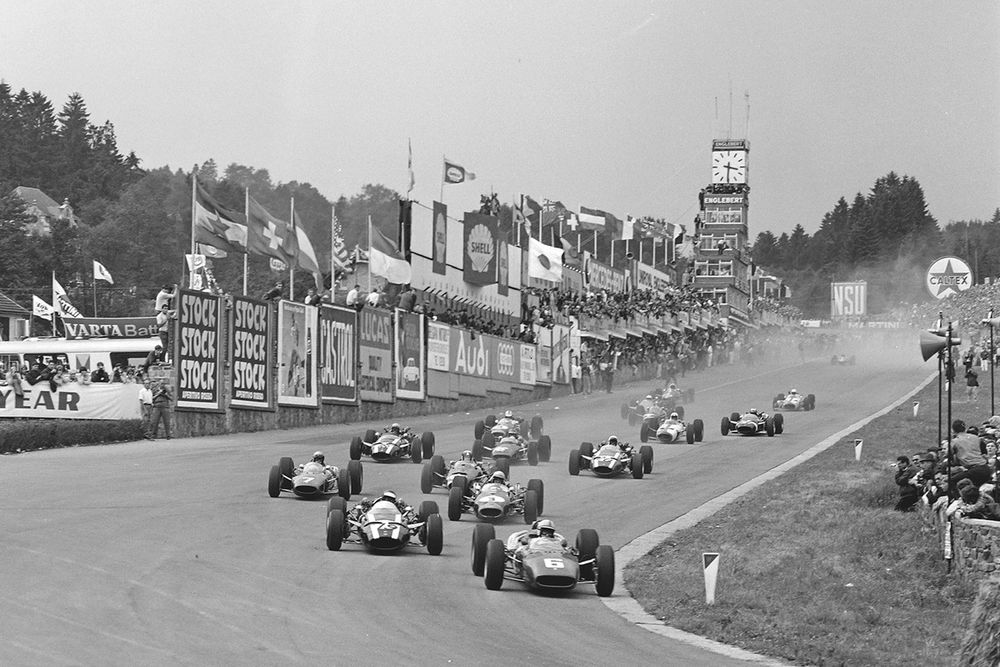
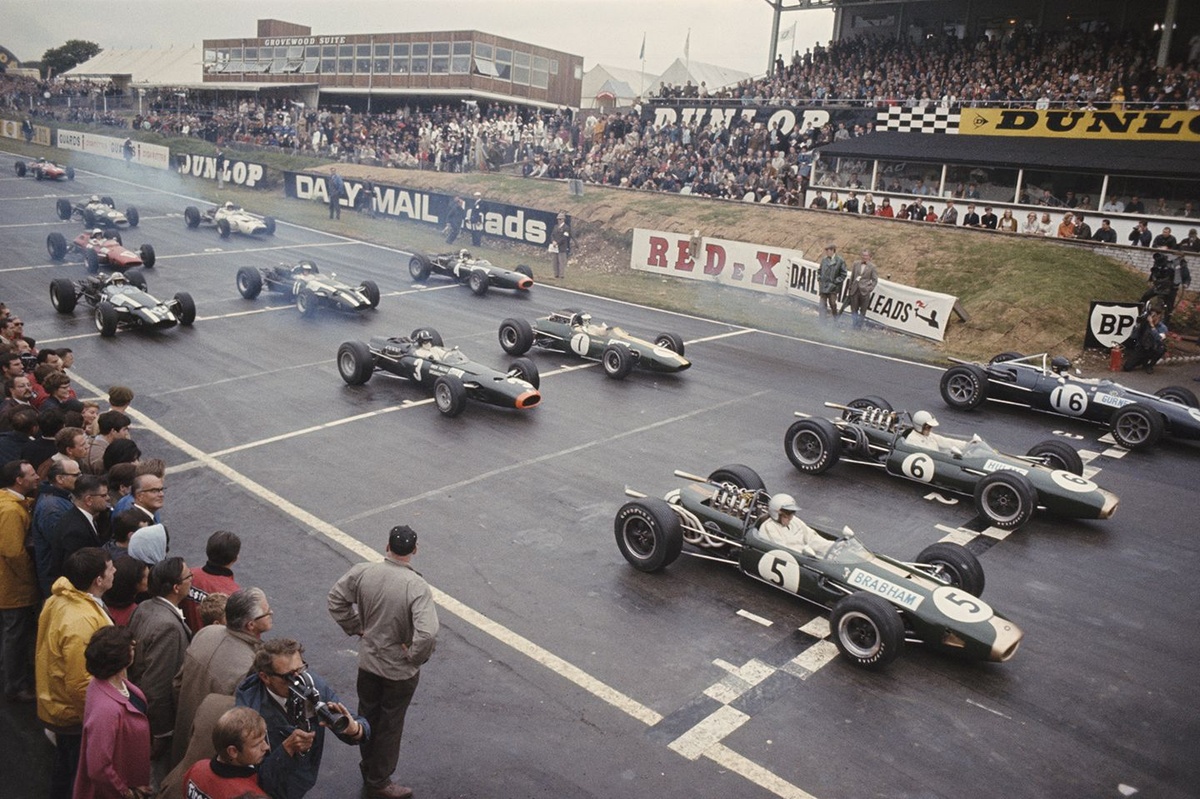
Surtees (6) won at Spa; Brabham (3) survived a spin to finish fourth
Photo by: LAT Images via Getty Images
Meanwhile, at a drawing board near Northampton, a pale and drawn Keith Duckworth – he lost 40lb in nine months of 16-hour days, seven days a week – was designing the most important engine in F1 history: the brilliantly simple, and simply brilliant Ford-Cosworth DFV V8.
No tangles of electrical ‘spaghetti’ or ‘viper’s nest’ exhausts; just a neat, efficient package bolted snugly to the Lotus 49 ‘bracket’.
“The writing was on the wall,” remembered Surtees, who had joined Honda for 1967: its V12 was powerful but, with its pre-war Alfa Romeo cues, too large, thirsty and heavy.
“The biggest problem racing against British machinery was the characteristics of their engines, which made them easier to drive. In Keith Duckworth, you had someone who fully appreciated what was required.”
Stewart: “His DFV was the best thing to happen to F1. Ken Tyrrell went to Zandvoort just to see it [win on its June 1967 debut]. As soon as he did – bingo!”
This article is one of many in the monthly Autosport magazine. For more premium content, take a look at the March 2026 issue and subscribe today.
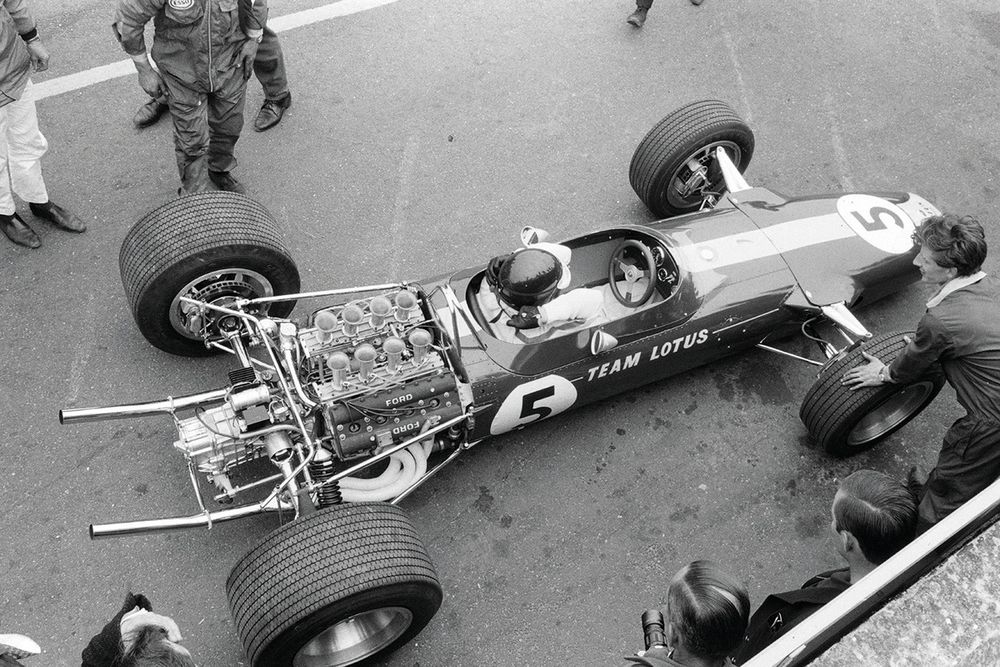
The game was changed beyond all recognition by the arrival of the Cosworth DFV
Photo by: Rainer Schlegelmilch / Getty Images
We want to hear from you!
Let us know what you would like to see from us in the future.
– The Autosport.com Team