
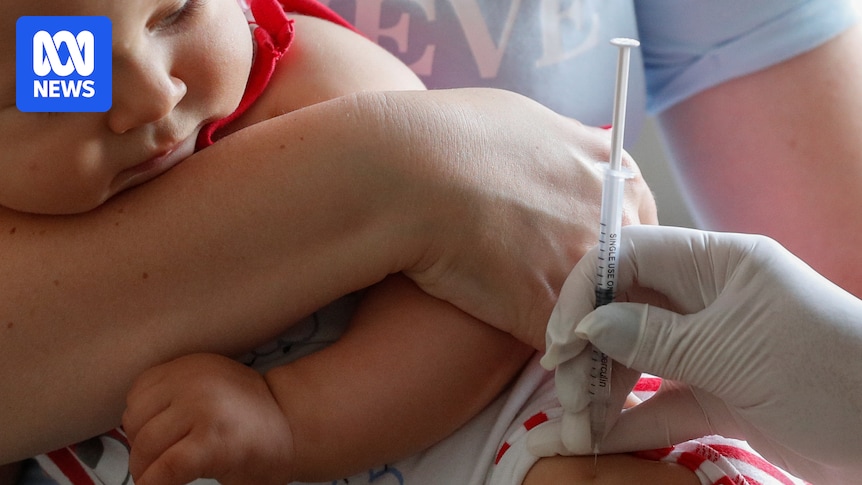
A “potentially catastrophic” decline in Australia’s childhood vaccination rates has contributed to the sharpest increase in cases of whooping cough in 35 years, infectious disease experts say.
Rates of whooping cough, a highly contagious respiratory disease also known as pertussis, rose to almost 800 cases per 100,000 Australian children in 2024-25, according to a recent Productivity Commission report.
The average rate was 183.5 per 100,000 children for the pre-pandemic years, from 2015-16 to 2018-19.
The Australian Centre for Disease Control’s surveillance system showed 57,257 whooping cough cases were confirmed in 2024, with 37,663 of those cases involving infants and children aged up to 14.
That spike marked the highest yearly number of cases since 1991, when cases of whooping cough were first recorded.
Almost 26,000 of the cases were detected in NSW and more than 15,000 in Queensland.
Another 25,272 notifications of whooping cough were then confirmed by authorities in 2025.
Whooping cough is a potentially fatal infection caused by the bacterium bordetella pertussis and can lead to severe coughing fits that can linger for months, according to Australia’s Centre for Disease Control.
Common symptoms often include a runny nose, sneezing and a mild dry cough within the first week of illness. After two weeks, the infection can worsen and lead to long episodes of heavy coughing.
Archana Koirala, a paediatrician and infectious diseases specialist from the National Centre for Immunisation Research and Surveillance, said COVID-19 pandemic lockdowns and social distancing rules were a factor in the 2024-25 spike.
“The bacteria is spread similarly to how viruses are spread, and so if you restrict people from coming into contact with each other, the bacteria is restricted in its spread as well,” she said.
“Immunised children didn’t get exposed to that usual kind of circulation … and so they didn’t get that immune boost.
“We saw a decline in coverage across Australia, and so what happens is that [among] those who are vaccinated, their immunity waned … and a proportion didn’t get their vaccines in time.
“That’s like a perfect storm for an outbreak.”
In Australia, routine childhood immunisations are administered from birth until the age of four to protect against diseases such as hepatitis B, diphtheria, pertussis, polio, rotavirus, measles, meningococcal and influenza.
Paul Griffin, the director of infectious diseases at Mater Health Services, agreed.
“The unfortunate reality is that when vaccination rates decline, population susceptibility and therefore risk goes up, and these things will increase,” he said.
“If we don’t do something about it, we’re going to start seeing a whole host of these things that really should be much better controlled than they are at the moment, and that includes basically all vaccine-preventable diseases.
“It is potentially catastrophic.”
In September last year, 91.54 per cent of children aged one, 89.57 per cent of two-year-olds and 93.17 per cent of five-year-olds were vaccinated for preventable diseases, according to quarterly data released by the federal health department.
All three age groups fell short of the national target of 95 per cent.
The data showed it was the lowest national coverage rate for one-year-olds since 2014, the lowest for two-year-olds since 2015 and the lowest for five-year-olds since 2016.
“Even a slight decline in vaccination can have a big impact on population immunity and case numbers and burden of disease,” Dr Griffin said.
“We know [whooping cough] is a devastating infection, particularly in those most vulnerable, and we need to make sure we don’t continue to see this trend into the future.”
Dr Koirala said the childhood vaccination rate decline also coincided with an increase in the number of measles cases.
The Australian Centre for Disease Control reported 181 cases had been confirmed in 2025 — up from 57 in the previous year.
About 30 cases have been detected this year.
If the vaccination rates do not rebound, Australia could face a potentially disastrous re-emergence “of diseases that we have almost eliminated”, such as endemic measles, she said.
Australia was among the first four nations globally to eliminate the constant local transmission of measles in 2014, according to the World Health Organization.
At least 37,663 cases of whooping cough affecting infants and children aged up to 14 were identified across the country in 2024. (ABC News: Gregor Salmon)
“We’re really worried because measles is a very infectious virus and we know that when the coverage gets below 95 per cent in the population, that’s when large outbreaks have occurred,” she said.
“We’ll see a measles death, we’ll see a whooping cough death … and if vaccine hesitancy increases, we’ll have more circulation of the bacteria.”
Vaccine advocate flags dangers of social media
Catherine Hughes, the co-founder of the Immunisation Foundation of Australia, lost her son Riley in 2015.
He died from whooping cough at just 32 days of age.
She said watching Australia’s childhood vaccination rates continue to decline “makes your heart sink”.
“You think back to that time when you watched your baby in hospital get worse and worse and sicker and sicker and ultimately not survive. It’s such a simple, easy way to prevent it,” she told the ABC’s Radio National Breakfast.
“To know that these rates are the worst that they’ve been in 10 years for childhood immunisation, it’s not great news.
“I worry that this trend will continue.”
Loading…
Ms Hughes became a vocal immunisation advocate after Riley’s passing, saying she is concerned about the rise in misinformation and “anti-vaccine propaganda” that continues to proliferate on social media.
“A couple of years ago, a lot of the social media companies would use fact checkers and it did help mitigate to a certain degree some of the anti-vaccine propaganda that we see, but that has been dropped in the last 12 to 18 months,” she said.
“At the end of the day, all it really does is serve as a reminder to me of why it’s important that we continue to speak out … about the importance of vaccination.”
Eroding trust and misinformation at the heart of declining vaccination rates
Dr Griffin believes it is now “far easier to be misinformed than to be informed” about vaccination safety in Australia.
“We need to be more proactive in getting good information out there,” he said.
“Make sure people know where the good sources of information are, empower our frontline workers in this regard, our pharmacists and our GPs with good information and the time and resources to be able to spend time with patients, with parents to be able to make sure that everyone gets the right information.”