
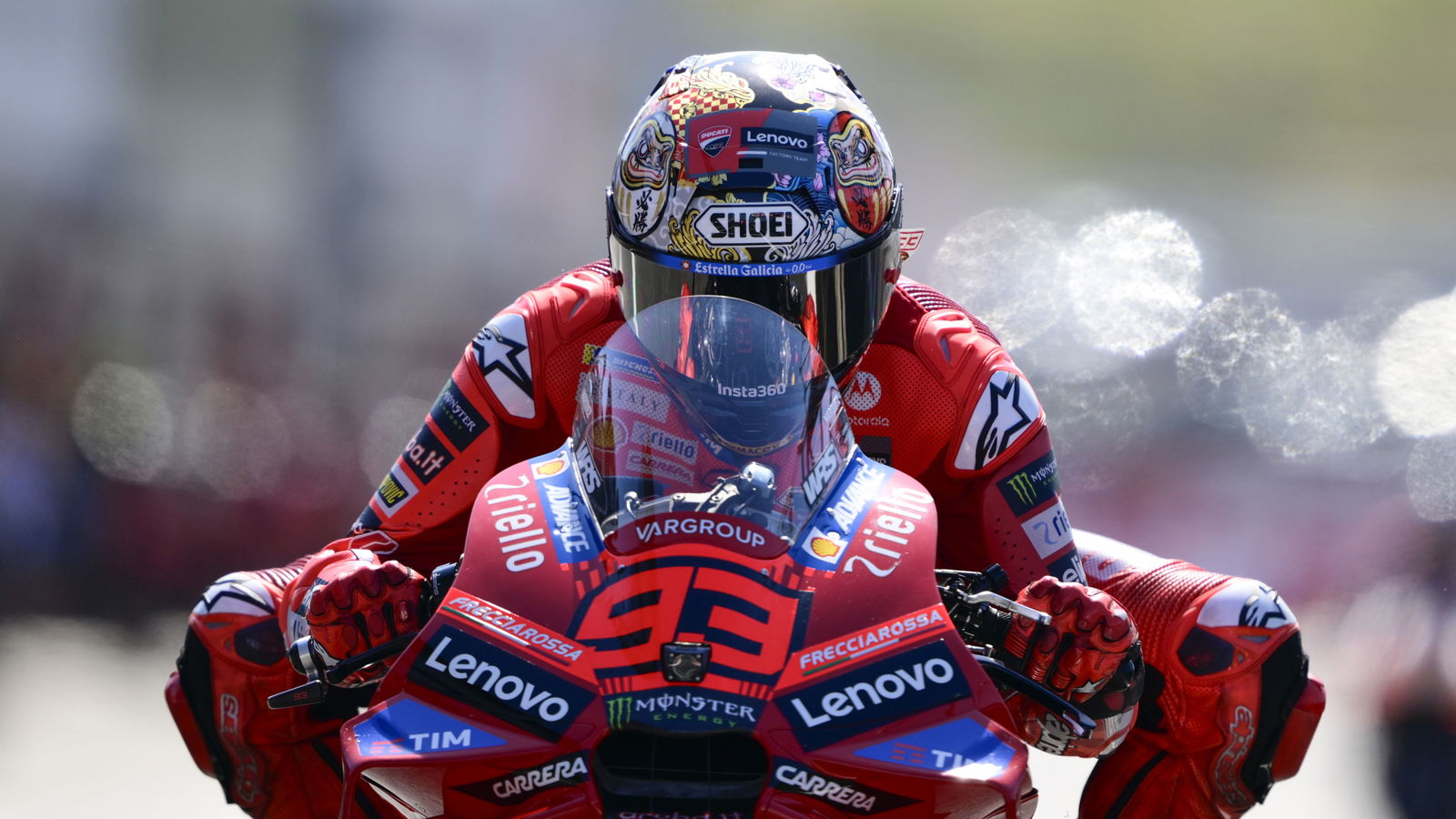
Marc Marquez’s dominance of MotoGP can be distilled down to two aspects of his racing approach, Casey Stoner thinks.
Stoner never raced against Marquez, of course, in fact the Australian was replaced by the Spaniard at the Repsol Honda team after his early retirement at the age of 27 in 2012.
Looking from the outside for the entirety of Marquez’s MotoGP career, Stoner believes his dominance of the premier class has been down to race craft and understanding how to build a race.
“There’s no doubting his [Marquez] talent, his speed, anything like that, there’s no questioning it,” Casey Stoner said, speaking to Crash.net in an interview organised to highlight his role in the new Ride 6 videogame, in which he is a kind of ‘boss character’.
“If you did, then there’s something wrong with you.
Article continues below ADVERTISEMENT
Article continues below ADVERTISEMENT
“But […] I think so many riders fell into the same trap. Yes, there’s a lot of fast riders out there at the moment, but I don’t think there’s a lot of them that use their full capacity of their race craft. That’s where Marc beats them now.
“Marc did have a big weakness in the past that I don’t think anybody’s noticed and I still won’t say anything about it. But it was surprising that nobody was able to exploit it, I suppose, because everyone [looked at him] like ‘final boss’ and instead of figuring out what they need to do, what they need to improve in themselves, maybe how to race against Marc, they just kind of saw him as this incredibly difficult competitor.”
Marquez went six years between titles, longer than any other rider in MotoGP history, winning in 2019 and then not again until 2025 as injuries kept him away from the track and an underperforming Honda pushed him to move to Gresini Racing before finally landing at the factory Ducati team last year.
Stoner thinks the time between titles has been a benefit to Marquez’s mentality, that he’s stronger and more intelligent now than he was in the 2010s, by the end of which he was 26 and just entering his theoretical physical peak. This intelligence then allows Marquez to win in more strategic ways, rather than simply through pure speed and a willingness to take risks that were more commonly associated with his style in the 2010s.
“I mean, my MotoGP career was as long as [the time between Marquez’s last two championships],” Stoner said.
Article continues below ADVERTISEMENT
Article continues below ADVERTISEMENT
“He’s been there quite a few years now.
“But what it’s done, over these last years that have been difficult for him, is just build another level of strength and intelligence and patience. It’s seemingly what I think everyone that’s racing him now lacks.
“Nobody seems to understand what he’s doing in the races to preserve tyres and do all this sort of thing. They just see this one-speed Marc, where he plays a different card each week.
“But a very common theme I saw throughout [2025], that nobody picked up on enough, was how patient he was with the tyres.”
This tyre treatment aspect of Marquez’s current style of racing is comparable to F1, in Stoner’s opinion, and in particular to Max Verstappen.
Article continues below ADVERTISEMENT
Article continues below ADVERTISEMENT
“It’s a little bit like Formula 1,” Stoner said. “The really good guys at the moment, in particular Max [Verstappen] – when they’ve put the new tyres on after a pit stop, he takes several laps before he starts to put pace into them, and that gives him an extra 10 or 15 laps towards the end of the stint, [and] with a lot more pace after looking after the tyres and bringing them in slowly, softly.
“I think Marc has realised what’s necessary out of these [MotoGP] tyres and he really is patient with them.”
Part of Marquez’s ability is riding the bike without too much interference from the electronics, which Stoner thinks allows the electronics to work more effectively later in the race because Marquez’s style preserves grip.
“One thing that I think he’s very good at as well is– everybody else is just relying on the electronics, and the electronics are only reacting to a reaction,” Stoner explained.
“So, the bike underneath starts to slip or slide, then the electronics will take over more. So, Marc is basically keeping the electronics back from that and basically conserving the tyre as much as possible so that, when the electronics do take over, they’re not having to deal with this incredibly fast slip that’s coming up – it’s a lot slower and more predictable.
Article continues below ADVERTISEMENT
Article continues below ADVERTISEMENT
“And he can make those tyres last a lot longer to the point that when the electronics take over, when the grip level goes down, his grip level is much higher because he was so gentle on them at the start. I saw that race after race.
“If you go back, you can just see his patience so often with the tyres, unless it was a certain race or track that he felt he had pace to go out and take charge, and in that case he sort of would flip the switch and make everybody think that they don’t know what he’s doing.
“But I think he just listens to the bike and the tyres well enough now to understand what part of the race is won, and if you watch all of the recent [races], especially the second part of the year, it was always at the end of the race that he was incredibly strong because he was so gentle on the tyres in the early stages.
“I think people just didn’t pick up on that enough.”
A lack of reliance on electronics is one of the standout characteristics of Stoner’s own style, one which was born on oil-slicked Australian dirt tracks.
Article continues below ADVERTISEMENT
Article continues below ADVERTISEMENT
It means that it’s something Stoner is well-positioned to notice in the approach of other riders, and means he knows the advantages of such a style.
“It’s something that I prided myself on, that I didn’t need the electronics,” Stoner said.
“I found that level of grip and would ride in front of them [electronics] because a rider, if they’re able to understand where the grip level is – a little bit in front of the electronics – is always going to be faster because they can react, or they’re ready to react, a lot quicker than what the electronics are.
“The electronics are always in delay because they’re not expecting it until it’s gone, the grip.
“So, I think that’s how Marc sort of plays things a little bit more, is he just does not put the same amount of pressure, he picks up the bike far more than everybody else. He’s much more patient, especially at the start of the race, he’s taking a lot less out of the tyre, he runs a little less corner speed, picks up the bike, drives it out with a little more certainty, doesn’t have it sliding and spinning and moving and really stressing the tyre.
Article continues below ADVERTISEMENT
Article continues below ADVERTISEMENT
“And because he’s able to stay on just on that line, a little bit ahead of the electronics, then basically later on, when the tyre grip is going down, the electronics will kick in a little bit more; he’s already got a percentage of tyre, if you like, that is better than the rest and that just allows him to find something that the others cannot.”
Subscribe to our MotoGP Newsletter