
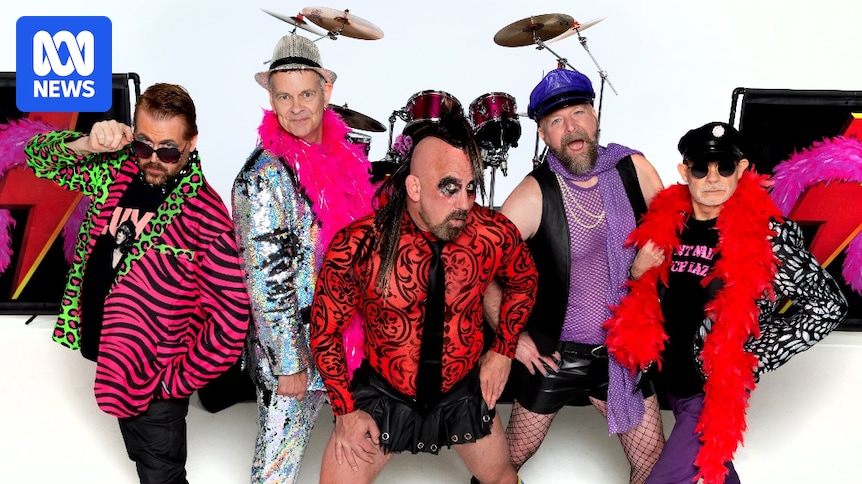
You need more than a great name to be a great band.
But it certainly doesn’t hurt — just ask Chris Freeman.
“A few of us put together an all‑gay tribute to The Go‑Go’s, we were called The Gay-Gays,” the American musician says.
“When The Go‑Go’s announced their final tour, we got asked to play the after party for their last show. We thought, ‘Well, let’s take that as a sign and we’ll break up as well.'”
Only, The Gay-Gays didn’t really want to call it a day. They still played brilliantly together, still loved the chaos and camaraderie that come with being in a band. So the scheming began.
“One of us started playing Back in Black, the riff, and said, ‘How about GayC/DC?'”
Dirty Deeds, Done Properly
GayC/DC — billed proudly as “the world’s first (and only) all‑gay tribute to the music of AC/DC” — may have begun with a joke name, but the band is built on genuine reverence for Australia’s rock’n’roll titans.
Loading Instagram content
Every member is a true believer, and they know any AC/DC tribute will be scrutinised by diehards who miss nothing.
“Right from the very beginning, we knew that the music had better be good,” Freeman says.
“We took about six months of woodshedding to make sure we got this. Because AC/DC sounds simple, but it’s not.”
That discipline mattered for two reasons.
First: they weren’t about to put their name on anything that fell short. And second: there were certain parts of the AC/DC live spectacle they knew they couldn’t replicate.
“We don’t look anything like AC/DC,” Freeman says. “Our Angus is 240 pounds of solid muscle; there’s no way he’s going to get on my shoulders.
“So, we took the look aspect of it and turned it around.”
They also have fun with the lyrics: TNT becomes PnP (look it up), the word “rock”, a constant throughout AC/DC’s work, becomes something quite different with one letter change, while turning Whole Lotta Rosie into Whole Lotta Jose is a whole lotta fun.
Behind this camp and chaos is something genuinely heartfelt, though.
“We thought, ‘What if we heard the lyrics growing up as young gay kids that we’d always wanted to hear?'” drummer Brian Welch says.
“As hard rock and metal fans and being gay, all we heard was about women, girls, fast cars … Great! But really, it didn’t speak to the whole of us. There was something missing.”
We salute you
Much like the band they honour, GayC/DC does not deal in subtlety.
Their shows are loud, joyful and deliberately outrageous, which means they’re often stepping boldly into spaces where they don’t know how they’ll be received.
“It’s always a ‘what are we going to run into tonight?’ situation,” Freeman says. “Every show, we don’t know who’s going to be in the audience, who needs to be turned around.
“Most of the time when we’re playing, we’re using a lot of humour, which we find is the sweetener for the bitter pill, if you will.”
The strategy works. They routinely convert purists who arrive unconvinced and leave euphoric.
“When we tour the US, we get the folks in the back of the club with their arms folded, waiting to see what we’re gonna do,” Welch says.
“By the end of the last song, they’re up front, they’re singing, and they hang around after the show to thank us.
“One guy said, ‘I came here with my girlfriend, and I did not see this coming. I don’t think I ever need to see AC/DC again, but I will see you every time you come through town’. That means a lot.”
For all the irreverence, their devotion to AC/DC is unwavering.
“We are never taking the p**s out of AC/DC or their music.
“We worship them. They run in our DNA,” Welch says.
“We make sure the crowd knows from the very first song that they’re in on the fun. We bring them along for the ride.”
Welch estimates roughly 70 per cent of their audience is straight — not surprising when heavy rock still sits outside the musical diet of many queer fans.
“Here in the US, a big part of the LGBTQIA+ community wants track artists, they want drag queens, they want lip syncing, they want top 40,” he says. “They don’t want older guys playing rock’n’roll.
“But the older guys that love rock’n’roll, the gay bears, the gay rockers, the gay bikers, they come to the shows and they love it, and they bring their friends.”
Still breaking barriers
Chris Freeman may not be a household name, but he is a bona fide punk icon.
His band Pansy Division was a pioneering punk act when it emerged in the early 1990s.
They were unapologetically, loudly queer at a time when the punk and hardcore scenes were awash with macho aggression.
Loading Instagram content
“I think the crossover for people who like GayC/DC that liked Pansy Division is pretty slim. I’m not sure why,” Freeman considers.
“We do see them, people come up and tell me they are a Pansy Division fan, but I don’t know if that’s a lot of our audience.”
At this point, Welch jumps in, determined to ensure Freeman’s impact is recognised.
“We wouldn’t be doing this if it wasn’t for Pansy Division,” he says. “They kicked open a lot of doors for gay musicians to be who they are.
“They were the first out gay punk band on an arena tour opening for Green Day. Chris has had more things thrown at him on stage … and I say that with love because he took all the hits for us.
“This band would not be able to stand on the shoulders of giants if they hadn’t come before us and said, ‘This is who we are. This is what we do. This is what we play. If you like it, great, stick around. If you don’t, change your channel.'”
Audiences in 2026 are more open-minded, but the band understands why some diehard AC/DC fans might side eye a queer reinterpretation of their sacred texts.
“If you don’t like the way we look, if you don’t like the song titles, that’s fair,” Welch says.
“But after the show, let’s have a drink and talk about what was the first tour you saw AC/DC on. Or your favourite song. Let’s talk as AC/DC fans. There’s common ground there.
“I wish more people, especially here in [America], would see that there’s common ground that if you take just a half hour out of your day and talk about music. Both parties can walk away going, ‘You know what? That guy’s not so bad.'”
And sometimes it flips entirely — they’re not only converting AC/DC purists, they’re creating brand new AC/DC fans out of people who never connected with the band before.
“I think we’ve had more people come up to us and say, ‘I came because of Pansy Division or the gay element, but I wasn’t really an AC/DC fan, but now I am’. We’ve actually had people go, ‘Wow, now I think I like AC/DC after watching you guys.'”
GAYC/DC starts its Australian tour in Brisbane on Thursday before shows in Southport, Melbourne, Adelaide, Perth and Sydney.