
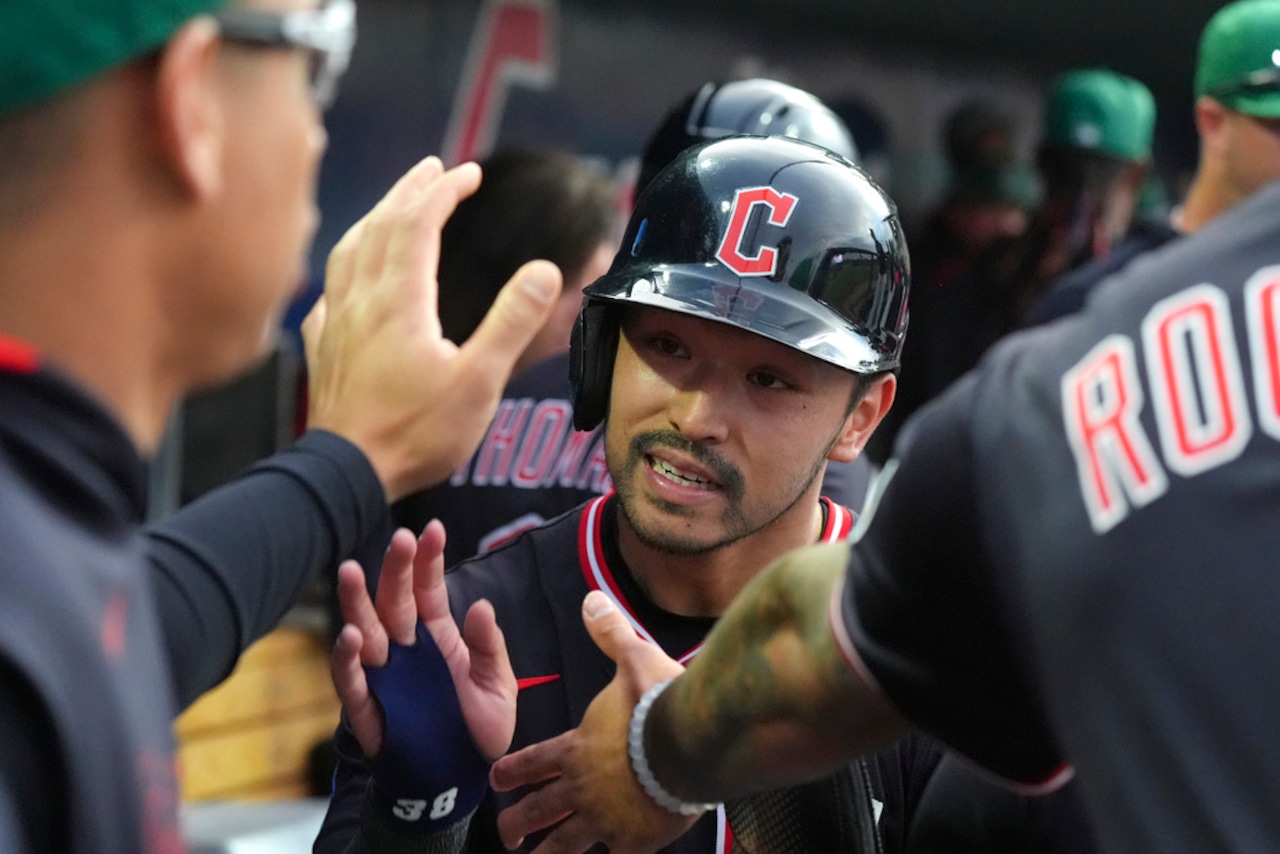
CLEVELAND, Ohio — Steven Kwan continues his ascent as one of baseball’s most complete outfielders and the Guardians face a critical strategic decision about his future — one that’s becoming increasingly complicated by upcoming labor negotiations that could eliminate a key team protection.
The potential disappearance of MLB’s qualifying offer system after the current collective bargaining agreement expires following the 2026 season has created a ticking clock for Cleveland’s front office, according to Guardians beat reporters Joe Noga and Paul Hoynes.
“We don’t know in 2027 or beyond the 2026 season, based on the labor negotiations, whether or not there will be a qualifying offer. How does that play into the strategy here with Kwan and whether or not they’re able to re-sign him, or when they look to trade him,” Noga speculated on the Cleveland Baseball Talk Podcast.
Under the current system, teams losing qualified free agents receive draft pick compensation — a crucial consolation prize for small-market clubs like Cleveland when they can’t retain homegrown stars. Without this system, the Guardians could potentially lose Kwan for nothing when he reaches free agency after 2027.
“It would be difficult for me, if I’m the Guardian’s front office, to let Steven Kwan play the next two years and not make him a qualifying offer, the just let him walk for nothing. You get nothing in return,” Hoynes said.
This uncertainty creates three clear paths for Cleveland: extend Kwan long-term, trade him while his value is maximized, or risk the qualifying offer system still existing when he reaches free agency.
The players’ union has historically opposed the qualifying offer system, viewing it as a restriction on free agency. “They see it as restrictive to free agents, because if you’re attaching draft pick compensation, teams that are signing some of these high level free agents might shy away,” Noga noted.
This opposition makes the system’s elimination a real possibility in the next labor agreement, which would dramatically alter how Cleveland approaches Kwan’s situation.
Further complicating matters is the risk involved with qualifying offers themselves. If extended one, Kwan could accept it — potentially forcing Cleveland to pay more than they’d prefer for a one-year deal, similar to what happened with Gleyber Torres and Detroit earlier this offseason.
“It’s kind of a cat and mouse game. And right now a big part of the, the equation is unknown just because of the basic agreement and what the terms of the new one will be,” Hoynes explained.
For the Guardians, this labor uncertainty adds significant pressure to make a decision on Kwan sooner rather than later. While the team traditionally maximizes control over homegrown players, the potential elimination of qualifying offers could force Cleveland’s hand toward either extending or trading a star outfielder before he approaches free agency.
As Cleveland continues building around a young core, the Kwan decision represents perhaps their most significant strategic challenge — one that extends beyond performance projections to the complex realities of baseball’s labor landscape.
Read the automated transcript of today’s podcast below. Because it’s an AI-generated transcript, it may contain errors and misspellings.
Podcast Transcript
Joe Noga: Welcome back to the Cleveland Baseball Talk Podcast. I’m Joe Noga, joined by Paul Hoynes. Hoynsie, the case against Emmanuel Clase and Luis Ortiz that’s ongoing in federal court continues to have twists and turns, the latest of which the revelation on Friday that Clase not only was throwing rigged pitches in as early as 2023, but as some of our. Our biggest fears have. Have been realized, he was, in fact throwing rigged pitches. At least one that the federal government can prove in the 2024 postseason. At the conclusion of a dominant season by Clase, during the regular season, a postseason in which he went.02 with a era better than nine and had suffered two notable collapses, he indeed did throw a at least one rigged pitch, that pitch being the first pitch of his outing on October 5th in game one against the Tigers. What was your reaction, you know, not just as a reporter, but just as somebody who’s observed baseball for as long as you have, finding out that that Clase actually was doing this in the playoffs against the Tigers and that the federal government has proof that he did this?
Paul Hoynes: Yeah, just really disappointing, Joe. You know, the whole thing has been disappointing, but that adds even more to it and just, you know, kind of realize, at least in my mind, that no matter how, what the outcome of this trial is, what the outcome of Major League Baseball’s decision is on Clase, that he can never pitch again for Cleveland, there’s. There’s just no way that you can have that guy come back into the locker room and pitch for you when you know that, you know that. That federal authorities have, you know, have. Have. Have, you know, indicted this guy and said he’s been throwing rigged pitches not only during the season, but, you know, since 2023, but in the postseason, when the whole goal of the organization is to reach the World Series, to win the World Series, and this guy is messing around in the postseason, you know, allegedly. So just really disappointing. It’s. It’s, you know, it just shows that you. That you don’t respect the game, that you don’t respect yourself, that you don’t respect, you know, the.
Joe Noga: The situ.
Paul Hoynes: That your teammates or the organization, it just. It’s really just a bad, bad look, and it just keeps getting worse. Joe, we. We’ve been speculating on this. You know, we. We’ve done stories on why didn’t, you know, federal authorities have, in the first indictment in November, why didn’t they say anything about the 2024 season and, and the. Especially the 2024 postseason and now we know.
Joe Noga: Yeah, and you know, the numbers themselves spoke, spoke volumes in the 2024 postseason. And a lot of people initially went to the, the collapses that he had, the grand slam or the, I’m sorry, the home run that he gave up, I believe, to Carrie Carpenter in that Tiger series, the two run home run that he gave up in the ALCS against Aaron Judge. But on, I don’t think on either of those pitches, it really doesn’t look like. And it could be argued that, you know, he was actually trying to get those guys out. I mean, a 98 mile an hour fastball on the black outside to Aaron Judge. There’s only one person on earth who can, can hit that ball out of the ballpark in that situation, and it’s Aaron Judge. Again, we’ve made that argument before. But, you know, you know, just looking back now that we, you know, you sort of open your eyes to some of the other pitches that were thrown. And I’m watching, I’m right now, as we’re talking, I’m watching this video on a loop over and over again. This first pitch to Matt Vierling in the ninth inning October 5th in game one, a game that the Guardians were, they were ahead seven nothing at the time. So yeah, there were, there was really no risk at all involved, you know, to the team for, with Clase throwing, throwing that pitch and having it being rigged, I believe it was, it was supposed to be, it was whether or not the pitch was above or below 99.45 miles an hour was what the wager was. And it, it went for $4,000. It won his conspirators, you know, $4,000 on that bet. Just watching it. It’s a spiked 93 mile an hour breaking pitch that Bo Naylor was 100% was not expecting. And you can see Bo Naylor diving out of the way, bailing on the pitch. It glances off his right shin guard and out of play. And you immediately think not only was he risking his reputation, his career and his, his teammates and whether or not they were winning, but he’s risking the health of his catcher, he’s risking the health of his teammates in that situation. You know, the ball bounces the wrong way and Bo Naylor’s out of a game.
Paul Hoynes: Joe, just really, it’s a horrible situation. And this guy, we also learned in this indictment that another co conspirator has been named and was arrested along with Clase and Ortiz. Robinson Vasquez, you know, is a friend of Clase’s and federal authorities Say that he was the middleman between Clase and bettors, that he arranged the bets, that he was Clase’s buddy, that he was, you know, a frequent, frequent person that stayed at Clase’s home in Cleveland and went to a lot of Guardians games. And so the thing just, just keeps getting more and more convoluted. This guy, you know, was arrested in December. He’s free on $100,000 bond, and he’s also, you know, charged with lying to the FBI. So, you know, just the whole thing is unsavory and it just keeps getting worse. Joe and Wednesday, all three of these guys will be back in court in the US District Court in Eastern New York for an arraignment. That’s Clase Luisa Ortiz and Germosin. So we’ll see what comes out of that on Wednesday.
Joe Noga: Another sort of tidbit that was revealed in the documents and in the filings was some of the COVID language that was used in text messages between Clase and his co conspirators, Germosin and that whole group. Hoynsie, I would like to read for you now a back and forth exchange between and allegedly this, according to the federal government, back and forth exchange between Clase and his co conspirators and some of the code words and code names that they used for the pitches. We’re talking about roosters and rock throwing. And this is how it goes. The, the co conspirator starts and the rooster. The same. Clase’s reply? Yes, the same rooster. The co conspirator throw a rock at the first rooster in today’s fight. Clase’s response yes, of course, that’s an easy toss to that rooster. Chicken number three. After I kill the first two, play the three, and if I can’t kill it, don’t play it. I have to kill the first two. So we’re talking about throwing rocks at roosters now. Hoynsie code words and the coded language of rigging pitches in the major leagues now between roosters and rocks. And it’s just the craziest of times as, as we get deeper and deeper into this whole thing. What do you think of the, I guess, you know, roosters and rocks, you use the coded language of things that you know the most, that you’re the most familiar with.
Paul Hoynes: Yeah, you know, classes involved in cockfighting and in the Dominican Republic, which is leg. And this is the excuse that they’ve used. You know, they’re, they all three have pleaded innocent, have, you know, have claimed innocence in this and they, they, they, you know, they have said that they’ve told prosecutors Clase and, and that, you know, they were talking about making bets on cockfighting in the Dominican Republic. But you know, the FBI, all these conversations were in Spanish, Joe. The FBI has, you know, intercepted all these conversations. They’ve translated them. And the agent who testified in this indictment that was released on Friday, you know, said they know that they know enough, you know, about Spanish that they know what was going on, that they weren’t talking about cockfighting. They were talking about throwing illegal pitches at certain pitch or fixed pitches at certain parts of the game to certain hitters so the betters could cash in on the prop bets. So it’s, it’s really interesting, but it’s a, it’s a convoluted scheme and, and it, so far it hasn’t worked. Joe. These guys are facing some serious, some serious.
Joe Noga: Yeah, more developments obviously upcoming this week and, and we’ll keep a close eye on that. Let’s get into some, some spring training stuff, some actual baseball stuff as opposed to dealing with the court things that are going on. Pretty much everybody is out there in Goodyear right now going through their own workouts and throwing off the mounds and things like that. Just sort of waiting for the first official workout of camp which comes Tuesday with report day being Monday. So Stephen Vogt’s had a couple of media sessions in the mornings the last couple of days and we found out some, some sort of, I guess key things. A lot of these things are things that we, we’ve been talking about all off season and we kind of, kind of knew for certain that certain things would be happening. But you know that he’s, he’s considering, he’s, he’s not considering going with a six man rotation right out of the gate with six starters in camp and that he anticipates there’s going to be a difficult decision there.
Paul Hoynes: Yeah, he, he told the starters, I guess from the first, from in their one on one meetings that you know, he’s going with the five man rotation. You know, they had success with the six man rotation in, but they’re going to open the season with five, which means somebody’s going to be unhappy at the end of camp. It’s going to be a decision that’s probably not going to be made until the end of camp. But he told them just go out and pitch and we’ll make the decision, make the decision as tough as you can on us and we’ll go from there. But it’s, you Know, we know the road, we know the starters. Tanner Bibee, Gavin Williams, Slade Ciccone, Logan Allen and Parker Messick, you know, and Joey Cantillo. So those are the six guys and we’re gonna, we’ll have to see how it shakes out, Joe.
Joe Noga: Yeah, and the message, I, I guess vote is really big on the message of you can control what you can control. You can go out there and do your best work and, and show what you can show and, and then just let other circumstances sort of happen and fall where they might. You can’t control injuries. You control, you know, how your team plays behind you, maybe necessarily in a, in an outing, in a Cactus League game, you can go out there and execute your pitches to the best of your ability. And I think that’s a message that particularly those, those, you know, top three or four guys in the rotation can pick up on. It’s really hard to hear when you’re a guy fighting for that, that fifth and final spot in the rotation. And especially if you’ve got, you know, the experience level of a Logan Allen or you’ve show success at, you know, in just a few samples of a Parker Messick or you’ve got the potential of a Joey Cantillo. Those guys all have different reasons for coveting that fourth and fifth spot in the, in the rotation. And one of them is going to be disappointed starting the season at Triple-A as long as all six of those guys come through spring healthy. And that’s not always a given, as we’ve seen on many occasions in the past.
Paul Hoynes: You know, I think Logan Allen is going to pitch for Panama in the, in the World Baseball Classic. U. So he’s been building up early. He’s going to leave. I think they said that, that, that they, they start playing. Panama starts playing in Puerto Rico on March 6, so he’s going to be away from the team for a while. So all this, you know, kind of factors in the options factor in. Cantillo is out of options. So, you know, they, he, they basically got to find a spot for him either in the rotation or the bullpen, or you run the risk of losing him.
Joe Noga: And yeah, like you said, Allen and Messick really do have a little more flexibility there. Yeah, it’s, it’s just this rotation battle is, is going to, you know, from the very beginning of camp, all eyes are going to be on it because that sort of makes up a lot of what’s going on there where there won’t be too much of a battle, much of a battle at All Stephen Vogt coming out and indicating that Gabriel Arias and Brian Rocchio will get the majority of innings and playing time and the first opt. They’re the first options, basically, at shortstop and second base. Rocchio obviously came on and had a really strong second half of the season last year after a brief stint in the minors. And, you know, he showed the sort of playoff Rokio presence that we’re used to seeing now. But you can’t deny that that position, second base, is one that is, you know, sort of earmarked for other options later on with this organization, with Travis Bazzana the number one overall pick from 2024, climbing the ranks in the minor. So really, you know, Rocchio and Arias, you know, sort of cemented in the middle at the start of camp, but are really both of them competing for that shortstop job?
Paul Hoynes: Yeah, I don’t know, Joe, because, you know, Stephen Vogt said they could switch a couple times. You know, you could see Rocchio at short. You could see, you know, areas at second for some, you know, spring training games. But basically those two are going to be in the middle of the diamond. You know, I think most of spring training, and I would think if they both make it through healthy, that’s the way it’ll be on opening day. But you’re right. Bazzana, you know, should, at some point this season make a move to the big leagues. If he stays healthy and everything goes according to plan, his plans and the guardians, and that should. That’ll cause a ripple somewhere, Joe. People are going to be moving around if that’s the case.
Joe Noga: Yeah. And vote. Also mentioned, there will be times when Rocchio plays short and they move Gary Gabriel Arias over to third when they give Jose Ramirez the day off his feet as a DH or, or. Or wherever they. They give him a day off in, In. In a game or whatever. Yeah, there’s. There are options early on, but expect this to be an area where there could be some volatility, some change at some point during the season as we move forward. But as of right now, according to Stephen Vogt, it’s Arius and Rocchio up the middle from the beginning of camp, from the beginning of camp. David Fry working as. Mainly as a catcher. And this is the time when, you know, catchers are in most demand because the, you know, everybody’s there with the pitchers and, and throwing off the mounds, getting their bullpens in, learning new faces and getting to know each other on the mound and behind the plate. But we find out that David Frye probably will not be much of a factor at third base or in the outfield during camp. That that still leaves his flexibility in terms of positional availability at first base as well, but probably not at outfield.
Paul Hoynes: Yeah, I think they still, they don’t think it’s fair to really test Fry’s arm from multiple positions. In fact, you know, that’s probably how he injured the arm to begin with when he was bouncing around the diamond playing three, four, five different positions. All those positions required a different kind of throw, and, you know, that put a lot of strain on the arm. So I think they’re really going to be cautious with him. I’m not catching. Obviously, you got to make the throw to second base. That’s a long throw. But, you know, I think they want to, you know, just keep it as restricted as possible and then maybe at the end of camp let him play first base. But, you know, Vogt was, you know, he was. He’s talked to Fry. Fry has told him it’s nice to just be able to play catch, to make throws and not worry how your elbow is going to feel every time you throw the baseball.
Joe Noga: Yeah, you know, having him play at first base, obviously there’s not as much throwing going on for a first baseman. He’s not required to make a lot of long, hard throws in a game. I do remember Fry making a really nice throw as a first baseman. It was a. What is it? It was a 2, 6, 2 double or 2, 3, 2 double play that he turned against the Yankees in a game in early 2024. And it was, it was a pivotal play in that game. And I just remember, boy, you know, the, the arm really plays at the major league level there for David Fry. And then by the end of the year, of course, was in a sling. So not the greatest of situations there. Hoinsey, before we wrap up, wanted to mention, you know, or read your. Your. Your response to a hey, Hoynsie post over the weekend. And the idea of the guardians, what if they let Stephen Kwan walk after playing out the. The end of his club control in, you know, 2026 and then the 2027 season and then getting make, you know, making him a qualifying offer and giving him getting draft pick compensation if he signs elsewhere. I thought you at the end of your response to that question in that we don’t know in 2027 or beyond the 2026 season, based on the labor negotiations, whether or not there will be a qualifying offer. How does that play into the guardian strategy here with Kwan and whether or not they’re able to resign him or when they look to trade him.
Paul Hoynes: Yeah. So, you know, I guess that’s the unknown factor, Joe. That’s the X factor in this whole thing. In the last negotiations on a basic agreement, they tried to, I think the players had the option of adopting, agreeing to a worldwide draft, and if they did that, the owners would do away with the qualifying system. But, you know, that never worked. They did not. They, you know, there’s still no worldwide draft, so who knows? I mean, we don’t know what’s going to happen after 2020. We don’t know how the negotiations are going to go. But, you know, Joe, it would be difficult for me, if I’m the Guardian’s front office, to let Stephen Kwan play the next two years and not offer, not make him a qualifying offer and let him walk for nothing. Then you get nothing in return. You know, so that’s why, you know, A, if you, you try to extend them, B, you, you. If you, if that’s not, if that’s not. If that’s not available to you, you, you then you got to try to trade them or, or at least, you know, make him a qualifying offer when he becomes a free agent. And yes, he may take it. He may take. Turn around and take it. We saw Gleyber Torres take a one year, $20 million qualifying offer this winter.
Joe Noga: With Detroit, and that was a surprise. And, and the Tigers are, are now locked into paying him that because they may or may not have expected him to do that. We’ve seen in the past with the Guardians where they, we kind of anticipated them making a qualifying offer to guys like Michael Brantley or, you know who it was, Cody Allen. Yeah, other guys, those qualifying offers never materialized. And you think that it was because the Guardians were afraid the guys were going to take the offer and they would be on the hook for, at the time, 17, $18 million.
Paul Hoynes: Exactly, Joe. You know, it’s kind of a cat and mouse game. And right now a big part of the, the equation is, is unknown just because of the basic agreement and what the terms of the new one will be.
Joe Noga: Yeah, the, the Players association, historically not a huge fan of the qualifying offer system. Like, like you said, they, they had the chance to get rid of it with the last labor negotiation and that never materialized. But you know, that, that’s always sort of on their minds is getting. Because they see it as restrictive to free agents, because if you’re attaching draft pick compensation to, you know, teams that are signing some of these high, high level free agents. You know, if you’re, if you’re the Dodgers and you’re signing Shohei Otani, you’re, you’re forfeiting a draft pick, you know, and a high draft pick for signing those big ticket free agents. So, you know, that’s the case in, you know, with a lot of the players association sees this as sort of a, you know, not necessarily a soft cap, but a restriction on free agency that, you know, makes it less free, I guess, in a lot of ways. So just something to keep an eye on. And an idea that popped up when in that response that, that I thought was worth mentioning here on the podcast. Worth mentioning on the podcast. Twins is going to be in Arizona beginning Monday and all week. So we’ll keep an eye and an ear out for your reports from training camp. Always good to hear from you out there. We’ll look forward to it beginning with your, your first, I guess, official podcast out there on Tuesday morning.
Paul Hoynes: Good deal. Joe.