
February 17, 2026 — 7:18am
Save
You have reached your maximum number of saved items.
Remove items from your saved list to add more.
Save this article for later
Add articles to your saved list and come back to them anytime.
Got it
AAA
Emergency services are warning people to have their bushfire plan ready and to postpone activities involving heavy machinery, as extreme fire danger once again bears down on Victoria.
The temperature is set to reach 37 degrees in Melbourne on Tuesday, with wind gusts up to 60km/h and the risk of thunderstorms in central and western parts of the state.
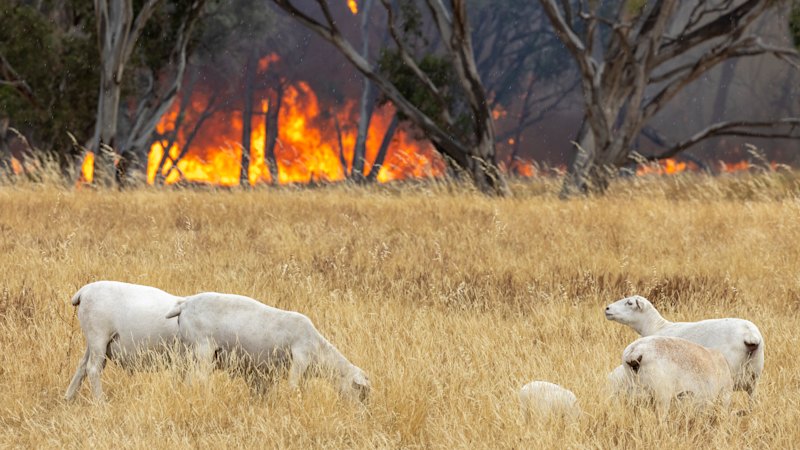
 Sheep grazing near a bushfire in Longwood East in January. Jason South
Towns across Victoria will also feel the heat, with Mildura forecast to hit 37 degrees, Seymour, Bendigo and Wangaratta 35, Geelong and Bairnsdale 36 and Ballarat 32.
A total fire ban has been declared for the central (including Melbourne, Geelong and Ballarat), North Central, Southwest, West and South Gippsland and Wimmera fire districts, meaning no fire can be lit in the open air or allowed to remain alight on February 17.
Extreme fire danger is forecast in each of these areas, and also in Victoria’s north-east. There are currently no emergency warnings or advice messages active in the state, but authorities said any new fires that start will be difficult to fight.
“The concerns will very much be for the western parts of the state, in particular, down into western south Gippsland, where we still have a lot of grassland fire load in our landscape,” said Emergency Management Commissioner Tim Wiebusch in an update on Monday afternoon.
“The whole state is still a tinderbox in terms of the fuel types that are there, and so the concerns, particularly around the metropolitan area, would be in those north-western suburbs, all the way through the grasslands down towards Geelong.
“Please make sure you’ve downloaded the Vic emergency app. If you haven’t already, make sure you’ve set the watch zone for the area that you may be either living, working or holidaying during this period of time.”
Related Article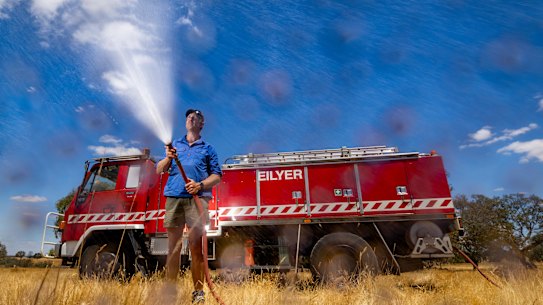
The Bureau of Meteorology’s Morgan Pumpa said a cool change would not reach Melbourne until the late afternoon or evening, as a south-westerly wind change pushes an ocean breeze across Victoria.
“That’s in the east that we’ll see a little bit of cooler air … for the most part, everyone should just expect winds to be hot, and they’re going to be dry,” Pumpa said.
Thunderstorms were possible in a large swath of Victoria, stretching from Echuca-Moama to Mount Baw Baw to Traralgon, Pumpa said.
Parts of the state have not had meaningful rain for weeks, leaving abundant dry fuel despite major blazes already this season.
“We’re seeing very dry fuels across large parts of the state, and when that’s paired with low humidity, fires can start easily and spread quickly,” said Country Fire Authority Chief Officer Jason Heffernan.
“Days like [Tuesday] are about prevention. The safest choice is to postpone activities involving machinery and keep up to date with changing conditions.”
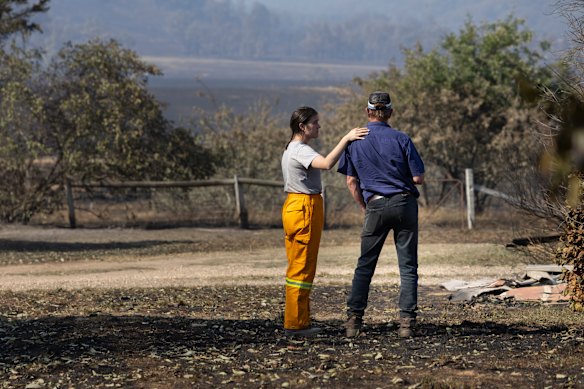 Resident Robbie Cumming (right) is comforted after seeing the ruins of his home near Yarck in January 2026.Jason South
Speaking on 3AW radio Tuesday morning, Heffernan said firefighters were hopeful for some rain on Tuesday, but the long-range forecasts were bleak.
“So we could see a dry autumn and the beginning of winter,” he said.
The anticipated temperature spike has also prompted V/Line to implement extreme heat timetables on Tuesday.
Related Article
On the Ararat, Ballarat, Geelong, Maryborough, Seymour, Shepparton and Warrnambool lines, trains that usually travel at up to 160km/h need to slow down to 90km/h or less because steel tracks expand in the heat.
The dangerous weather predicted follows a January during which fires burnt more than 400,000 hectares of Victoria.
One person was killed and nearly 1600 structures were damaged or destroyed after fires began in the first week of the year, and were then aggravated by extreme heat peaking on January 9.
A major bushfire in the Otways flared up later in the same month, prompting further evacuations and causing further property losses.
On Monday, Wiebusch said the Otways fire would hopefully be contained next week, while two enormous fires in Longwood and Walwa were only contained last Friday, six weeks after they ignited.
A gusty south-westerly wind change with some rain is set to move through parts of Victoria on Tuesday afternoon.
With AAP
Be the first to know when major news happens. Sign up for breaking news alerts on email or turn on notifications in the app.
Save
You have reached your maximum number of saved items.
Remove items from your saved list to add more.
 Angus Delaney is a reporter at The Age. Email him at angus.delaney@theage.com.au or contact him securely on Signal at angusdelaney.31Connect via email.From our partners