
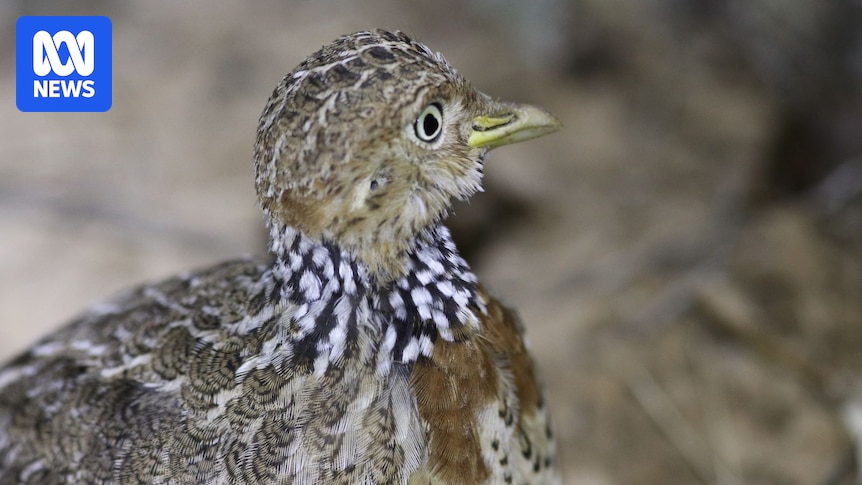
Ecologists say they have confirmed the presence of a critically endangered bird on a western Queensland pastoral lease where it was previously unrecorded.
Australian Wildlife Conservancy (AWC) staff photographed the rare plains-wanderer, known for its black and white neck and shy behaviour, on a cattle station near Bedourie while picking up audio recordings as part of a recent monitoring project.
31 bioacoustic recorders across the property also picked up its call.
The bird is difficult to find due to its low population, estimated at 250-1,000 individuals.
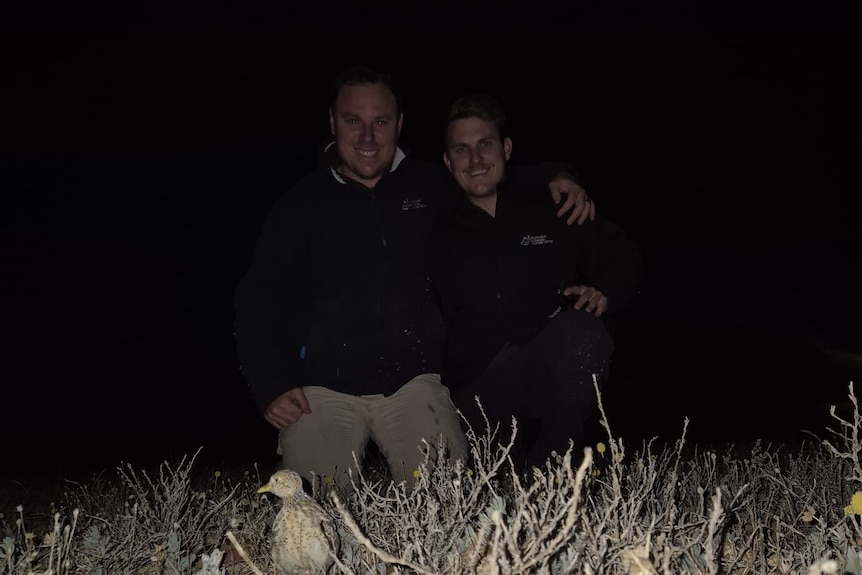
AWC staff sighted the plains-wanderer multiple times over several days on a western Queensland NAPCo property. (Supplied: Australian Wildlife Conservancy/Hayden DeVilliers)
Researchers say the extent of the bird’s peripheral populations in semi-arid regions of Queensland and South Australia is poorly studied, with its distribution better defined in New South Wales and Victoria.
AWC staff member Jamie Hackeson said he was among the first to see the species on the property.
“Encountering the plains-wanderer on that night felt like finding a needle in a haystack,” he said.
The bird was spotted as part of a project that aims to track endangered species across 6 million hectares of pastoral land.
The cattle station where the bird was spotted has not been publicised by ecologists for fear of habitat disturbance.
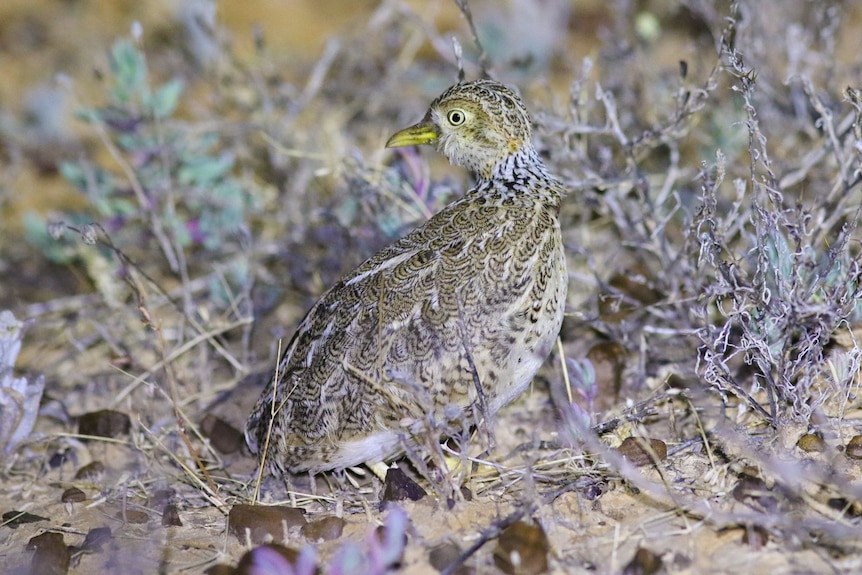
The plains-wanderer expertly camouflages in low vegetation, making it difficult to find. (Supplied: Australian Wildlife Conservancy/Jamie Hackeson)
Spotting rare bird comes down to ‘luck’
An algorithm developed by researchers at the Queensland University of Technology sorted through thousands of hours of audio recorded across the property, flagging potential plains-wanderer calls.
AWC wildlife ecologist Tessa Manning manually checked 3,000 of the recordings and found the algorithm sometimes confused the plains-wanderer’s low call with dingoes.
“Some people compare it to cattle, like a mooing sound,” she said.Loading…
She verified that 16 monitoring stations captured more than 10 plains-wanderer calls each.
Ms Manning said the bird’s appearance and tendency to hide under low vegetation can make it even more elusive.
“They’re very small, and they’re very, very good at camouflaging … you just can’t see them until you’re on top of them,” Ms Manning said.
“It’s just a bit of luck of the draw to actually see the plains-wanderer.”
Far-flung bird populations come to light
University of Adelaide PhD candidate Saskia Gerhardy is compiling data to develop a species distribution model for the bird.
“They are a species that we can’t really get a good number on at the moment because they’re so cryptic, because they’re so far-flung across the range,” she said.
AI technology called in for ‘cryptic’ bird, and other remote species on the brink
Ms Gerhardy said new technology had improved detection capabilities, enabling previously unnoticed populations to be identified.
“What we found in South Australia, at least, is these birds are living really successfully, they’re breeding successfully, they’re doing their mating behaviours,” she said.
“So we believe that because they’re so well adapted to this habitat and living there so happily, that they are likely to have been using this habitat for a long time.”
The project to find endangered species is in partnership with the Northern Australian Pastoral Company.
“To know such a rare and remarkable species is established on one of our properties is a real privilege and responsibility for us as land managers,” said the company’s CEO Allan Conoey.
He said the partnership enabled land management that supports both production and conservation outcomes.
“This discovery demonstrates what can be achieved when industry and science work together with shared purpose,” he said.