
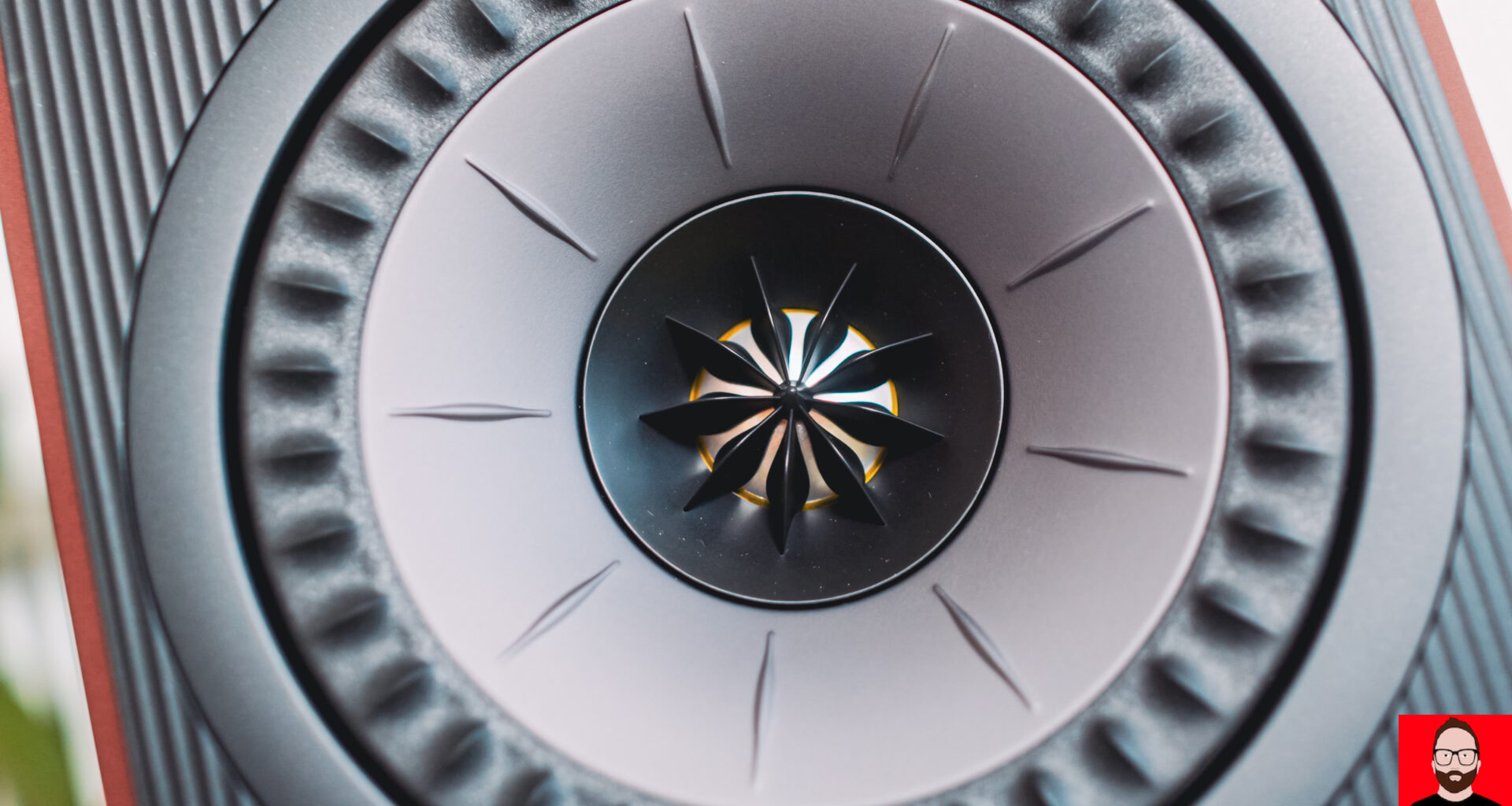
Strip the streaming module out of an active loudspeaker, and what do you get? In the case of KEF’s Coda W: better sound for less money. At €899/US$999, these active loudspeakers – where the amplifiers and DSP crossover live inside the speaker cabinets – cost the same as the smaller LSX II LT. And yet the Coda W outperform them in almost every way that counts.
Let’s dive in…
Under the hood
The Coda W runs a 12th-gen Uni-Q driver array — one generation newer than the LSX II LT’s 11th-gen — with a 5.25″ mid/bass driver versus the LSX’s smaller 4.5″ unit. Two Class D amplifiers supply 70 Watts to the mid/bass and 30 Watts to the tweeter nestled in its centre, the same power split as the LSX II LT. That’s a bigger mid/bass driver for the same money and without any hit to KEF’s exceedingly high build quality standards.

Say what now? Two amplifiers per loudspeaker? That’s how active loudspeakers work. The incoming digital signal is split by DSP — a digital crossover divides the frequency range between the tweeter and mid/bass driver — and each slice is handed off to its own dedicated amplifier, which then juices the driver. No passive crossover components sitting between the amplifier and the drivers, soaking up power and smearing phase. It’s a cleaner, more direct signal path.
The primary Coda W loudspeaker handles all the DSP processing and sends the signal to the secondary loudspeaker via a proprietary USB-C interlink cable that carries data at 24-bit/96kHz. That’s similar to the LSX II LT’s lasso approach. And like its predecessor, only the primary Coda W speaker needs to see mains power.
I don’t get hung up on the 24-bit/96kHz not being 24-bit/192kHz because I know the drivers, their amps and the DSP will dominate what I hear. Like seeing an ant next to an elephant.

Connectivity
Without KEF’s W2 network streaming platform onboard, the Coda W relies on its Bluetooth input or whatever third-party hardware you bring to the party. Hard-wired connectivity lives on the rear of the primary loudspeaker: TOSLINK and a USB-C socket that the more costly LS50 Wireless II doesn’t have. Soundbar replacement enthusiasts should note the HDMI ARC input whilst staying mindful of the cable vomit that inevitably yawns from the primary speaker’s rear.
The Coda W has also inherited the LS50 Wireless II’s on-speaker touch controls — power on/off, input selection, mute and volume up/down — so you’re not entirely dependent on the supplied plastic infra-red remote or KEF’s Connect app, which communicates with the Coda W over Bluetooth.
On that: the internal Bluetooth audio module supports aptX Adaptive for lossy ‘hi-res’ audio and aptX Lossless for lossless CD-quality. All iPhone users and most Android users will still need a dongle to make aptX Lossless a reality. I’ve written about the what and the why here, but I pushed a Sennheiser BTD700 into an iPhone 17 Pro’s USB-C socket, and it worked as advertised.
I also ran HDMI ARC from my TV for YouTube and Apple Music, knowing full well that my Samsung ‘The Frame’ TV’s OS resamples everything to 48kHz. I don’t get hung up on that number I know the drivers, amps and DSP will dominate what I hear. Like seeing a mosquito next to a rhino.

Vinyl playback
The Coda W also houses an internal MM phono stage — again, absent from the LS50 Wireless II and the LSX family. Gain staging happens in the analogue domain, but the RIAA equalisation is handled by DSP.
I hooked a Rega Planar 8 fitted with an Ortofon 2M Black into the Coda W’s phono input, and the result was… fine. Not thrilling. The Coda W’s phono stage failed to provide the one thing the 2M Black needs: a dose of excitement. Your mileage may vary with livelier cartridges, but I see the Coda W’s phono input as more of a convenience feature better suited to more wallet-friendly turntables. And a convenience feature is exactly what we’d expect at this price point.
Both analogue inputs (MM phono and aux) are digitised to make use of the KEF Connect app’s boundary-compensating EQ settings and subwoofer integration.

Streaming music
Back with streaming, I fed the Coda W via TOSLINK with a FiiO SR11. I chose the FiiO over the WiiM Mini because the FiiO is Roon Ready and the WiiM is not. For Roon Ready in WiiM country, we need the WiiM Pro.
Now here’s a neat trick: the SR11 (or the WiiM) can take its power feed from the Coda W’s USB charge-out port, so the outboard streamer fires up when the loudspeakers do. One USB-C cable, one TOSLINK cable, done.
I built a playlist in Tidal and played it back via Roon: Radiohead’s “There There”, PJ Harvey’s “This Mess We’re In”, Johnny Cash’s “I See A Darkness”, A House’s “I Wanted Too Much” and Surface Access’s “Isolation Depth”.

Sound
I did most of my listening with the Coda W on Solid Steel stands in my lounge room before moving them upstairs to my office area, where they sat atop ear-level stands.
The Coda W’s overall character is one of dynamic physicality with a hint of warmth, largely attributable to its full-sounding bass. This is not a clinical or analytical loudspeaker. Some people might reach for the M-word (‘musical’), but the way I see it, subjective pleasure is not an objective quality. ‘Musicality’ loses its meaning as soon as its ascriber leaves the frame, and I want to convey what you might hear.
For example, PJ Harvey’s “This Mess We’re In” is a good litmus test for vocal texture and midrange presence. The Coda W lends Harvey’s voice real body without smothering the breathy edges that make the recording so intimate. There’s a generosity to the midrange here that doesn’t tip into bloat — it just sounds full.

Side-by-side comparisons
Back with the elephant: the LS50 Wireless II also runs a 12th-gen Uni-Q driver array but puts a metamaterial absorption disc behind the tweeter that’s juiced by 100 Watts of Class A/B amplification. Into the surrounding mid/bass driver, the LS50 Wireless II pushes 280 Watts of Class D power. But a pair of LS50 Wireless II goes for €2499 — that’s more than double the Coda W’s asking. Given that substantial price gap, I opted not to buy a pair of the latter for a side-by-side comparison here. I thought it more instructive to compare the Coda W to the LSX II LT — same money, same manufacturer — and the DALI Kupid powered by an Arcam A5+ integrated, which together sell for only slightly more.
The Coda W lends plenty of low-end wallop to Surface Access’s dub techno. If you’re a Basic Channel fan from back in the day, you’ll love this two-track single. Bass notes don’t offer the last word in definition, but what the Coda W lacks in texture, it makes up for in physical excitement without collapsing into a one-note thump when asked to play beyond club music.
In all but the smallest of rooms, the LSX II LT, rated by KEF down to 54Hz (-3dB), will need a subwoofer. The Coda W, reaching down to 41Hz, do not. Well, not necessarily. It’s easier to go without, but in moving from the LSX II LT to the Coda W, Johnny Cash tells us we must give up some micro-dynamic agility — but I think that’s a compromise worth making.

Then again, the LSX II LT are small enough to sit on a desktop and the Coda W are not. I had them upstairs in my office on stands, either side of the desk, and their larger-scale playback of Radiohead’s “There There” really expands the track’s strong dynamic contrasts and emphasises its moody drama in a way the LSX II LT can’t match.
I also like how the Coda W doesn’t overplay the grit in Johnny Cash’s voice. The LSX II LT can push it too far. The Coda W’s richness with vocals has more in common with the DALI Kupid paired with the Arcam A5+ — and again, the DALI, rated to just 63Hz (-3dB), ache for a subwoofer’s low-frequency augmentation, and the Coda W do not. Well, not necessarily. And if you want to add a subwoofer to the Coda W, the KEF Connect app makes lighter work of its integration by applying the low- and high-pass filters inside the primary loudspeaker’s DSP. That integration becomes fully bespoke if your subwoofer comes from KEF.
The bass wrinkle
Now comes the biggest wrinkle (and it’s a good one): the Coda W’s 41Hz reach goes deeper than the LS50 Wireless II’s 45Hz. Same 5.25″ mid/bass driver, roughly the same cabinet size — so why? According to KEF, the Coda W is the first implementation of its all-new Dynamic Bass Boost (DBB) algorithm, which handles bass behaviour as volume changes. But I also suspect a shift in design philosophy. The Coda W has a larger internal cabinet volume than the LS50 Wireless II (I think) and less amplifier power applied to its mid/bass driver. That might make the Coda W sound less muscle-cramp-tight in the low end than the LS50 W II — at least, that’s how I remember ’em. But long-term memory cannot underpin a reliable comparison, so pour salt as necessary.

The everyman active
The way I see it, the Coda W are to €1000 actives what the Wharfedale Linton are to €1000 passives: a “please the majority” loudspeaker. A hifi system in a box that anyone stepping up from Sonos could happily embrace. There’s enough scale, drama and physicality to make everything a proper lean-in experience. And there’s enough warmth at the edges to sidestep the wince caused by shriller recordings — A House’s “I Wanted Too Much” played through more transparent loudspeakers would likely bite harder. (And yes, that A House album is still – err – the greatest).
And the Coda W comes in at the same price as KEF’s more compact LSX II LT and – this is the big one – slightly less than Sonos’ flagship ARC Ultra soundbar. That should be important to those who value stereo separation when listening to music.
Start your Coda W journey with Bluetooth and HDMI ARC from a TV, then add an outboard streamer as budget allows. Maybe you’ve got an old Raspberry Pi lying around — you could power it directly from the back of the Coda W’s primary box. Or maybe you’ve already sprung for an Eversolo or a WiiM. Network streamers now come in all shapes and sizes: some people swear by a touchscreen, others think they’re a waste of resources.

The streamer question
And this is why I am beginning to think that active loudspeaker manufacturers would do well to leave streaming out of their loudspeakers, as KEF has done here. Streaming platforms evolve fast. The underpinning hardware much less so. The WiiM Mini didn’t exist three years ago. The FiiO SR11 wasn’t a thing until less than two years ago. Both have damped my enthusiasm for Raspberry Pi-based alternatives.
Baking a streaming module into a loudspeaker sees it age at software speed while the drivers and amplification age at hardware speed — which is to say, barely at all. By leaving it out, KEF lets the Coda W’s acoustics and electronics do what they do best without chaining them to a streaming platform that might look dated in ten years. KEF’s W2 platform is still going strong after five, but the Coda W shows us that we don’t need it. Well, not necessarily. And without W2 on the build sheet, we get a better-sounding active loudspeaker than the LSX II LT, but for the same money.
I call that a win. And a DAR-KO Award.

Further information: KEF