
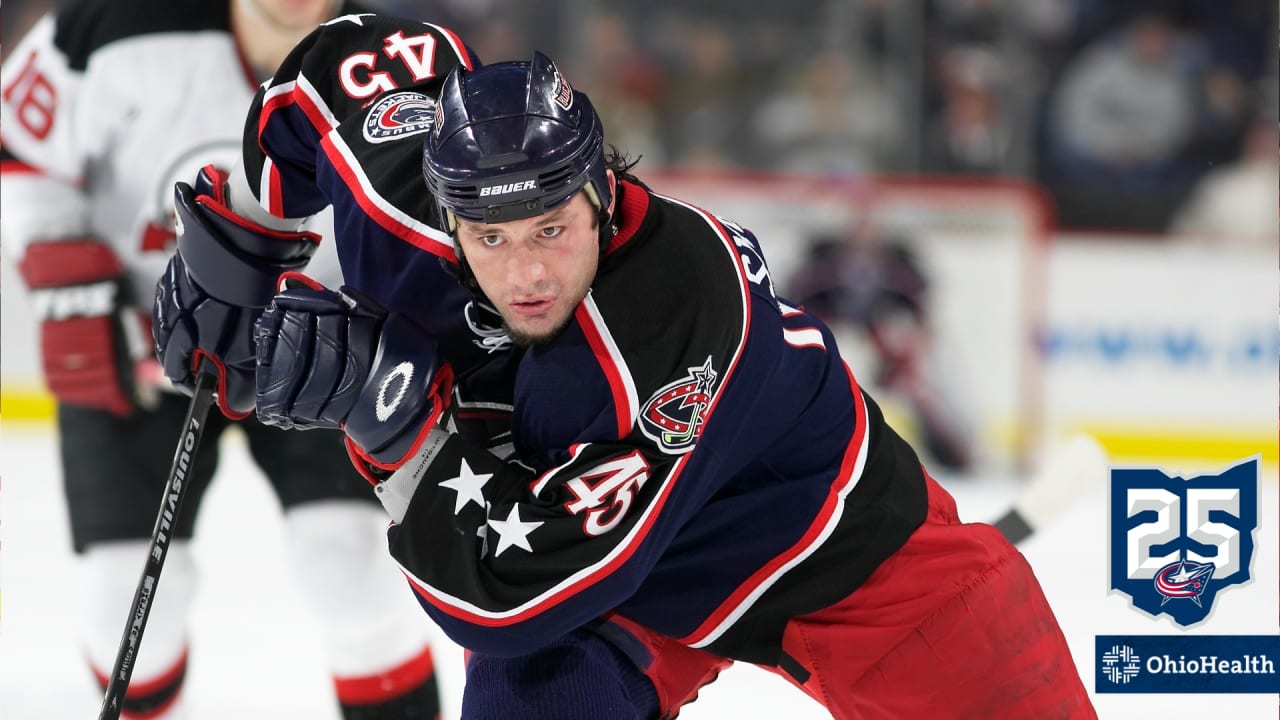
He’d play hockey in the winter, then put the bag away in the summer. While he had some talent – his midget B team won a championship when he was 17 years old, “and I like to think I was a pretty good factor,” Shelley quips – a hockey career didn’t appear to be in the cards when he was a senior in high school playing with “teammates that would smoke cigarettes and eat French fries between periods.”
But luck arrived in 1994 when the then-Quebec Major Junior Hockey League – one of the three leagues in Canada that serves as the top incubator for top talent north of the border – arrived in Halifax. Needing homegrown players, the Mooseheads extended an invitation to the big but raw forward from across the island in Yarmouth.
Not that Shelley believed it when the call came.
“I was mowing the lawn and the phone rang, and I went in and answered the phone,” Shelley said. “And they said, ‘Jody, we’d like to invite you to the Halifax Mooseheads inaugural training camp.’ I said, ‘Well, I got to ask my mom and dad. You’ll have to call back.’ Hung up the phone and walked away. They call back a few weeks later, and I went up to camp and ended up getting in a fight and doing OK and somehow made the team.”
Around 90 players were invited to the Mooseheads’ inaugural camp, but with his size, Shelley had a unique edge on some of the others. He’d never been in a fight to that point in his life, he said, but he quickly realized that physical play was his ticket to success.
He went on to score 48 goals and post 98 points over three seasons while racking up 933 penalty minutes, and Shelley was a force his final season, racking 25 of those goals and 420 PIMs. He was captain of the Mooseheads that season, as a Halifax team that featured Alex Tanguay up front and Jean-Sébastian Giguère in net made it to the league semifinals before falling to a Chicoutimi team with future CBJ teammate Marc Denis between the pipes.
Shelley tore his ACL near the end of the season but played through it in the playoffs, and there weren’t any offers from pro teams forthcoming. He chose to continue playing at Dalhousie University in Halifax while watching some of the guys he fought in the QMJHL – Peter Worrell, Georges Laraque and Gordie Dwyer – having success at the pro level.
The itch remained, and while Shelley had a scholarship to Dalhousie provided by the QMJHL, he admittedly wasn’t fully in on school. Then the phone rang again, and this time, the Saint John Flames of the AHL were on the line. Doreen wasn’t the biggest fan, but the tryout opportunity Shelley received was something he believed he couldn’t pass up.
“I got offers to go to the American Hockey League,” Shelley said. “Saint John offered me a 25-game tryout. They were with the Flames, and I could turn that into an invite to camp and an American Hockey League contract. I called my mother Doreen, and there were two things she was worried about – my teeth and my education.
“As soon as you sign a professional contract, you lose the scholarship, so I called her to let her know I was pursuing a dream and I was going to leave school to go sign this tryout, which meant nothing. The tryout could have been one day. The max is 25 games. She was in tears. I said, ‘Well, I have to do it if I can play one game in the NHL,’ you know? These guys are playing. I have to try it.”
He ended up playing 18 games with Saint John that year, then signed a deal to return – or so he thought. Shelley ended up playing just eight games in Saint John the next season and 52 with Johnstown of the ECHL, where he met a young radio broadcaster named Bob McElligott.
Shelley spent two seasons in the same situation, then was a free agent. With an expansion franchise coming to Columbus, Blue Jackets assistant general manager Jim Clark reached out to add some muscle to the team’s affiliate in Syracuse, and suddenly Shelley found himself in the CBJ system.
Again, fate would smile on Shelley. Columbus traded enforcer Krzysztof Oliwa to Pittsburgh midway through the season, leaving the Blue Jackets without a pure fighter, and the Penguins were set to return to Nationwide Arena on Feb. 17 with Oliwa in tow and revenge on his mind.
Shelley signed an NHL contract with the Blue Jackets on Jan. 31, then worked with Syracuse coach Gary Agnew on his game. He studied videos of Oliwa knowing what was coming, and finally the call came in the days before the game against the Penguins.
Shelley knew the assignment, but he also was aware of who was on the other side of the ice. The Penguins weren’t quite the juggernaut that won Stanley Cups in the early 1990s, but it was still a star-studded squad headed to the Eastern Conference Final with a lineup that included such names as Mario Lemieux, Jaromir Jagr, Kevin Stevens and Alex Kovalev.
Nine minutes into the game, Shelley finally got the call from head coach Dave King and stepped on the ice for a faceoff in the neutral zone. We’ll let Shelley take it from here.
“I came out to this dot right here in front of the penalty box,” Shelley said, pointing from a spot in the Nationwide Arena seating bowl. “I was here to fight Krzysztof Oliwa. I didn’t see Steve McKenna, who was on the other side of the ice. I didn’t even know he was on the roster. It’s like, this is the Pittsburgh Penguins. Mario was there! I couldn’t believe it. I floated around warmups, I floated on the ice, I heard the cheers, but it was like, it wasn’t me. It was like I was in another land.
“And the puck drops, I look at Oliwa, and here comes 6-foot-whatever Steve McKenna. I’m like, ‘Wait a second, this isn’t supposed to happen!’ So I fought him, and I had a short trip, three steps to the penalty box, and the crowd was going bananas. Somehow, I got four seconds of ice time with that.
“The next shift, Dave King put me out on a faceoff in the offensive zone. I wasn’t thinking defense at the time, (so he put me) as far away from my own net as possible. The puck hits the ice, I fight Oliwa. The place goes crazy. I did my job.
“He gave me one more shift in the offensive zone, I think. I don’t even remember that. I just remember the crowd, the buzz, the atmosphere, the team, the organization, talking to Geoff Sanderson and Luke Odelein and thinking, ‘Is this real? Is this really happening right now?’”