
Cannondale has officially launched the latest version of the SuperSix Evo road bike today. After much speculation, some internet leaks, and the bike spotted being raced at the Tour Down Under, the new SuperSix is officially here.
The Gen 4 version of the SuperSix launched back in March 2023, just under three years ago. The SuperSix has been around for a long time now, regularly making lists of the best road bikes, and now the latest fifth-generation model is here.
You may like
It’s also not just the SuperSix, which launches today; the brand has revamped its time trial bike, the Superslice, which launches at the same time.
Image 1 of 3
 Here it is, the brand new SuperSix Evo (Image credit: Cannondale )
 Cannondale says most frame shapes have been changed(Image credit: Cannondale )
 And there’s a pair of new Cannondale handlebars (Image credit: Cannondale )
So, what’s changed? To quote Cannondale: “Our mission was clear – keep the unmatched speed and handling while shaving weight everywhere we could.”
The brand says it has aimed to preserve and improve aerodynamics, whilst dropping weight and improving aesthetics. The Supersix has been tweaked, refined and improved, according to Cannondale, whilst maintaining the renowned SuperSix handling characteristics.
The SuperSix has long had a link to low weight throughout the years, and the new bike has been made lighter. In fact, the Lab71 SL version comes in at a claimed 6.4 kg out of the box. Cannondale says this is the lightest disc frame and fork it has ever made.
There are three SuperSix frame tiers: Series 0, which is the carbon grade used on the top spec Lab71 bikes, Hi-Mod follows, and then there are the third tier ‘Carbon’ models. Cannondale quotes weights of 728, 781 and 910 grams, respectively, for size 56cm painted frames. And fork weights of 392, 414 and 427 grams, creating net savings of 72, 37 and 35 grams.
You may like
Visually, the biggest giveaway that this is the new bike is the different-shaped seatpost, which loses the curved cutout the outgoing one had, though they are interchangeable should Gen 4 users want to upgrade. Top spec bikes get titanium hardware on the saddle clamp, and the new seatpost really improves the bike’s aesthetics for our money.
The other key giveaway is the slimmed-down and much narrower fork crown area and head tube. This area has been made more aerodynamic and is clearly narrower. Below is a nice comparison of Healy’s 2025 World’s bike and the new machine, which I snapped at the launch.
The bearing top cover and seatpost clamp cover have also been tidied and tweaked; they now both integrate very cleanly into the frame, instead of sitting proud. It’s another neat little improvement.
Bikes will come with Cannondale bottle cages and aero bottles; the cages themselves have been updated for this release and are claimed to be 26% lighter and offer better bottle retention.
Image 1 of 2
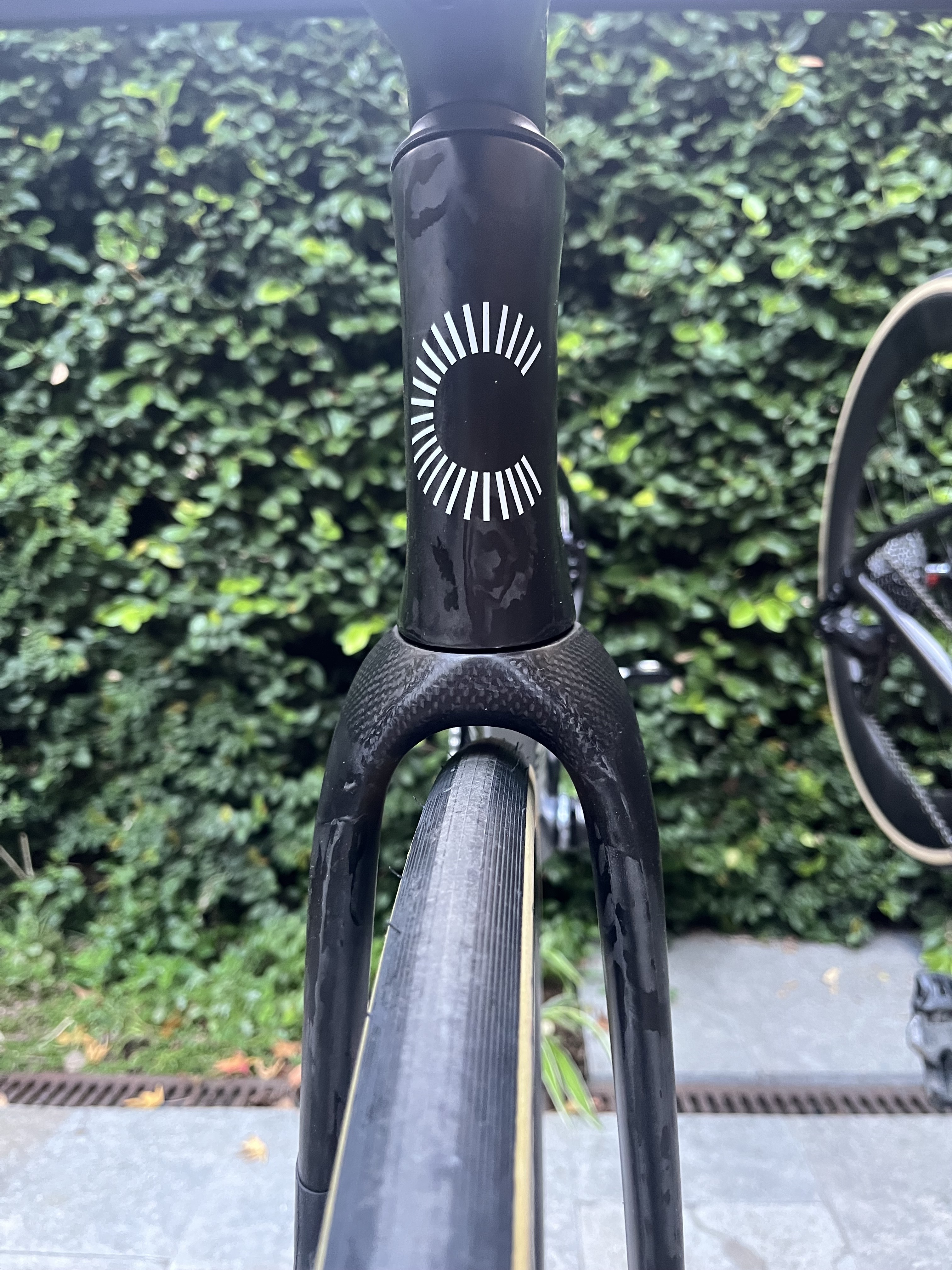 Here’s the Gen 4 front end – This is Healy’s Worlds bike (Image credit: Tom Wieckowski )
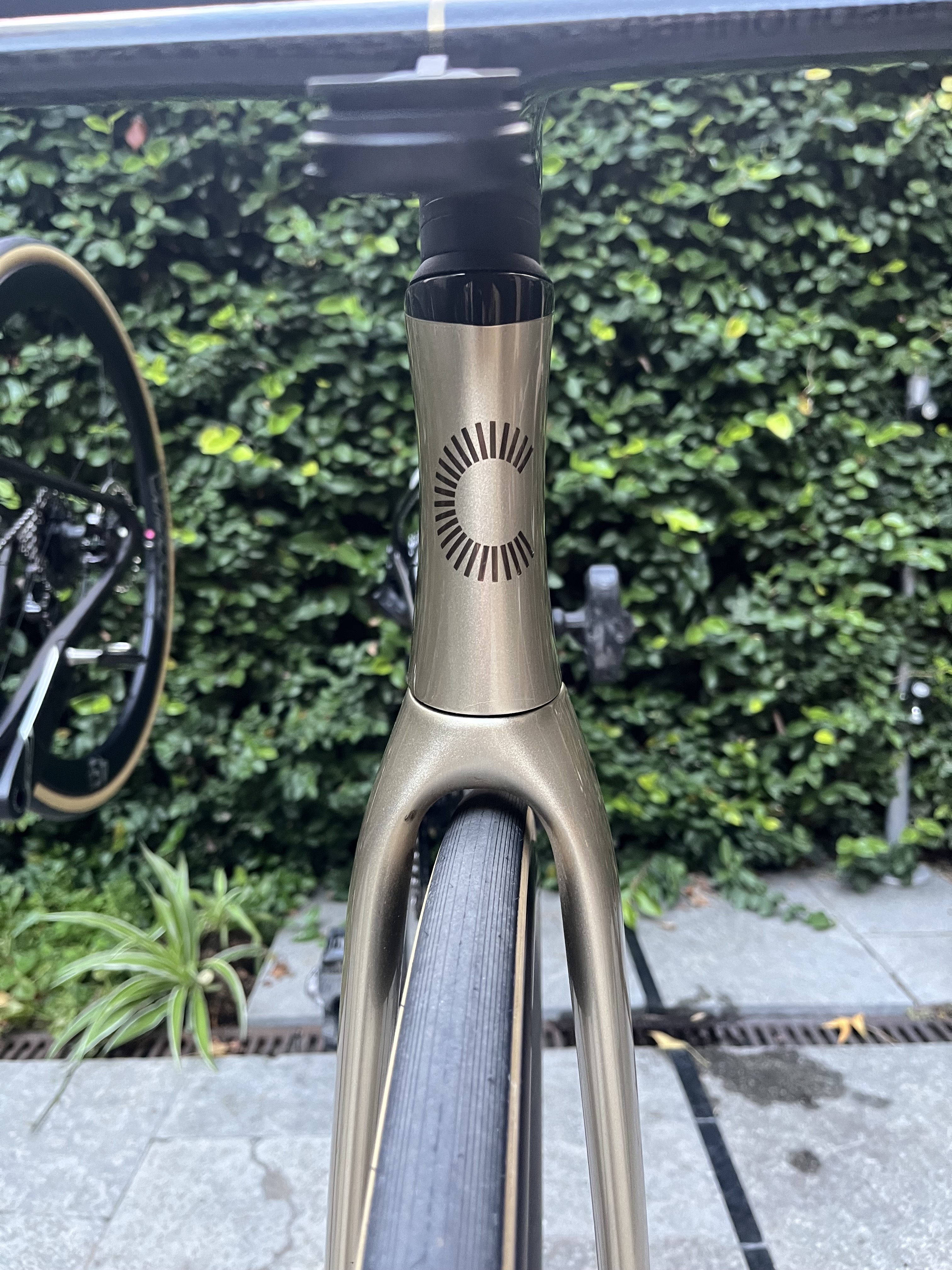 And here’s the new 5th gen bike – A lot slimmer (Image credit: Tom Wieckowski)
On the frame, Cannondale says “Every shape has been replaced, besides the seat post cross section. And whilst the profile is carried over, the whole post has been redesigned.”
The bike does look very similar to the outgoing frame, but it seems a lot has been done to optimise, well, pretty much every shape on the frame.
Cannondale provided a fascinating white paper on the SuperSix, which is worth a news piece on its own. There’s too much to include here, but the brand explained its philosophy and working processes instead of making any big claims about how fast or how much faster than something else this bike is.
There aren’t any X watts faster than X bike claims to read about here. An approach that seems to generate interest and scorn in equal measure of late, depending on a brand’s testing.
The brand says its focus is on speed for racers when it comes to race bikes, and it appears its priority is on the SuperSix being as fast as possible (within the confines of the UCI frame rules) whilst being as light as it can be, a contrast to some brands that appear to prioritise aero features at the expense of lower overall weight. The brand claims wheel changes are enough to take the bike from max aero efficiency to lightweight mountain guise as needed.
There are probably some commercial concerns in there too, but that’s the bones of it. It’s clear the brand is happy with and confident in the SuperSix; the Gen 5 sees the brand making its bike even better through a combination of CFD and wind-tunnel testing.
The white paper data sheet on the bike is included below, and Cannondale quotes a small drag saving of 0.003 m2, which refers to the bike’s CdA number between the 4th and 5th gen bikes when tested at a weighted 40Km/h road speed across a range of yaw angles (the angle at which wind hits the bike).
It sounds like there are smaller, hard won improvements to be made now when it comes to improving the SuperSix platform. The brand explained in its white paper that improvements are harder to achieve but not impossible.
“We set ourselves a high-water mark with the fourth-generation SuperSix Evo. Within the rules of racing and physics, there was no low-hanging fruit to further revolutionise performance. But that does not mean there was no improvement to be made.”
Check out our Labs aero test to see how the bike fared against other WorldTour favourites.
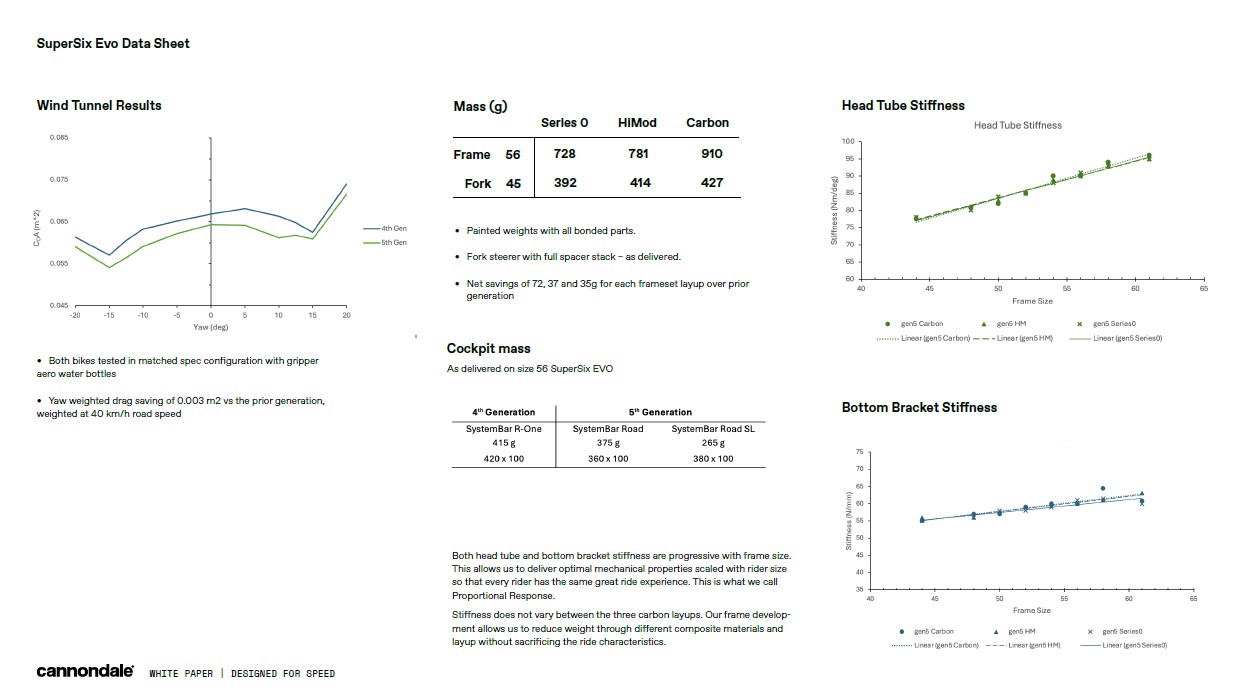
This is Cannondale’s white paper SuperSix data sheet (Image credit: Cannondale)
The SuperSix geometry has also been changed, and there are new frame sizes. The new Evo is 10mm lower at the front compared to the old bike, and someone at the launch told me Ben Healy himself had been keen on this.
The seat tube has been shortened, which creates a more sloping top tube and leads to more seatpost showing for riders. Riders familiar with traditional SuperSix geometry will know the feeling of the bike feeling big at times due to the horizontal top tube and smaller amount of post showing, even when it’s not, and this is feedback that Cannondale has listened to.
Sizing has also been changed; the 51cm size has been eliminated, and now riders can choose from 50 and 52cm machines instead. This sizing area had caused issues for some in the past, and the brand mentioned being aware of riders sizing down to get the fit they wanted.
As a comparison between the fourth and fifth gen machines, the outgoing Gen 4 bike in a size 56 bike has a stack of 575mm and a reach of 389mm, whilst the new bikes’ numbers are 565 and 393.
The tube shapes and carbon layup are also specific to each size, which Cannondale says achieves optimal stiffness across the size range.
Image 1 of 2
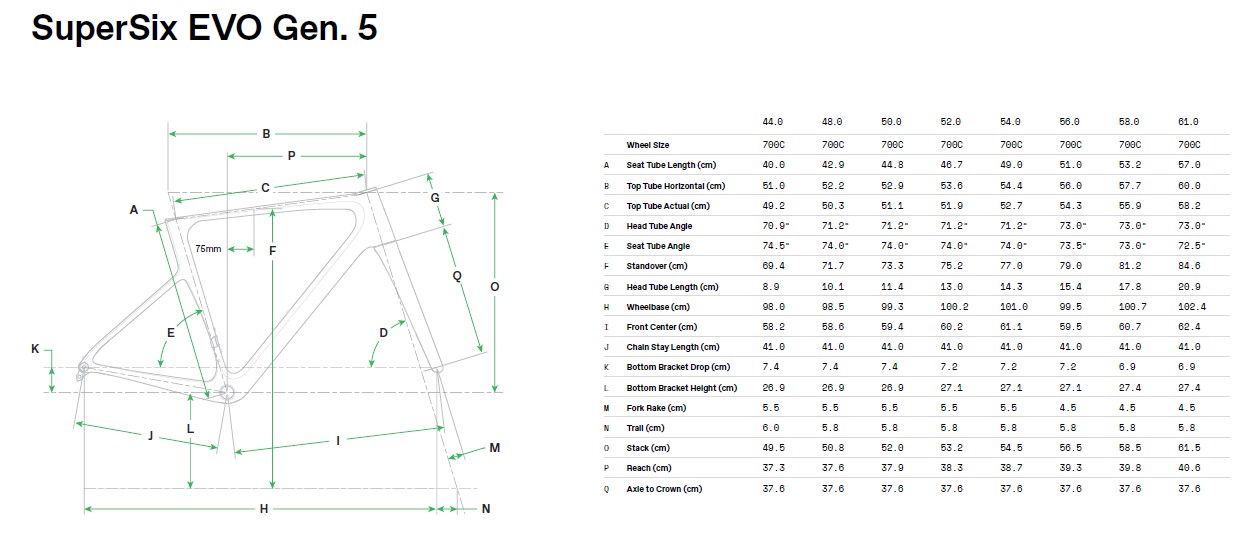 Here the new SuperSix geo chart (Image credit: Cannondale )
 And the previous bikes numbers (Image credit: Cannondale)A brand new handlebar
Cannondale has also developed a brand new pair of integrated handlebars which are fitted to higher-end models and available to buy seperately though they are over $500, and have a very smart carbon fibre finish.
The brand has developed a new SystemBar Road and an SL variant, both of which naturally play nicely with the Cannondale Fly Delta triangular steerer tube. Both are carbon fibre integrated handlebars; the Road bar prioritises aerodynamics and has 20mm of flare on each side. Ben Healy used a somewhat disguised version of this bar at the Rwanda World Championships.
The SL version is fitted to the superlight SL bike builds that the brand is offering. It features rounded tops, which are less aero but prioritise low weight and comfort.
The Road bar comes in stem lengths of 90-150mm and widths of 340-380mm, rejoice no 440 options here. The SL version comes in 90-130mm stem lengths and 380-400mm widths. The bars also have an alloy mount that’s Garmin, Wahoo and Hammerhead compatible.
The bars have a reach of 80mm, a drop of 130mm and a -6 degree stem angle.
Image 1 of 4
 (Image credit: Cannondale)
 (Image credit: Cannondale )
 (Image credit: Cannondale )
 (Image credit: Cannondale )
When it comes to frame details, the Gen 5 SuperSix has clearance for upto 32mm tyres with 4mm of clearance everywhere.
The frame uses a BSA 68 bottom bracket; the days of BB30a and the like are now firmly behind us.
Seatposts are available in -15 and 0 degree setback options, and the frame is an electronic groupset compatible only. Interestingly, the front derailleur mount is riveted to the seat tube, meaning a super clean 1X chainset setup won’t be possible, though the brand recommends using the mount to fit a chain keeper if you do go down this road.
(Image credit: Cannondale)Pricing and models
The Gen 5 SuperSix will be available as a frameset and in a range of build options across the different Lab71, Hi Mod and Carbon tiers.
The two SL bikes are easter eggs in the range to a degree, favouring low weight over all-out aero performance, which is a nice nod to the SuperSix’s heritage.
Eight full builds will be available in total; the entry price point for a new bike is $4,999 for the Evo 5 with 105 Di2 and rises to $13,499 for the Lab71 models.
Image 1 of 5
 Here’s the top spec Lab71 bike (Image credit: Cannondale )
 (Image credit: Cannondale )
 (Image credit: Cannondale )
 (Image credit: Cannondale )
 (Image credit: Cannondale )Swipe to scroll horizontallyCannondale SuperSix Evo pricing
Model
Groupset
Wheels
Price
Cannondale – SuperSix EVO LAB71
Shimano Dura-Ace Di2 / 4III PM
Reserve 57/64mm
£12,000 / $13,499 / €11,999
Cannondale – SuperSix EVO SL LAB71
SRAM Red AXS + PM
DT Swiss ARC 1100
£12,500 / $13,499 / €12,799
Cannondale – SuperSix EVO 1
SRAM Force AXS
Reserve 57/64mm
£8,995 / $9,499 /€8,499
Cannondale – SuperSix EVO SL 1
Shimano Ultegra Di2 + 4iii PM
Reserve 34/37mm
£8,795 / $8,999 / €7,999
Cannondale – SuperSix EVO 2
Shimano Ultegra Di2
DT Swiss ERC 45
£5,995 / $6,499 / €6,299
Cannondale – SuperSix EVO 3
SRAM Force AXS
DT Swiss ERC 45
£6,995 / $6,999 /€6,499
Cannondale – SuperSix EVO 4
SRAM Rival AXS
DT Swiss ERC 45
£5,495 / $5,499 / €4,999
Cannondale – SuperSix EVO 5
Shimano 105 Di2
Vision SC45
£4,495 / $4,999 /€4,499
Cannondale – SuperSix EVO LAB71 A/M Frameset
NA
NA
£4,995 / $5,999 /€5,999
Cannondale – SuperSix EVO Hi-MOD A/M Frameset
NA
NA
£3,995 / $4,499 /€4,499