
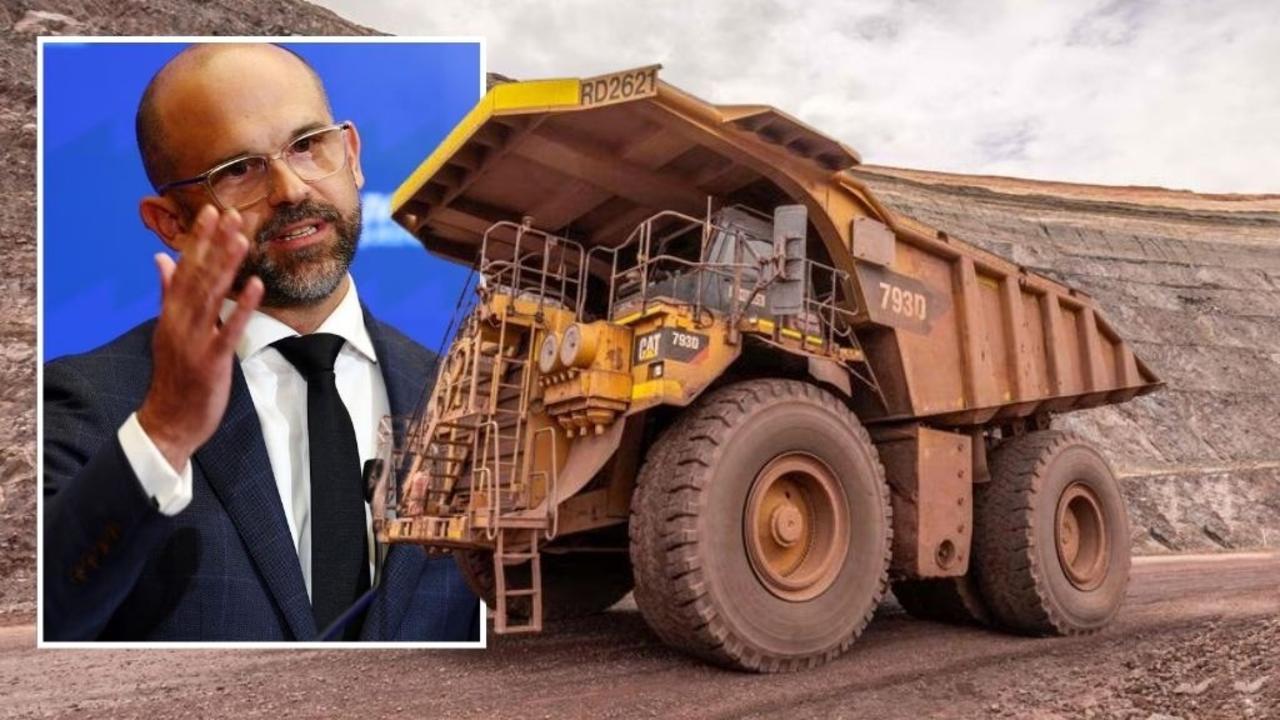
BHP says its Queensland operations are suffering “acute challenges” with the mining giant paying more in taxes and royalties than it is making in profits.
“Against a backdrop of the material impact of the Queensland Government’s coal royalties on business returns, BMA is taking further action to reduce costs, such as placing Saraji South into care and maintenance in Q2 FY26 and removing ~750 roles across Queensland,” a BHP statement read.
Treasurer David Janetzki wouldn’t be drawn on the health of the mining sector but said the state government had delivered a stable tax environment, streamlined approvals and would use coal for longer.
“We have been clear about our support for the industry and what it means for regional Queensland, we’ve delivered a stable environment and that’s what we’ll continue to back in,” he said.
“We’ve been clear about our position before the election, there will be no change to coal royalties and that remains our position.”
Coal royalties are tipped to contribute $5.38bn to Queensland’s budget this financial year and an average of $5.64bn each year over the next three years.
The revenue is critical for Mr Janetzki, who is forecasting an $8.96bn deficit this financial year.
“Coal royalties play a vital role in paying for hospitals, roads, dams, bridges, nurses, teachers, doctors – it’s an important role that it plays,” he said.
Despite dire results for the Queensland BHP Mitsubishi Alliance (BMA), company revenue for the first six months of the financial year lifted 11 per cent to $US27.90bn ($39.45bn) while profit came in 28 per cent higher at $US5.64bn ($7.97bn).
However, the mining giant reported that BMA returned 0 per cent on capital employed.
BHP chief financial officer Vandita Pant said the company’s return on investment had been disappointing lately, largely because of the falling prices of raw materials.
“But equally because of the royalty regime, where what we are paying in taxes and royalties is higher than the profits that we are generating,” she said.
“Many times higher. And that remains a real headwind and a challenge despite good work that our team is continuing to do there.
“Longer term, from the commodity perspective, we have one of the best portfolios from a quality of coal perspective, which has been high graded over a period of time.
“Longer term, the demand, the dynamics of met coal of high quality remain positive. However, from a business operational return perspective, the challenges are acute.”
BHP told the ASX that Australia’s steelmaking coal exports last year were estimated to have declined by over 20 per cent from the peak levels recorded in 2016.
“Recovery is slower than anticipated amid years of under investment. Queensland remains the major seaborne supplier,” the mining giant said.
“There is a risk of increasingly constrained supply with coals of the highest quality becoming increasingly scarce overtime.”
According to a report from the Queensland Resources Council conducted by Commodity Insights, the state government’s royalties policy is driving industry collapse and threatening tens of thousands of jobs.
Queensland’s 40 per cents maximum royalty rate is 12 per cent higher than Indonesia’s and nearly four times the global average of 12.9 per cent.
Only two coal projects are currently under development versus 27 stalled in early stages, with Queensland’s coal project pipeline halving over the quarter century.
Queensland’s share of the global metallurgical coal market fell from 53 per cent in 2019 to 44.6 per cent in 2024.
The report’s lead director Dr Matt Anderson, from Commodity Insights, warned that the cumulative effect of withdrawn capital, stalled projects, operational slowdowns, and rising financial pressure, confirms that Queensland’s coal sector was no longer experiencing a temporary downturn.
“This retreat and fiscal burden, threatens the sustainability of the sector and the communities that depend on it.,” he said.
Bowen Coking Coal went into administration last year, and job cuts at BMA, Whitehaven, Coronado, QCoal and Anglo American over the past 12 months.
According to lobby group, the Greater Whitsunday Alliance a 10 per cent reduction of direct coal jobs in the Bowen Basin will result in an estimated loss of 2404 jobs and $291.6mn in lost gross value added.
It said a 10 per cent reduction in supply chain spending will impact the regional economy $945.8m in lost gross value added.