
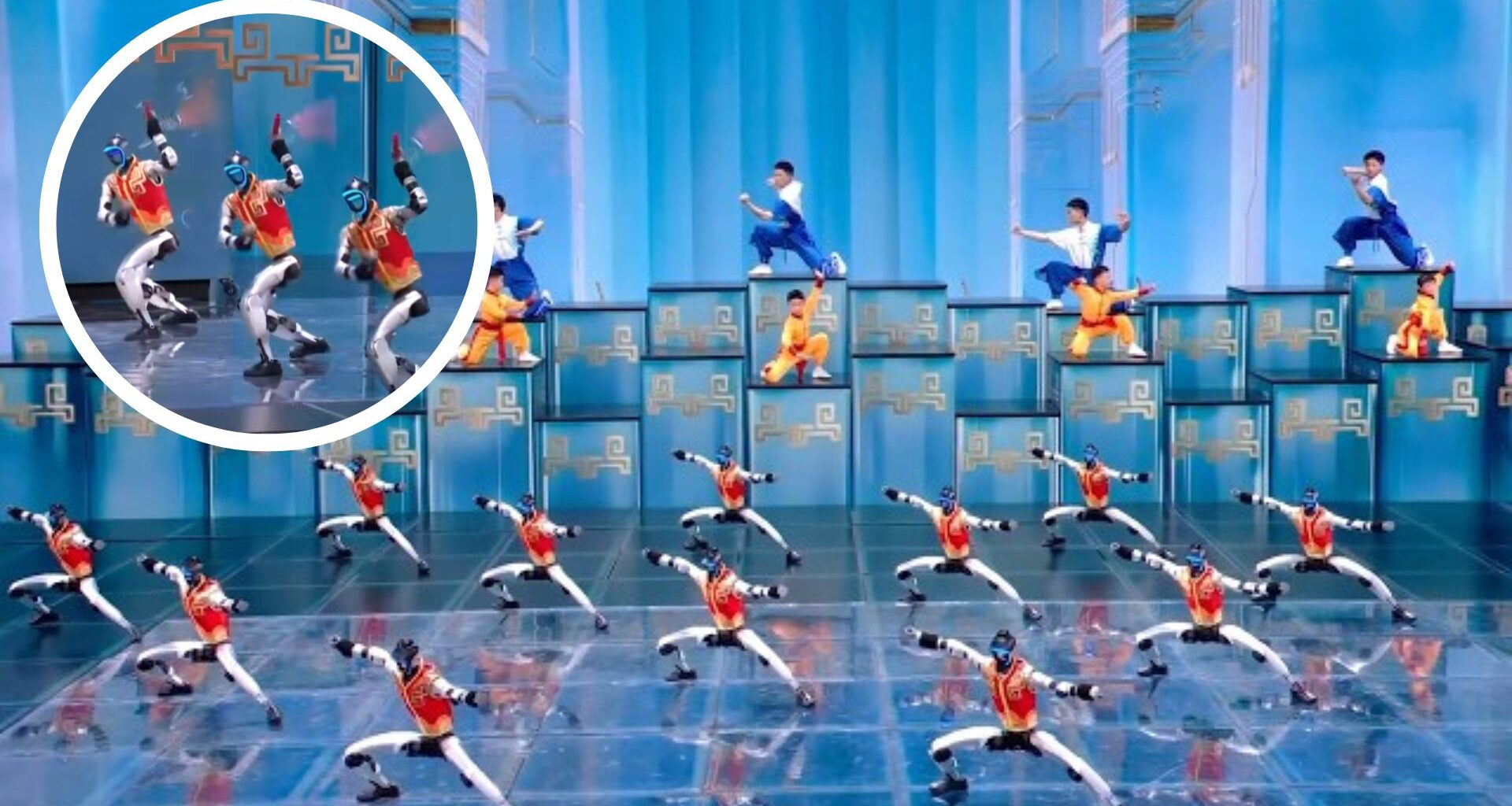
On Monday, hundreds of millions of viewers witnessed an unprecedented fusion of ancient tradition and cutting-edge robotics at the 2026 China Media Group Spring Festival Gala.
Humanoid machines joined young kung fu artists to deliver a synchronized martial arts performance.
This “Chunwan” spectacle, often compared to the American Super Bowl, showcased China’s rapid advancements in bipedal locomotion.
Unitree Robotics led the charge by deploying a fleet of G1 and H1 humanoid units. These machines executed “Drunken Fist” imitations to demonstrate innovations in multi-robot coordination.
They handled traditional weapons like swords, poles, and nunchucks with elite human precision. The performance featured table-vaulting parkour and 3-meter aerial flips that pushed the hardware to its structural limits.
One unit even executed a seven-and-a-half rotation “Airflare” grand spin.
The robots also mastered high-speed cluster repositioning at speeds of 4 meters per second. This maneuver required immense torque and real-time motion control to avoid collisions.
When one robot fell during the routine, it performed a spin-recovery to its feet as part of the act.
These “silicon warriors” even launched from spring-loaded boards and trampolines to perform mid-air stunts.
This level of coordination effectively marries ancient Chinese martial arts with modern precision engineering.
Showcasing industrial policy
Beijing utilized the gala to highlight its strategic focus on the robotics sector. Four major firms, including Unitree and MagicLab, reportedly invested 100 million yuan into the production.
This massive marketing push signals the government’s desire to lead the global humanoid market.
While the gala focused on entertainment, the underlying goal remains industrial utility. Experts view these displays as a prelude to deploying robots in factories and logistics centers.
The variety of robots on stage demonstrated a diverse range of engineering philosophies.
Some robots, like Noetix’s Bumi, appeared in comedy sketches to show social interaction capabilities.
Others, like the taller H2 model, focused on theatrical flourishes. The H2 even dressed as the legendary Monkey King while riding a “somersault cloud” powered by quadruped dogs.
This blend of folklore and physics effectively turned a cultural holiday into a showcase for national industrial prowess.
Scaling for future utility
The success of the 2026 gala highlights the maturing supply chain for humanoid components. Engineers have moved beyond simple walking patterns to achieve “human-like” athletic performance.
This transition requires sophisticated sensors and rapid data processing.
Currently, these machines excel in controlled entertainment settings. However, the precision seen on Monday suggests they are nearing readiness for more rigorous tasks.
China’s tech giants are betting heavily on these versatile platforms. They aim to bridge the gap between novelty and necessity within the next few years.
\The gala proved that the hardware can survive intense, high-speed operation without mechanical failure.
As these robots become more affordable, their presence will likely expand far beyond the stage. For now, the world watches as these silicon warriors master the art of the knockout.