
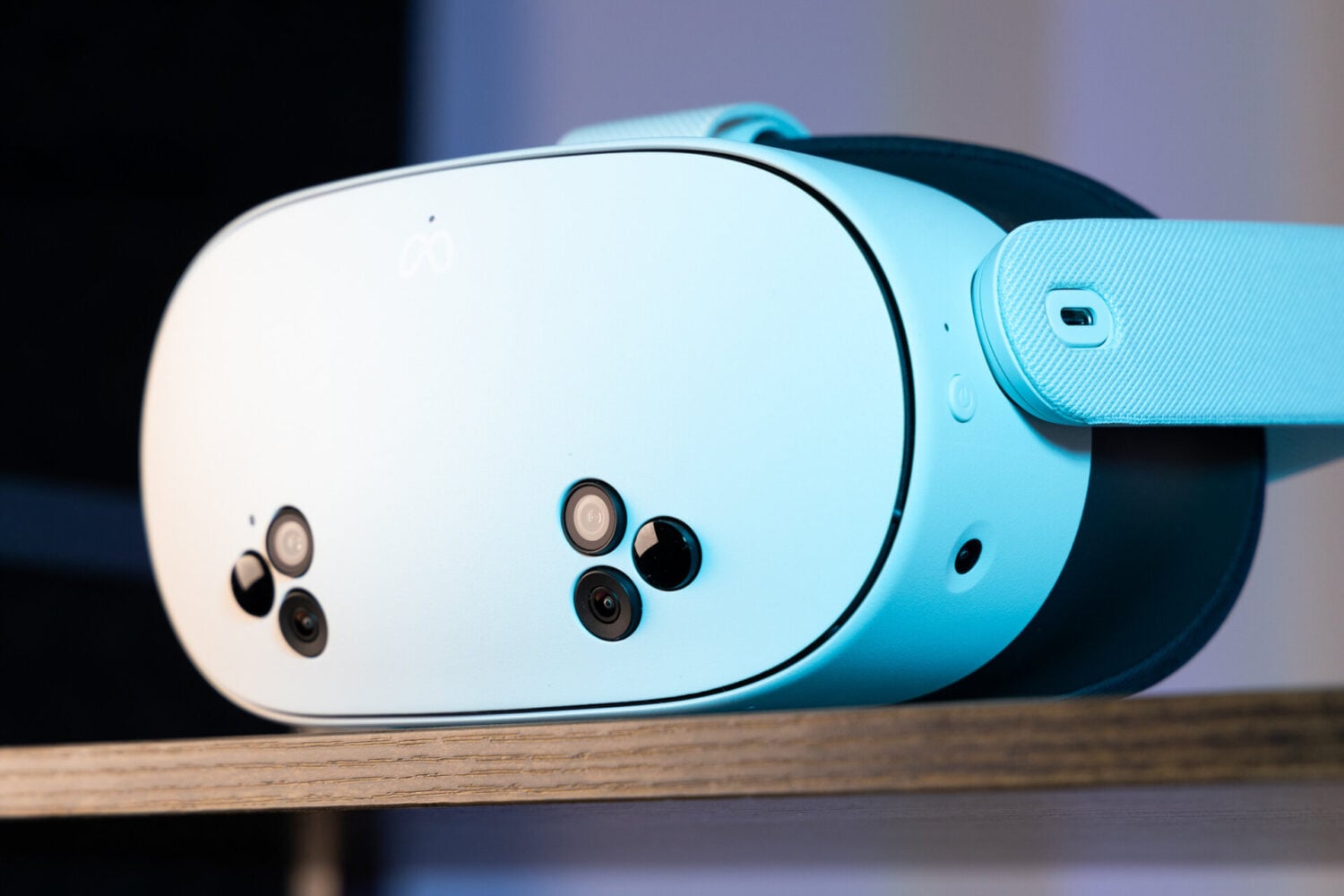
As I sit here and type these words, I can’t help but think of the Meta Quest Pro. According to Meta, I was supposed to be doing all of what I’m doing right now in a VR headset, not on a tired old laptop. That was the vision that Mark Zuckerberg outlined way back in 2022, and as you may already be aware, it has not come to pass.
Instead of revolutionizing work, the Quest Pro, Meta’s work-focused VR headset, saw its $1,500 price slashed down by $500 a few months after launch, and then finally discontinued in January of 2025. To add even more insult to that work-related injury, Meta officially wound down Horizon Workrooms for good on Monday. Horizon Workrooms, in case you need a refresher, was the company’s metaverse for work, which was apparently so awesome to work in that Meta’s own employees never really bothered to use it. In some ways, the closure of Horizon Workrooms is just yet another indictment of the Quest Pro and everything it tried to do for the future of exchanging labor for monetary gain.
And while the Quest Pro is the most obvious monument to a failed work-focused VR experiment out there, it’s far from the only one. It’s safe to say that four years after the Meta Quest Pro’s release, working in VR is still not working out.
Take the Vision Pro, for example. Apple’s mixed reality headset is a lot of things. It’s a premium screen for watching movies, it’s an immersive FaceTime machine, and it plays some games, although not nearly enough considering that gaming is still the best part of VR. But don’t you dare call the Vision Pro an XR headset—Apple’s machine is a spatial computer. In addition to doing all the stuff you’d expect from an XR headset, Apple’s machine is something you’re supposed to use as a substitute for a MacBook in a lot of ways.
In addition to watching movies or playing games, Apple originally marketed its headset as a productivity tool—something you could use for 3D rendering or remote assistance. Beyond that, though, it also envisioned the Vision Pro as a tool for more everyday white-collar work, pitching its “spatial computer” as a great way to multitask with big-ass virtual windows. The Vision Pro isn’t just a headset; it’s supposed to be a little bit of MacBook, iPhone, and iPad all on your face.
The thing is, in some metrics, the Vision Pro is a success in that regard. It does adeptly handle multitasking, and combined with the Vision Pro’s hand- and eye-tracking input system, the headset makes a windowed XR experience feel easier than you’d expect. It also comes with features that could be useful for work, like Personas, Apple’s digital avatars that are surprisingly not wonky. The thing is, those successes actually highlight working in VR’s monumental failure. Apple may have made the ultimate headset for working, and no one seems to care.
 © Adriano Contreras / Gizmodo
Sure, price is still a major factor in work-focused VR/XR hardware. When Meta’s Quest Pro was released in 2022, people gasped at the $1,500 price tag, only to nearly scream a couple of years later when the Vision Pro debuted at a still-shocking $3,500. Those prices are going to automatically alienate a major portion of the potential audience. Then again, Apple has made a name for selling gadgets at a premium that most people would expect to be a dealbreaker. So, why is the Vision Pro different? For one, it’s a headset.
As someone who’s strapped quite a few headsets to his face, I can say for certain that the most obvious downside of headsets is likely the biggest reason why working in VR has been a bust—headsets absolutely suck to wear for long periods. If you’ve ever tried to use one for an extended period, you know what I’m talking about. They weigh on your face and your nose, they’re hot, and the battery life is sub-optimal at best. There are a lot of cool things you can do with a computer strapped to your eyeballs, but there are a lot of downsides to trying to make that work, too.
Beyond the hardware, there are also significant shortcomings with software. The Vision Pro might have useful features like the ability to run iPad apps and mirror or extend your MacBook screen, but input methods are less than ideal. One thing people do a lot while they work is type, and that’s something that XR companies have just begun to improve on a software level.
I recently tested out Meta’s experimental Surface Keyboard feature in the Quest 3, and it’s a marked improvement on typing in VR, though not something you’d want to use all the time. Previous typing methods are nothing short of painful, though, both in the Quest and the Vision Pro. Luckily, you can use the Quest 3 and the Vision Pro with all sorts of different Bluetooth keyboards, though passthrough with Vision Pro, which lets you see the keyboard on your desk while donning the headset, only works with Apple’s own Magic Keyboards. But something about using most wireless keyboards that you can’t see just doesn’t feel as seamless as Apple and Meta have made the Vision Pro or Quest out to be.
That’s all to say nothing of battery life, too. Unless you work for about two hours a day (if so, can you give me a recommendation at your job?), then you’re going to have to keep your headset plugged in or take it off to charge incrementally throughout the day. In either case, it adds to the overall burden of using a headset for long periods while you’re supposed to be meeting deadlines or smashing KPIs, or whatever it is you do to pay your rent on time.
In some ways, you have to work to enjoy VR. Because of those constraints I mentioned, and plenty more, the experience of using headsets is not what most would consider easy, and if there’s one thing that people do not want work to be, it’s harder. Headsets, however good or bad they are at doing the things that companies like Meta and Apple make them for, just aren’t the ideal form factor for serious business yet. Maybe that will change as things get lighter, less expensive, and maybe even more powerful, but I’m skeptical. If I were to bet, I’d be blogging about the future of work in VR from the same device I always use—a tired old laptop.