
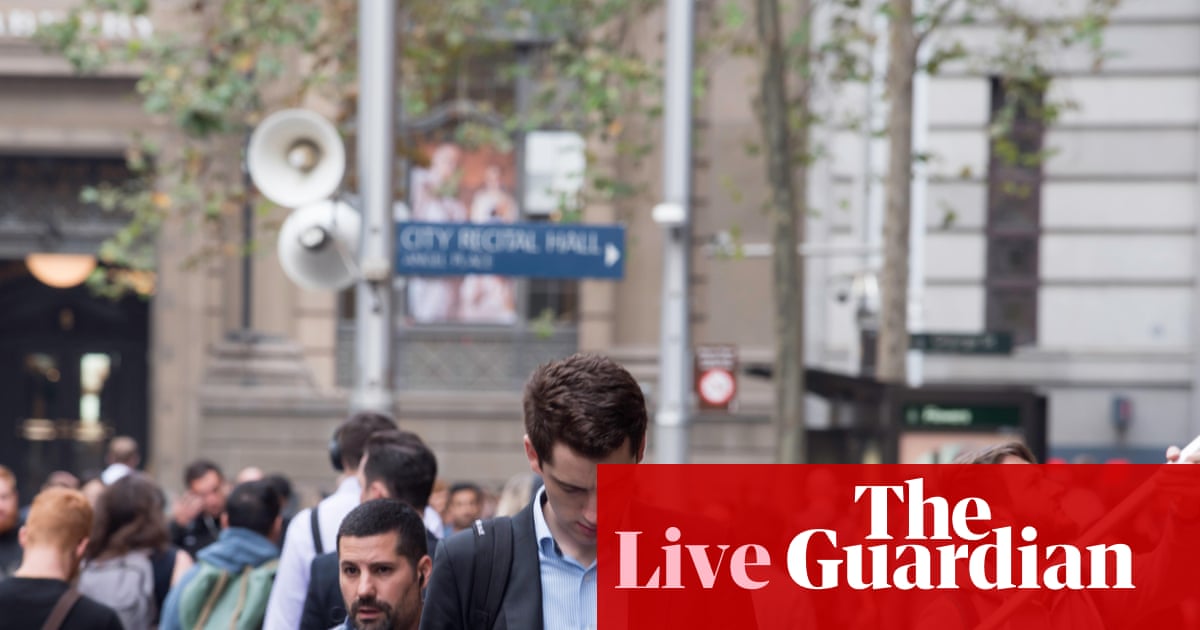
Real wages fell in 2025 Luca Ittimani
Australians’ real wages fell in 2025 as the pace of wage growth held steady while prices rose.
Wages rose 0.8% in the last three months of 2025, taking the annual pace to 3.4%, as expected by markets and the Reserve Bank.
Consumer prices rose 1% in the month of December alone, and 3.8% over the full year of 2025.
Private and public sector wages both rose 0.8% in the December quarter, the seasonally adjusted data released today by the Australian Bureau of Statistics showed.
Over the full year, public sector wages were up 4% while private sector wages were up 3.34%, which the ABS attributed to new state government agreements delivering both backdated and new pay rises in 2025.
Surging pay for healthcare workers in New South Wales and federal funding for aged care and early childhood workers were the biggest contributors to December’s steady result.
Updated at 19.54 EST
Key events
Show key events only
Please turn on JavaScript to use this feature
 Natasha May
Vaccine confidence declining among Australian parents, survey shows
Parents are becoming less accepting of routine childhood vaccines, according to new findings from the National Vaccination Insights project released today.
The nationally representative survey of over 2,000 parents of children under 5 conducted in 2025 found the top barrier was parents feeling distressed about vaccinating (32%).
Compared to the same survey carried out in 2024, lack of trust in the information from healthcare providers rose from 6.4% to 8.8% while not believing vaccines are safe rose from 6% to 8.3%.
This year’s study showed the proportion of children fully vaccinated was relatively high at 93.7% and 92.7% nationally in 2024 according to the National Centre for Immunisation Research and Surveillance. However, while practical issues like cost or travel used to be the most significant reasons for not vaccinating children, the study shows parents are now more influenced by beliefs and concerns about the vaccines themselves.
ShareNSW Labor minister says Hanson trying to ‘rip apart’ communityLuca Ittimani
A Labor minister in the New South Wales government, Steve Kamper, has rebuked Pauline Hanson for her inflammatory comments about Muslim Australians.
Kamper, a member of Chris Minns’ frontbench, issued this statement this morning:
The statements from Pauline Hanson are reprehensible, bigoted and wrong.
Her comments are aimed to rip apart our community for her own political gain, to attack the very multicultural and multifaith foundation our society is built on … We must never give in to hate or those that would seek to divide us.
Updated at 20.31 EST
 Tory Shepherd
‘Long haul’ in search for missing Gus Lamont
Police are in the search for missing four-year-old Gus Lamont for the “long haul”, the South Australian police commissioner, Grant Stevens, told radio station FiveAA this morning.
Gus went missing on 27 September last year, and initially police believed he had wandered off from his remote home at Oak Park station in South Australia.
But earlier this month, SA police declared it a major crime and said they had a suspect who lived with Gus.
Police launched a new search on Monday, but it concluded on Tuesday with no new evidence found.
Four-year-old Gus Lamont was reported missing in September 2025 from his family’s farm at Oak Park station near Yunta, in the outback north of Adelaide. Photograph: SA police/AFP/Getty Images
This morning, Stevens said “we’ll be spending more time up there”, in reference to the station, which is about 300km inland from Adelaide. He said:
Probably, sadly, I think the case of Gus Lamont is going to feature quite frequently in the news cycle as major crime continue to do their work.
This is going to be a, probably, a long haul for us … we’ve always said that we are exploring every possibility, and that remains the case.
The investigation led to police arresting a 75-year-old on unrelated gun charges earlier this week. Stevens said that was likely “around storage, ammunition, registration, licensing, those sorts of offences”.
Updated at 20.21 EST
 Benita Kolovos
Did the Victorian premier intervene in health workers’ pay deal?
The premier, Jacinta Allan, held a press conference at Footscray hospital this morning where she was asked about her intervention in the HWU deal.
Allan would not say whether she directly intervened to make it happen:
We’re really pleased to say we have reached an in principle agreement. There’s still a bit of a process to be worked through here, but this is part of our workforce that deserves a pay rise. We always had that view, and we’ve negotiated in good faith.
I’m not going to be invited to go into the back and forth of the negotiation process, other than to say we’ll always back our hard-working healthcare workforce.
The Victorian premier, Jacinta Allan, tours the new Footscray hospital in Melbourne on 17 February 2026. Photograph: Joel Carrett/AAPShare
Updated at 20.08 EST
Benita Kolovos
Victorian government and Health Workers Union close to deal
Victorian healthcare workers have been offered a new pay deal by the state government in a bid to bring their weeks-long industrial action to an end.
The deal proposes a 12% pay increase over two-and-a-half years, which the Health Workers Union (HWU) lead organiser, Jake McGuinness, says was a “significant improvement” on previous offers. He told reporters:
It allows these workers to get ahead of some pretty tough times financially. The offer has not come through in writing yet, so we’re still waiting on the full details before we can put it to members, but at an initial glance it’s a good offer, it’s a respectful offer, and it’s one that the union will be happy to commend to our members.
McGuinness says the offer came just hours before a planned protest at the opening of Footscray hospital. The event will still go ahead, though it is planned for during workers’ lunch break to minimise disruption. He says the premier’s intervention led to the new offer:
The premier has really taken this issue on in the last couple of weeks and championed it and made clear that the priorities of her government are getting a fair, liberal increase to low-paid healthcare workers. From what I know, the premier is the reason this has gotten over the line.
Once the offer is received in writing, the HWU will take it to members for a vote. In the interim, the workers’ industrial action, which involved not supporting category 2 and 3 elective surgeries, closing one in four hospital beds, ceasing cleaning of non-clinical areas including offices, staff rooms and cafeterias and suspending the training and onboarding of new staff, will end.
McGuinness says “hundreds” of elective surgeries have been affected.
The HWU represents most hospital staff other than nurses and doctors. This includes cooks and cleaners, orderlies and security guards, ward clerks, allied health assistants, theatre technicians and phlebotomists.
Updated at 20.05 EST
Real wages fell in 2025Luca Ittimani
Australians’ real wages fell in 2025 as the pace of wage growth held steady while prices rose.
Wages rose 0.8% in the last three months of 2025, taking the annual pace to 3.4%, as expected by markets and the Reserve Bank.
Consumer prices rose 1% in the month of December alone, and 3.8% over the full year of 2025.
Private and public sector wages both rose 0.8% in the December quarter, the seasonally adjusted data released today by the Australian Bureau of Statistics showed.
Over the full year, public sector wages were up 4% while private sector wages were up 3.34%, which the ABS attributed to new state government agreements delivering both backdated and new pay rises in 2025.
Surging pay for healthcare workers in New South Wales and federal funding for aged care and early childhood workers were the biggest contributors to December’s steady result.
Updated at 19.54 EST
 Patrick Commins
Some stats behind Australia’s migration policies
The new leader of the opposition, Angus Taylor, has promised an “immigration policy that puts Australians first, raises the standards, reduces the numbers and says to people who don’t accept our way of life that the door is shut”.
It’s reported that Sussan Ley’s draft migration policy would have aimed to reduce net overseas migration (Nom) to 170,000 a year, compared to about 240,000 leading into the pandemic, and 305,570 in the most recent financial year.
To be clear, we do not have a Nom “target” – we have a permanent migration program of 185,000 people a year, most of whom are already in the country.
Experts say precise targeting on Nom is impossible, as it reflects both arrivals and departures; you can limit the first, but not the second.
Net overseas migration is high but has been trending down for some time. Arrivals are more or less back to where they were before the Covid-19 border closures, but departures are still low.
A graph showing the annual change in net overseas migration
Beware those who deliberately conflate overseas arrivals and departures data (which count border crossings) with Nom to make exaggerated claims about “mass migration”.
The ABS has said “this data does not reflect the official ABS definition of migration and may lead to inaccurate conclusions on migration”.
Far from “out of control”, experts like Alan Gamlen from the ANU’s migration hub say the wildly oscillating net overseas migration figures reflect the delayed adjustment from the global shock caused by the pandemic.
Updated at 19.39 EST
Family of kidnapped 85-year-old says they are living ‘through a nightmare’
The family of Chris Baghsarian, the 85-year-old kidnapped from his home apparently by mistake, said last night they are “living through a nightmare” and the man’s abduction “feels surreal”.
Baghsarian was alone in his North Ryde home when he was taken and bundled into a dark-coloured SUV on Friday morning, allegedly by underworld figures. Police say it was a case of mistaken identity and they hold grave concerns for the grandfather, who needs daily medication.
The family said last night:
Chris’s kidnapping feels surreal, and we are struggling to make sense of the fact that he has been taken and that our family has been caught up in something that has nothing to do with us.
Chris is a devoted father, brother, uncle, and grandfather. He is deeply loved, gentle, and the kindest person we know – someone who would never hurt a fly.
As we wait for some form of closure or resolution, we ask for privacy and respectfully request that the media stop publishing photos of our extended family.
This is an extraordinarily distressing time, and we need space to support one another and focus on navigating what comes next.
Chris Baghsarian. Photograph: Nsw Police/AAPShare
Updated at 19.21 EST
 Ima Caldwell
Man charged with murder after Merrylands stabbing spree had allegedly absconded from hospital
A man has been charged with murder after a stabbing attack in Sydney’s west that killed a man and left two people critically injured.
The 25-year-old accused had absconded from health care 10 days before the attack while being transferred between hospitals, authorities said. Western Sydney local health district said the man had escaped from care 10 days before the stabbings.
“The district is aware a person alleged to be involved in the incident is a recent patient of Cumberland hospital, which provides acute inpatient care for people with complex mental health needs,” a spokesperson said, adding:
On 7 February, this person absconded from care while being transferred from Cumberland hospital to Westmead hospital emergency department for further medical assessment.
Read more here:
Share Melissa Davey
Government defends use of algorithm to assess aged care supports
A spokesperson from the Department of Health, Disability and Ageing has defended the government’s use of an algorithm to assess elderly people for aged care support, saying the Integrated Assessment Tool (IAT) “ensures service recommendations and referrals are tailored to an individual’s needs”.
It follows a report from Guardian Australia today, where aged care workers described the IAT as “inhumane” and “cruel,” locking elderly people into a classification of need that must be accepted by assessors to secure support. But aged care professionals say the IAT often gets this assessment wrong, recommending lower levels of support and therefore funding to elderly people.
“The IAT classification algorithm does not replace assessor input and relies on assessors documenting their advice in the IAT first,” the department spokesperson said, adding:
Assessors still play a critical role in achieving high quality assessment outcomes by using their clinical judgment and strong communication and engagement skills to complete the IAT during the assessment.
Monique Ryan. Photograph: Mick Tsikas/AAP
But independent MP Dr Monique Ryan says this “misses the point”.
“The input (by the assessor) might be right, but the algorithmic output can be entirely wrong,” Ryan said.
Ryan said she is increasingly hearing from constituents concerned that the IAT “is stripping the sector of clinical judgment and nuance” and leaving elderly people with inadequate care.
The department did not respond to questions from Guardian Australia about how the IAT algorithm assesses people including complexities and other factor.
Read more:
Updated at 18.44 EST