
CSIRO and industry are accelerating Australia’s space ambitions by turning advanced materials, optics and energy innovations into mission-ready technologies.
With Australian ingenuity firing across the space sector, CSIRO is working with industry partners to advance projects at any stage, or shepherd them from start to finish. This holistic approach not only accelerates innovation but ensures seamless translation from laboratory breakthroughs to real-world deployment.
Additive manufacturing: tailoring materials for space
Additive manufacturing, or 3D printing, is revolutionising how materials are designed and fabricated for space applications. CSIRO’s advanced additive manufacturing facilities allow for the rapid prototyping and production of complex, lightweight structures that are optimised for the demanding requirements of space. These methods enable the customisation of materials with specific properties – such as strength, thermal resistance, or radiation shielding – tailored to each mission’s unique needs.
Notably, CSIRO has collaborated with Space Machines Company to develop bimetal thruster components using additive manufacturing. The thruster, designed for in-orbit servicing and satellite manoeuvring, benefits from CSIRO’s expertise in material selection and configuration, and additive manufacturing. By working closely with industry partners, CSIRO ensures that these components achieve the necessary reliability and performance to operate effectively in the challenging space environment.
Radiation shielding and lunar dust solutions
Space presents a host of unique hazards that pose challenges for long-duration missions. To address this, CSIRO is using advanced composite materials and fabrication techniques to develop radiation shielding materials that protect astronauts and sensitive equipment from harmful space radiation.
Lunar dust is another formidable adversary. Highly abrasive and electrostatically charged, it can degrade equipment and pose health risks. CSIRO’s work in developing coatings and materials that resist dust adhesion can contribute to safer and more robust lunar operations. These efforts could support Australia’s involvement in international lunar missions and open commercial opportunities for local industry partners seeking to provide mission-critical components.
 Additive manufacturing is revolutionising how materials are designed and fabricated for space applications.
Space optics: precision for the harshest environments
High-performance optics are essential for everything from navigation and communication to scientific observation and exploration. CSIRO’s work in space optics is Australian-leading with advanced design, fabrication, and testing capabilities. A cornerstone of this capability is the Trailblazer single-point diamond turning machine – said to be one of the most precise tools of its kind in the Southern Hemisphere. This machine enables the creation of ultra-precise optical surfaces needed for satellites, telescopes, and guidance systems.
CSIRO is partnering with Australian aerospace firms to design and manufacture optical components that withstand the extreme thermal and mechanical stresses of launch and operation in space. These optics are critical for capturing trusted imagery of our Earth and could contribute to navigation systems that ensure the accuracy and safety of space missions.
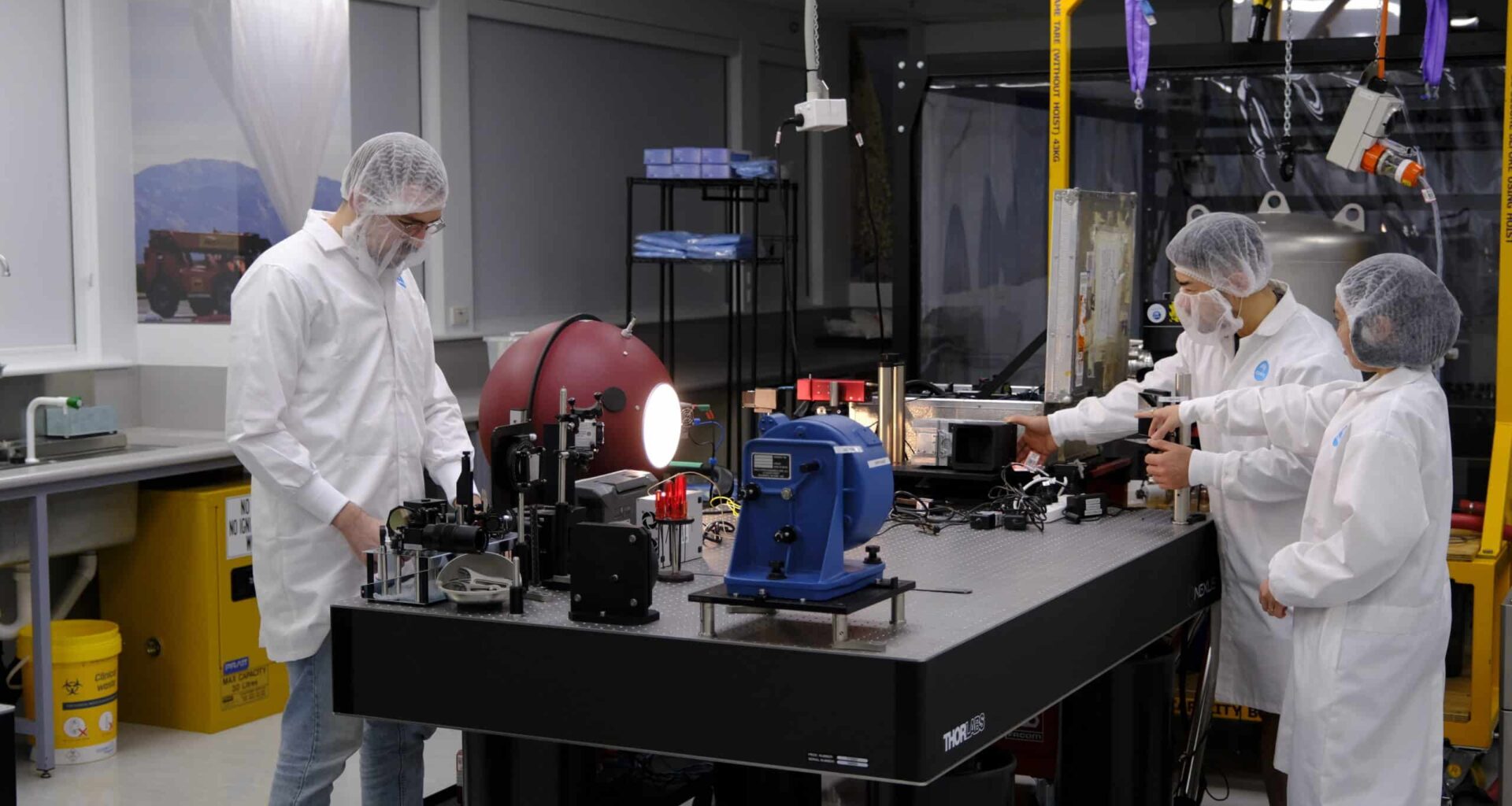
In a recent project, a cross-disciplinary team developed a hyperspectral Earth-observation instrument called CyanoSense. Named after the Cyanobacteria it is designed to detect, CyanoSense aims to monitor potentially harmful algal blooms and water quality. Designed, manufactured, calibrated, and verified at CSIRO, CyanoSense demonstrates the maturity of Australia’s end-to-end space optics ecosystem, spanning concept to flight operations.
By integrating advanced materials and sensor technologies, CSIRO is creating systems that are lightweight, reliable, and suitable for the extreme conditions of space. This work underscores CSIRO’s ability to deliver across the full range of space materials science.
Finding new ways to power space discovery
CSIRO is also redefining energy solutions for space with its world-first launch of Australian-made printed flexible solar cells. Developed using advanced perovskite materials and roll-to-roll printing, these lightweight, high-efficiency cells promise to overcome the mass and performance limitations of traditional silicon panels. With plans to translate terrestrial innovation into space-ready technology, offering a scalable, cost-effective power source for future missions, CSIRO is pushing the boundaries of renewable energy and manufacturing.
 CSIRO is redefining energy solutions for space with its world-first launch of Australian-made printed flexible solar cells.
CSIRO and industry collaboration
CSIRO’s end-to-end capability is not just a technical achievement; it is a strategic asset for industry partners. Whether a commercial enterprise requires initial feasibility studies, prototyping or rigorous qualification testing, CSIRO can engage at any stage. The agency’s collaborative approach ensures that industry partners – ranging from established aerospace primes to nimble start-ups – can access world-class expertise, facilities and networks in Australia.
CSIRO’s optics and additive manufacturing teams routinely work with industry at the concept stage, helping to define requirements, before moving into production and validation. This flexibility enables industry partners to mitigate project risks and achieve higher technical readiness levels faster than would otherwise be possible.
By offering seamless engagement – from blue-sky research to flight-ready hardware – CSIRO supports Australian industry to compete and thrive on a global stage. As we venture further, the partnership between CSIRO and the nation’s space innovators will turn bold ideas into reality, safeguarding astronauts and expanding the boundaries of what is possible for Australia in space.