
There’s a misconception that fresh pasta is somehow superior to the dried stuff. While the “fresh is best” mantra rings true for fruit, veg and other perishable produce, it simply doesn’t hold water where pasta is concerned.
In Italy, many pasta dishes from the country’s southern and central regions – including the classic Roman cacio e pepe – rely exclusively on dried durum semolina products. Meanwhile, in the north, fresh pasta enriched with flour and eggs – such as pappardelle and tortellini – reigns supreme.
While there are many historical factors to explain that divide, a big one is that most of Italy’s durum wheat cultivation happens in the hotter southern regions, such as Campania, where spaghetti was popularised. And because durum has a high protein content, dried shapes are better at maintaining their structural integrity and achieving that perfect al dente bite.
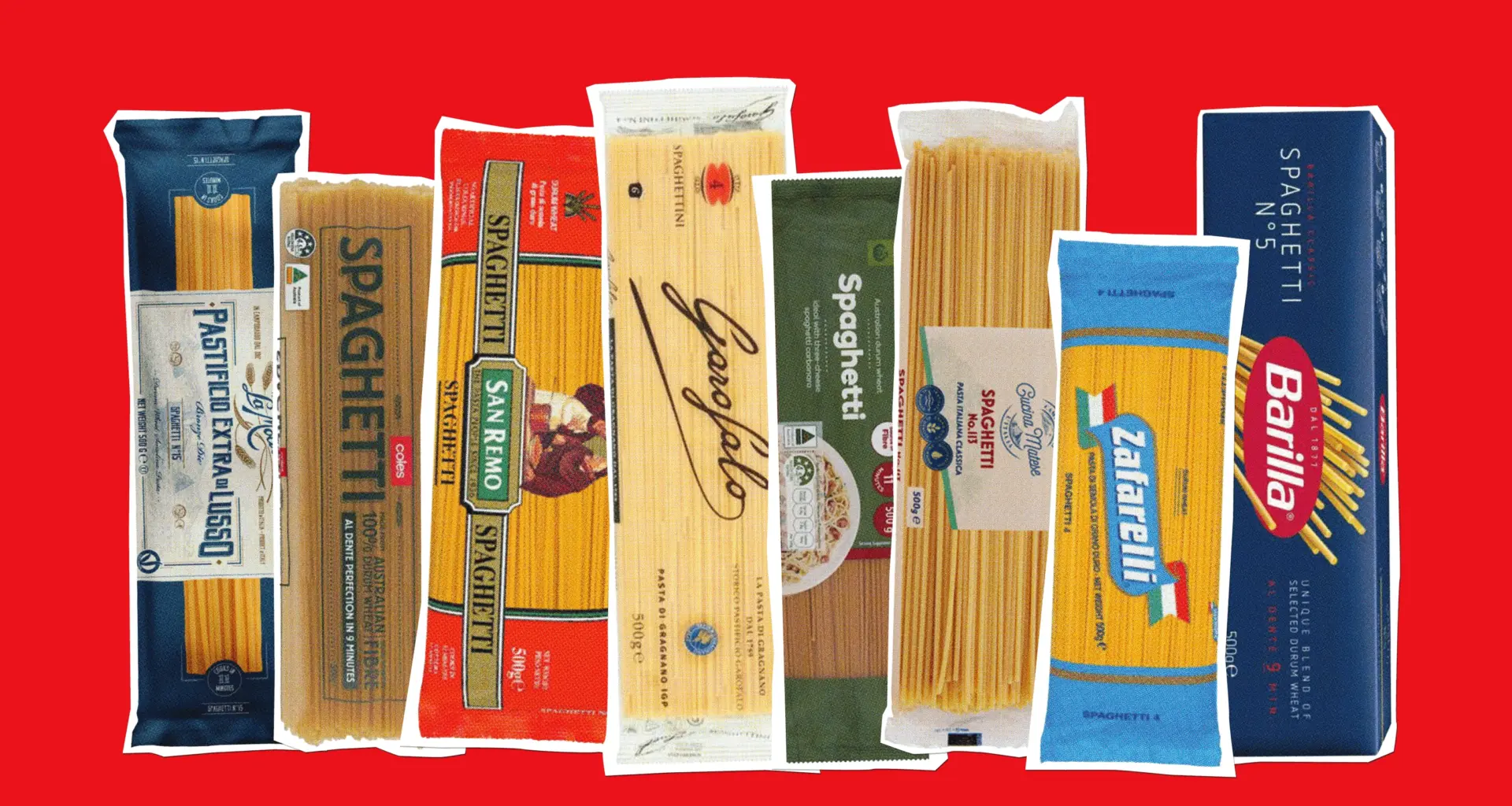
Spaghetti is a staple in my kitchen at home, so I was really interested to put these products to the test. I thought the olive oil and soy sauce articles in this series were fascinating because of the stark differences between brands. In this trial, though, the variations were far more subtle.
I expected to notice a bigger difference in taste between the Italian and Australian products, but it turns out white durum has a pretty benign flavour no matter where it’s from. That’s why it’s really important to season your pasta water! For me, the markers of quality in this test were mainly texture and how well each brand held its sauce.
I cooked each one according to the package instructions, but if the prescribed time felt a little long, I’d check it sooner. That was the case for some of these, which would have pushed the noodles past al dente texture, which I think is really important. (Some people love soft pasta, but I definitely don’t.) Then, I’d serve it two ways: tossed with Cobram light olive oil, and a simple tomato sauce made from a can of Mutti Polpa, cooked down and seasoned with a little salt.
I noticed some noodles had an inconsistent texture after being thoroughly cooked. Someone might read that and think I should’ve left those products to boil a little longer, but I can assure you these weren’t underdone. The exterior had chew while the insides were brittle.
This test demonstrated to me that bronze-drawn spaghetti (where the pasta is shaped using a bronze die) is better at holding sauce thanks to its rougher, more porous exterior, as opposed to those drawn through a Teflon die, which can be often be a sign of mass production. Spaghetti is essentially a vehicle for sauce, so texture arguably has the biggest impact on flavour overall.
Incidentally, this also confirmed my favourite brand. I’ll also equally say that if that particular product isn’t available, there are a bunch of alternatives I’ll happily buy now, because those are just as good.
La Molisana Pastificio Extra Di Lusso Spaghetti No.15
Sample price: $3.50 (500g) at Woolworths
Origin: Italy
Cooking time: 11 minutes
La Molisana is the brand I always reach for, so it was my benchmark going into this test. It’s bronze-drawn, so it held both sauces extremely well and had a consistent chew all the way through. And of all the spaghetti tested, this one might’ve been the thickest without entering bucatini territory. Best overall.
Score: 5/5
Garofalo Spaghetti No.9
Sample price: $3.50 (500g) at Harris Farm
Origin: Italy
Cooking time: 10 minutes
Again, Italian-made and bronze-drawn. Great chew and held sauce nicely. I only thought Molisana was superior because it was slightly thicker, which is my preference. And for the same price, you may as well get that additional value. Otherwise, Garofolo is a fantastic choice.
Score: 4.5/5
San Remo Spaghetti No.5
Sample price: $2.95 (500g) at Woolworths
Origin: Italy
Cook time: 12 minutes
Despite its smoother texture, San Remo did well holding sauce, which I can’t really explain. That said, the recommended cooking time was too long – I checked it at 10 minutes and the noodles were perfectly al dente, in my opinion. San Remo is everywhere, and it’s old faithful for a reason.
Score: 4/5
Cucina Matese Spaghetti No.113
Sample price: $2.80 (500g) at Coles
Origin: Italy
Cooking time: 11 minutes
This Italian brand is exclusive to Coles and, for a bronze-drawn product, it’s priced keenly against some of the more recognisable brands out there. Again, this one would’ve been too soft for me at the recommended cooking time. I thought these were ready to serve at the 10-minute mark.
Score: 4/5
Coles Spaghetti
Sample price: $1 (500g) at Coles
Origin: Australia
Cooking time: 9 minutes
Coles was surprisingly good overall. Where it faltered was that brittle interior, even though it was cooked completely. Coles makes an even cheaper product (Simply Spaghetti) for 10 cents less, and I’m curious to know what the difference is. If it’s a choice between the supermarket home brands, I’d choose this one.
Score: 3.5/5
Barilla Spaghetti No.5
Sample price: $3.50 (500g) at Coles
Origin: Italy
Cooking time: 10 minutes
It’s important to say that Barilla also makes bronze-drawn spaghetti, which is around a dollar more expensive and didn’t make it into this test. The sauce slid right off these noodles, which were a little too thin for my liking. Ten minutes seemed about right for cooking time, though.
Score: 3/5
Zafarelli Spaghetti No.4
Sample price: $2 (500g) at Woolworths
Origin: Australia
Cooking time: 8 minutes
Along with San Remo and Barilla, Zafarelli is probably the other brand most people are reaching for because it’s so ubiquitous and recognisable. Though the brand makes a spaghettini, these noodles were definitely on the thinner side and lack the chewiness I prefer.
Score: 3/5
Woolworths Spaghetti
Sample price: $1 (500g) at Woolworths
Origin: Australia
Cooking time: 7–11 minutes
This was the least favourite of the two home brands, and my least favourite overall. Every product I tested was chosen for its comparable thickness and price point, but this one could’ve passed as an angel hair pasta. For that reason, the cooking window of 7-11 minutes creates a much bigger margin for error. That’s not a product fault per se, but something to be mindful of.
Score: 2/5