
NORLIAH SYER-PETERSON: Levi was a really active, healthy 16-year-old. He just loved life, he loved cooking with me, he like going shopping, playing guitar in his room and we used to go to the beach a lot together, paddleboarding together. He was just an absolute joy every day.
TOM HARTLEY, REPORTER: Norliah Syer-Peterson’s precious bond with her son exists now only as memories.
One day last September, within 24 hours of saying he felt unwell, he was gone.
NORLIAH SYER-PETERSON: The thing with sepsis is it’s all based on time, and every hour counts.
TOM HARTLEY: Sepsis is when the body’s immune system overreacts to an infection and starts harming its own tissues and organs.
It can strike anyone and progresses astonishingly fast.
PROF. SIMON FINFER, DIRECTOR, SEPSIS AUSTRALIA: And it can result from any infection, from a scratch on your skin that becomes infected to a perforated or ruptured bowel.
And often people present to a hospital very late when it’s not possible to save them.
TOM HARTLEY: Professor Simon Finfer is the Director of Sepsis Australia, who’s treated countless patients during his 40-year career as an intensive care physician, including here at the Sydney Adventist Hospital.
He says the numbers nationally are far higher than most people expect.
SIMON FINFER: There were 84,000 public hospital admissions every year and over 12,000 deaths.
TOM HARTLEY: The tragedy, experts say, is that many of these deaths are preventable with earlier recognition and treatment.
But spotting sepsis is extremely challenging.
SIMON FINFER: We don’t have any specific diagnostic tests for sepsis. It’s a clinical diagnosis which requires people who are developing sepsis to understand that they’re developing sepsis and get themselves to healthcare.
NORLIAH SYER-PETERSON: Once this infection gets into the bloodstream and turns to sepsis, it is like a tsunami through the body.
TOM HARTLEY: Levi’s illness seemed to come out of nowhere. He came home after a day’s work with what felt like a stiff neck and a stomach bug.
NORLIAH SYER-PETERSON: At 1.30 am I was awoken to a loud bang. He had vomited in the bucket that I’d given him, and he wasn’t making any sense, so we rang paramedics.
They took his temperature, he had a fever of about 40.1, and then he was just laying there. He just said to me, “Mama, mama, mama,” and they were his first words to me as a baby and then he asked me if he was going to die…
TOM HARTLEY: In the ICU dozens of doctors and nurses fought to save him. Levi’s parents had no idea he had meningococcal B which had turned to sepsis.
NORLIAH SYER-PETERSON: I had one last type of communication with him, I just did the prayer sign and blew a kiss at him, and he did the thumbs up at me which he always did from a very young age.
And I felt when he was giving me the thumbs up he was trying to make me feel calm, make me think that he’d be okay, or that he will be okay wherever it is that he’s going.
After that his heart rate started to slow down as well so his heart was no longer beating effectively so they started CPR on him for 90 mins. and 7.40am the doctor called it. So it was extremely quick and extremely traumatic.
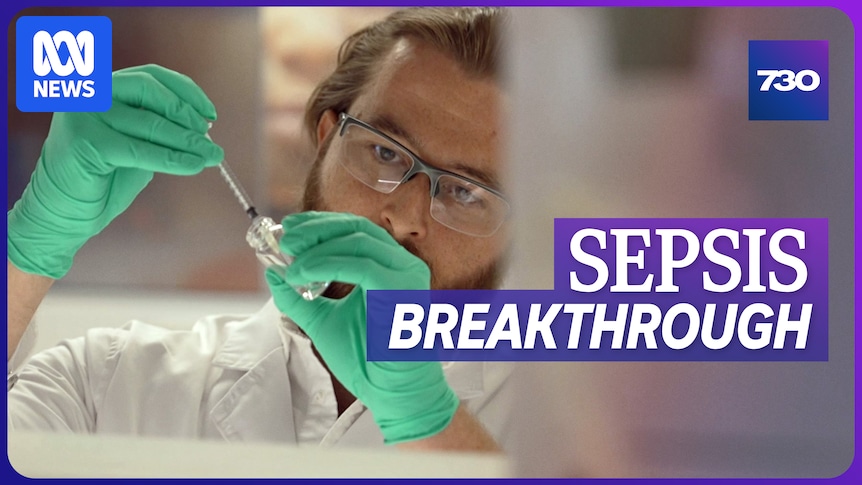
TOM HARTLEY: On the Gold Coast, a team of Australian scientists believe they may be on the brink of a breakthrough.
Professor Mark von Itzstein and his colleagues have developed a drug candidate designed to calm cases of sepsis.
PROF. MARK VON ITZSTEIN, GRIFFITH UNIVERSITY: So it is a classic drug candidate, which is a small molecule that is relatively stable when it’s administered to the patient and is able to interact with these nasty molecules that are secreted by damaged cells which means when you combine those pair, boom, it stops that engagement in causing further damage to tissue.
TOM HARTLEY: It’s a soluble powder, able to be injected intravenously.
An early clinical trial run by their industry partner – a Chinese pharmaceuticals company – has produced encouraging results but there’s a long way to go, with further trials needed before it’s approved to go to market.
MARK VON ITZSTEIN: It could be anywhere between two to five years. Two, being extremely optimistic, frankly, five, probably more realistic. But that will sit entirely with the industry partner.
TOM HARTLEY: Professor Finfer remains cautiously optimistic. He’s seen previous sepsis medications shelved, after they were proven to be ineffective.
SIMON FINFER: There’s no specific drug that treats sepsis despite literally billions of dollars being spent by the pharmaceutical industry and independent researchers trying to find such a drug. Hopefully we will find some drugs that make a difference.
MARK VON ITZSTEIN: Look, I think there are always risks. And you’re right, sometimes when a drug goes to market for a range of reasons, it may not be successful. I would remain optimistic that this will be one that will go further and succeed in actually treating sepsis patients.
TOM HARTLEY: Norliah Syer-Peterson is determined to turn her family’s tragedy into awareness. She wants all Australian states and territories to fund meningococcal B vaccinations and parents to be on the lookout for the signs of sepsis.
NORLIAH SYER-PETERSON: One day you’re happy and healthy, and by the next morning you’re gone, and nobody should have to go through that.