
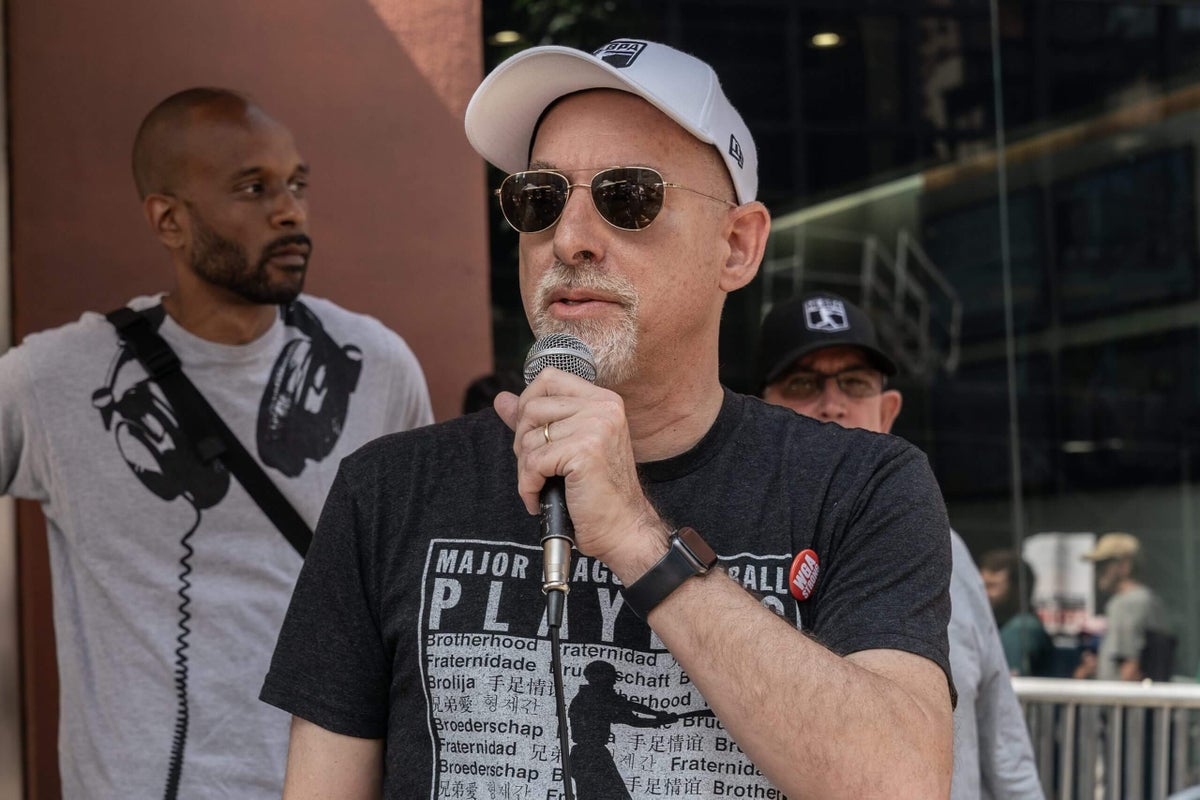
Two years before Tony Clark’s sudden resignation made Bruce Meyer the head of the Major League Baseball Players Association, Meyer composed a letter to quiet the union members calling for his ouster.
“Anyone peddling ‘easy fixes’ should be treated with suspicion,” Meyer wrote to the group in April of 2024.
Meyer, a longtime labor attorney, faces a situation where the fixes remain far from easy. After Clark stepped down on Tuesday because an internal investigation unearthed an inappropriate relationship with a staff member, the union announced on Wednesday that Meyer will take over on an interim basis entering a pivotal year for the future of the sport. With the collective bargaining agreement expiring in December, Meyer was positioned to lead the MLBPA in negotiations with commissioner Rob Manfred’s office. Now he will be leading the entire union as well.
Since joining the MLBPA eight years ago, Meyer has developed a reputation for unwavering conviction and limited interpersonal charisma, according to interviews with players, agents, executives and staffers from both the commissioner’s office and the union, many of whom requested anonymity in order to speak freely. He has impressed some within his coalition with his refusal to bend during negotiations with MLB officials during the 2020 Covid-19 season and during the lockout after the 2021 season. With Meyer at the negotiating table, the union made gains in the 2022-26 CBA, particularly in fighting tanking and service-time manipulation.
Yet a sense of distrust among some players led to an uprising against Meyer and Clark in 2024 that they eventually quelled. Along the way, people both inside and outside the union have labeled Meyer as a puppet of powerful agent Scott Boras, a charge both Boras and Meyer have vigorously denied.
Meyer’s champions call him a bulldog. His detractors call him a zealot. Which may make him ideal for the union as it prepares for what could be a lengthy, contentious labor stoppage this coming winter. Or it could make the union uniquely vulnerable as the 30 owners circle the wagons in pursuit of a salary cap. At a time when the owners have leveraged public outrage about the spending of the Los Angeles Dodgers into a push for their longstanding goal of a cap, the union was hastily calling team meetings and conference calls to figure out a way forward.
“I don’t think it has any impact on negotiating,” said Detroit Tigers ace Tarik Skubal, a member of the executive board. “Bruce has been our lead negotiator. He’s done it in the past. Although Tony has been the face of the PA in terms of negotiating, I’m still as confident as ever in Bruce and everyone else that we’ve got behind him.”
Added Houston Astros pitcher Lance McCullers, a former member of the MLBPA board, “My confidence in Bruce is extremely high. I think he’s fabulous at his job. He has a great understanding of how to help the players navigate these types of negotiations. He’s proven that over his career.”
But the process to crown Meyer featured bumps. The union’s leadership council convened a call with player representatives from all 30 clubs on Tuesday evening to discuss Clark’s resignation and determine new leadership. But the players stopped short of voting for Meyer, with at least three player reps objecting, according to a person informed about the call.
The vote on Wednesday proved to be more decisive for Meyer. Despite discussion of other candidates, the union decided to elevate its chief negotiator.
Meyer joined the MLBPA after a stint as counsel for the NHLPA, where he worked with former MLBPA chief Don Fehr. Meyer arrived with the players looking to regain ground, which some believe had been lost in CBA negotiations during 2011 and 2016. His initial title was a new one: senior director of collective bargaining and legal.
“It’s a role that requires a commitment to what you believe is right,” Clark said in The Athletic’s 2021 profile of Meyer. “Being a friend or being a dinner buddy is not what he’s focused on. And I’m grateful for that, because the most important things to us are our players and the game.”
That style came to the fore after the 2021 season, when the owners voted unanimously to lock out the players. The labor stoppage lasted 99 days, with the two sides reaching an agreement for a new CBA in time to avoid missing games in 2022. But the decision was not unanimous among players. The MLBPA executive board ratified the final proposal with a 26-12 vote. The eight-player leadership council known as the executive subcommittee, which counted five Boras clients, voted unanimously against the deal.
“Some players emerged from bargaining disappointed that we did not accomplish more and in particular that we did not miss games to see if more (gains) could be made,” Meyer wrote to the players in 2024. “To be clear, I sympathized and still do with these players and this position. But the reality is that players held firm throughout bargaining, and as MLB’s proposal got better and better, the vast majority of players believed that the deal on the table was a good deal.”
The vote demonstrated what some both inside and outside the union see as a divide for a path forward. The current system has permitted stars like New York Mets outfielder Juan Soto to land a $765 million contract and for Dodgers outfielder Kyle Tucker to find a deal that will pay him $57 million in 2026. But some players and agents fret about the financial fate of the sport’s middle class.
Meyer believes that the current, market-based system is still more beneficial to the middle class – and players on the whole – than alternatives favored by the league, such as a salary cap. Meyer has said he wants to make changes within the current structure to increase spending on players of various statures.
“The salary cap is bad for players at all levels, because it converts the system into a zero-sum game, which is to say a system where every time a player gets paid a dollar, that dollar has to come from another player’s pocket,” Meyer said recently. “The middle-class players get squeezed because they pay the stars, and everyone else gets basically whatever is left.”
But because Boras tends to represent players at the top of the market like Soto, some players harbored concerns that the agent carries undue influence on the union. The politics between agents and the MLBPA can be complicated. The union recently banned a high-profile agent, Jim Murray, for back-channeling with MLB officials during labor negotiations. The success of Boras can create resentment among other agents. Meyer has called the charges related to Boras’ influence “absurd,” but some players have disagreed.
During a lengthy call with union leadership in the spring of 2024, several player representatives expressed frustration with Meyer’s work on the current CBA and called for him to be replaced by Harry Marino, an ambitious young lawyer who had been instrumental in the creation of the minor league players’ union in 2022. The attempt to replace Meyer was ultimately shot down and the executive board released a statement distancing itself from Marino, but the incident highlighted the union’s factioning. Boras, for his part, called Marino’s gambit a “coup,” while defending the record of Clark and Meyer.
“The players who sought me out want a union that represents the will of the majority,” Marino said in response. “Scott Boras is rich because he makes — or used to make — the richest players in the game richer. That he is running to the defense of Tony Clark and Bruce Meyer this morning is genuinely alarming.”
Only two players on the latest edition of the union’s executive subcommittee, Skubal and New York Mets infielder Marcus Semien, are Boras clients. The members of the council understand that the disarray wrought by Clark’s departure and the lingering concerns about Meyer could be exploited by the owners during bargaining sessions.
“Anything that can be weaponized by somebody is going to be worried about,” said Pete Fairbanks, a Miami Marlins reliever and subcommittee member. “Our focus is going to be on making sure that we as an organization are checking our boxes and making sure that we’re set up to be headed towards the end of the year.”
Ken Rosenthal, Evan Drellich, Chandler Rome, Cody Stavenhagen and Katie Woo contributed reporting.