
The challenge
How can we unlock the energy storage potential of EVs?
Australia’s rapid uptake of rooftop solar and growing adoption of electric vehicles (EVs) are key features of our changing energy landscape. However, these changes are also creating new challenges for the electricity transition: unmanaged solar exports, increasing peak demand, and the need for more flexible energy storage to support grid stability.
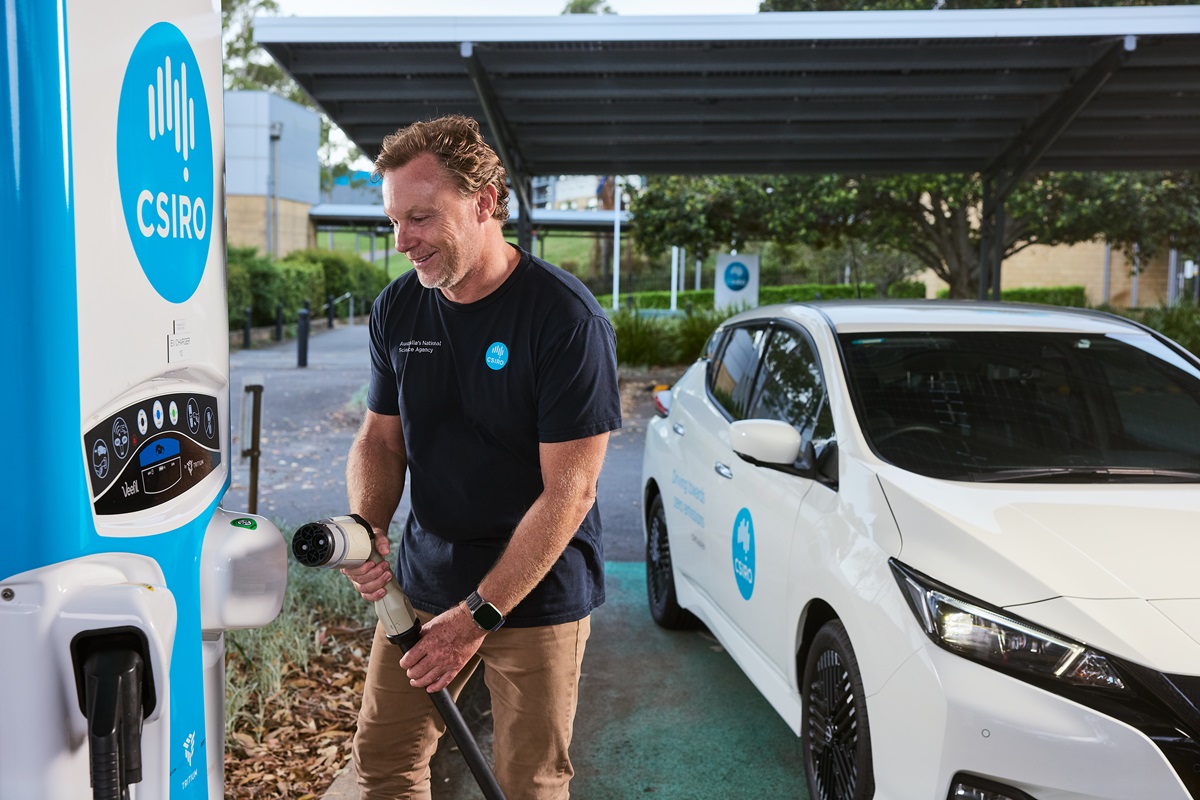
Sam Behrens demonstrates DC electric vehicle charging under CSIRO’s Newcastle Energy Centre’s Solar Carpark. CSIRO site vehicles, alongside staff and visitor personal vehicles can be charged using 100% renewable energy.
The challenge is clear: How can we unlock the energy storage potential of EVs – to integrate with homes and electricity grids for improved energy affordability, security and reliability as well as helping meet emission reduction goals.
Our response
Working with the electricity industry
CSIRO is working with the electricity industry to test how EVs could store cheap or on-site solar energy and then use it in the home and export it back to the grid during peak periods.
In one project, CSIRO and Essential Energy have partnered to deliver Australia’s first successful demonstration of combined charging system (CCS2) enabled vehicle-to-grid (V2G) technology using commercially available equipment.
Conducted at Essential Energy’s Innovation Hub and laboratories in Port Macquarie and CSIRO’s Renewable Energy Infrastructure Facility in Newcastle, the project recreated real‑world household energy conditions to demonstrate and test the use of a V2G capable vehicle operating as part of a laboratory-simulated household energy system.
Key elements of the project include:
Bi‑directional charging with commercially available EVs and chargers Testing an AUSEV Ford F150 Lightning with a Sigenergy CCS2 charger demonstrated that an EV can act as flexible household energy resource.
Australia’s first CCS2 V2G solution This milestone proves that EVs with the most widely used CCS2 charging plug can now support household energy needs and grid exports.
A configurable V2G laboratory A laboratory-simulated household and grid environment allowed researchers to model seasonal variations, household loads and export behaviours, delivering robust real‑world insights.
Industry‑ready testing facilities The combined capabilities and specialised EV testing equipment of CSIRO and Essential Energy are being accessed by industry partners to develop next‑generation V2G products for Australian market, improve integration standards, and explore control system innovations.
The results
Market‑ready CCS2 V2G solution
The project in its first year, demonstrated that V2G technology is potentially viable for a broad range of EV models coming onto the market in Australia. The results show that EVs can:
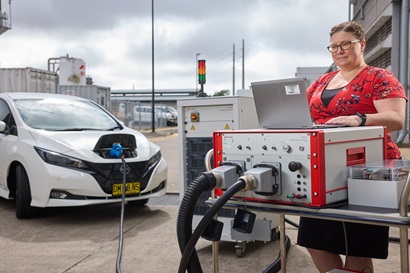
Kate Cavanagh at CSIRO’s Energy Centre in Newcastle, demonstrating the Electric Vehicle Emulator, which can simulate an EV, an EV charger, or monitor charging.
act as “batteries on wheels” to store excess rooftop solar
support grid stability during peak periods
increase solar self‑consumption
help reduce household energy costs
enhance resilience in regional and remote communities
The work has already gained national recognition, receiving the 2025 Energy Networks Australia (ENA) Industry Innovation Award for delivering the first market‑ready CCS2 V2G solution on an Australian electricity network.
The project is continuing to 2029, contributing to the continued development and collaboration that is helping to realise the enormous potential V2G technology offers: a future where millions of EVs collectively provide flexible, distributed energy storage, strengthening Australia’s renewable‑powered energy system.