
After about a year of delays, the Tasmanian government has released its strategic business case for the Greater Hobart Rapid Bus Network, but a lot of the detail has not been included.
No decisions have been made on exact routes or station locations and the start date for construction is also unknown.
It is also unclear how many buses will be needed, where the drivers will be recruited from and how many passengers will be able to travel in and out of the city.
Rapid buses were favoured over light rail along the old rail corridor through Hobart’s northern suburbs. (ABC News: Ebony ten Broeke)
But the business case has confirmed one thing — the project will still be years away, and that’s if the federal government agrees to pay for 80 per cent of it — which is what the state government is hoping for.
How much will it cost and where will it go?
The cost of the project is currently estimated to be $860 million, but it could be more. The government said there is a 50 per cent chance it will cost more than budgeted.
Costs were based on delivery of a northern corridor by 2032, a southern corridor by 2034 and an eastern corridor by 2036.
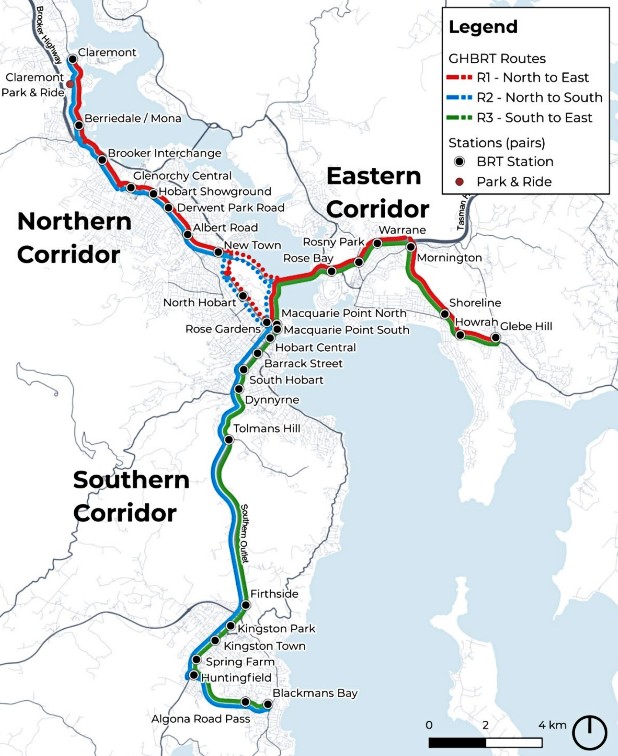
An ‘indicative’ map of the Rapid Bus Network from the strategic business case. Routes and stops not final. (Supplied: State Growth)
The northern corridor will be the first built and include Claremont and Glenorchy.
“The assumed route for the north goes out as far as Claremont, in the east out to Glebe Hill and in the south to Blackman’s Bay,” James Verrier from the Department of State Growth said.
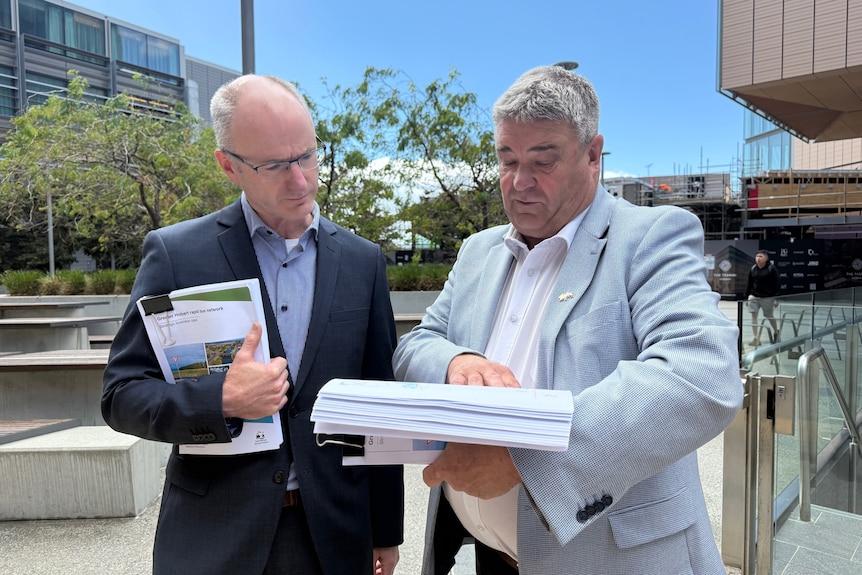
James Verrier (left) with Infrastructure Minister Kerry Vincent. (ABC News: Jessica Moran)
Mr Verrier said the detailed business report, expected to be complete by December, will involve the details that were excluded from the strategic business case.
“Hobart is growing at enormous rates and that’s going to continue,” Infrastructure Minister Kerry Vincent said.
“We need to move people around Hobart for work, for school, or recreation or retail therapy, we need to have a consistent, efficient, and reliable system of moving people in and out.”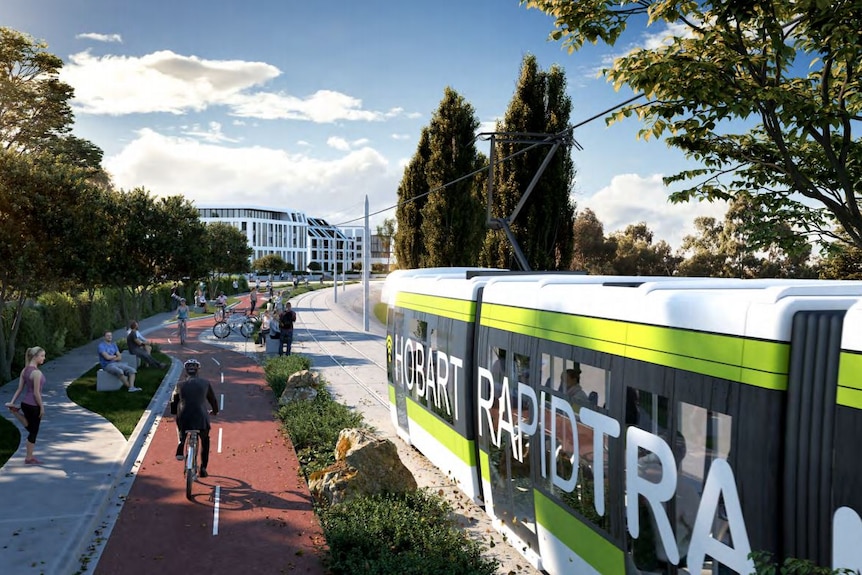
Previous proposals for light rail in Hobart have been discarded by the government as too expensive. (Supplied: Liberal Party)
Will it be built in time to help with transport issues for Macquarie Point stadium?
Minister Vincent said his “ambition” would be that it is.
“We still need to work through a bit of that detailed planning, but certainly over the next few years we’ll be able to stand up with confidence about a start date and time,” he said.
“The projects are still very much in sync … [the Department of] State Growth is very much aware that we need to keep communicating with the federal government for those timelines.
“They’re still within timelines of matching up.”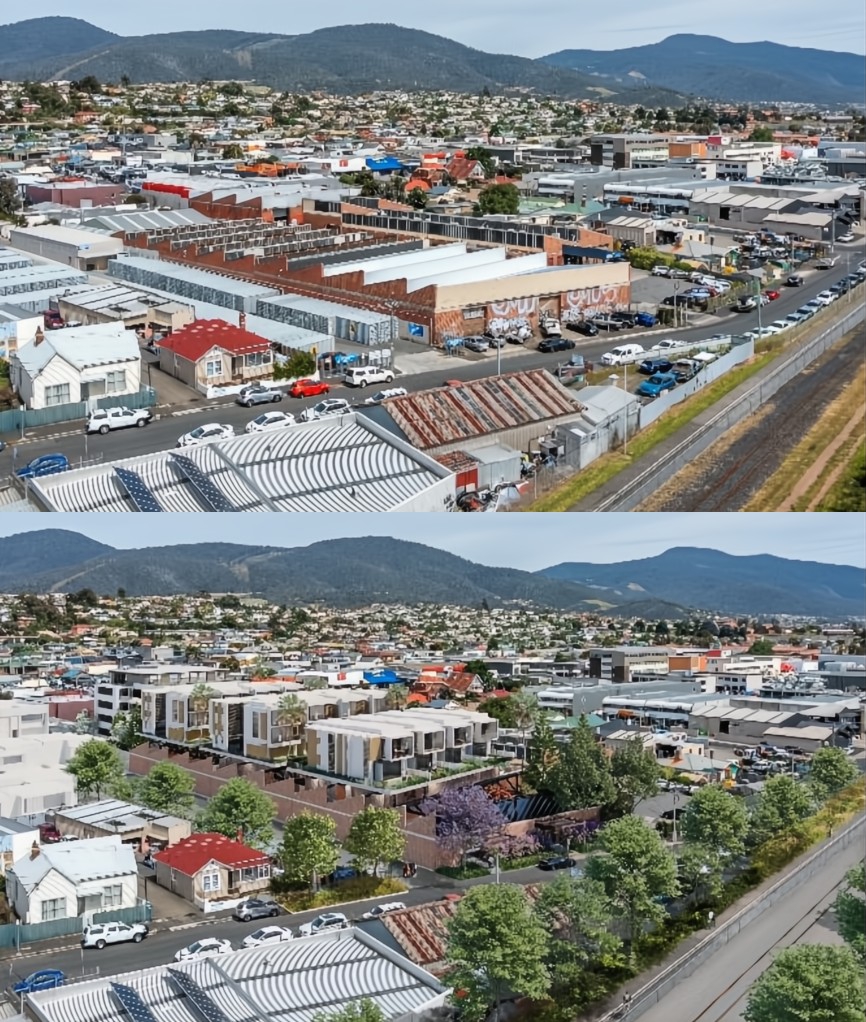
A before and after concept for Hobart’s northern rail corridor showing its conversion to buses, as well as medium-density housing developments along the route. (Supplied: State Growth)
In a statement, the state government said according to the Macquarie Point Draft Precinct Plan from October 2023, rapid buses were forecast to provide 3 to 6 per cent of the transport for major events at the stadium, when fully implemented.
“It is proposed that rapid buses would support transport to and from the new Macquarie Point precinct, in addition to a range of other transport services and infrastructure, including the expansion of ferry services, improvements to walking and cycling amenities, and a combination of existing and event-specific bus services,” the statement said.
Minister Vincent said once the detailed business case is written, it will be presented to the federal government for consideration.