
The union budget this year announced turtle trails along key turtle nesting sites in Kerala, Karnataka and Odisha to promote wildlife tourism.However, conservation volunteers across coastal states report declining turtle nesting.Experts stress that habitat restoration, sustained funding, and community-centred conservation must precede tourism expansion to ensure long-term success.
See All Key Ideas
On a humid morning at Kolavipalam beach in Kozhikode, at one of Kerala’s earliest community-led turtle conservation sites, volunteer Abdul Rahman walks slowly along the fenced hatchery enclosure, scanning the sand for any sign of disturbance. Two decades ago, he recalls, this stretch of the coast regularly recorded dozens of olive ridley nests each season, attracting conservationists, students, and eco-tourists eager to witness hatchlings returning to the sea. Today, months can pass without a single nesting sighting.
Just two days before this, the Union Finance Minister Nirmala Sitharaman announced, in her budget speech, a proposed “turtle trail” tourism initiative along the coasts of Kerala, Karnataka, and Odisha.
“The minister talks about turtle tourism,” says Rahman, looking toward the rock-armoured shoreline. “But first, we need turtles. Almost every night, we patrol the beach and find nothing.”
Kolavipalam once symbolised the success of community-driven marine conservation in Kerala, where local fishers maintained day-and-night vigilance against sand mining that could destroy hatcheries. Fishers here have long used turtle-excluding devices in fishing nets, and hatchery maintenance continues, but nesting numbers have declined sharply.
Why sea turtles matter
Sea turtles play a crucial ecological role in maintaining the health of marine and coastal ecosystems. By grazing on seagrass beds and controlling jellyfish populations, they help sustain marine biodiversity and support fish populations that coastal communities depend on for livelihoods. Nesting activity also contributes to nutrient cycling on beaches, enriching coastal vegetation and stabilising dune ecosystems that protect shorelines from erosion.
Globally, all species of sea turtles are considered threatened or endangered, primarily due to fishing bycatch, habitat loss, coastal development, pollution, and climate change. Because turtles migrate across oceans and depend on multiple habitats throughout their life cycle, conservation success depends on coordinated protection of beaches, near-shore waters, and open-sea ecosystems. Experts say that the decline of turtle populations often signals deeper ecological stress within coastal environments.
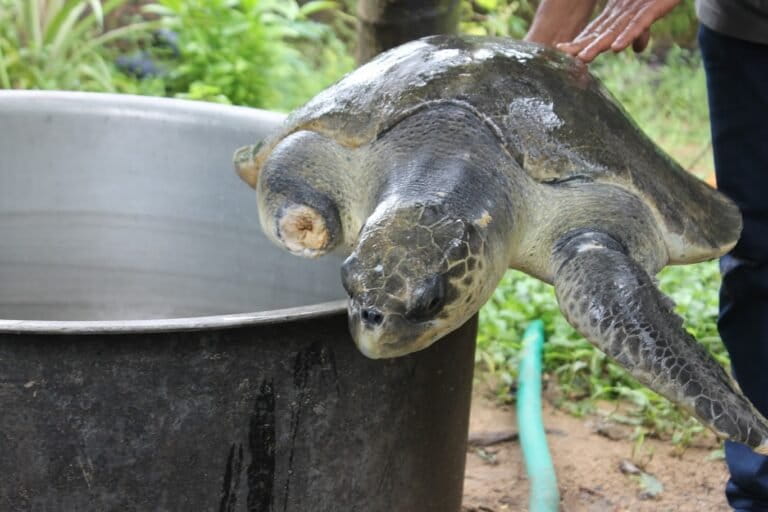 Large aluminium cooking vessels being repurposed at Naithal, a rehabilitation camp in Kasaragod to hold injured olive ridley turtles rescued from fishing nets or shoreline strandings. Image by K.A. Shaji.
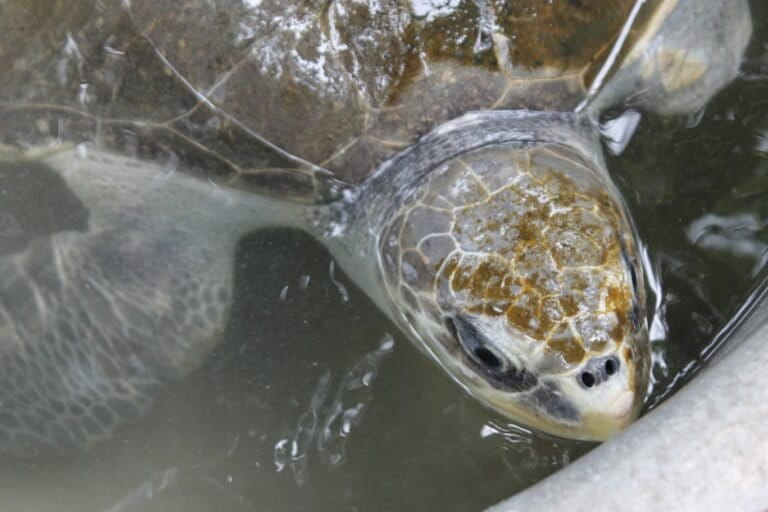 An injured olive ridley turtle undergoing rehabilitation in Kasaragod. Image by K.A. Shaji.
Shrinking nesting habitats along Kerala’s coast
Across Kerala, Karnataka, and parts of India’s eastern coast, shrinking nesting habitats, declining arrivals, coastal engineering interventions, and rising conservation costs are raising serious doubts about whether the ecological foundation required for tourism currently exists.
In northern Kerala’s Kannur and Kasaragod, community hatchery groups echo similar concerns. Volunteers who patrol beaches nightly during nesting season say shoreline armouring, artificial lighting, and coastal construction have steadily narrowed suitable nesting stretches. Seawalls are among the main reasons.
“Earlier, turtles could come anywhere along long open beaches,” said C. Sudheer Kumar, a member of Naithal, a collective in Kasaragod that maintains hatcheries at Thaikadapuram beach and runs a rehabilitation centre for injured turtles. Turtles injured after being trapped in fishing nets or affected by other incidents are cared for until they regain health and are released back into the sea. “Now the beach is broken by seawalls, groynes, and harbour structures. Even if turtles arrive, many places are no longer suitable for nesting.”
Local conservation groups in other parts of Kerala such as Malappuram, Thrissur, and Thiruvananthapuram have expanded their work far beyond egg protection. They rescue, transport to veterinary facilities, and treat injured turtles before release, involving fuel costs, coordination with fisheries officials, and post-release monitoring. Much of the work continues through volunteer effort, informal donations, and occasional support from non-governmental organisations.
According to Sudheer Kumar, maintaining a turtle in rehabilitation requires a minimum of ₹10,000 per month for food alone. “They normally eat sardine and each can eat more than a kg per day. Sardine decline is happening across the region, and so the prices are increasing,” he said. His team is currently caring for four turtles, with expenses largely from their own pockets. He believes the government’s proposed turtle-trail initiative could help if it channels funds directly into conservation, but along much of the coast, the turtles themselves are increasingly absent.
B.C. Choudhary, a leading researcher of olive ridley turtles, warned that “tourism plans assume stable nesting numbers, but that stability no longer exists.”
Further north, along Karnataka’s coast, particularly in Uttara Kannada and Udupi districts, community hatchery programmes have often been cited as conservation success stories. Yet volunteers say sea erosion, seawall construction, urban lighting, vehicular movement and expanding beach tourism have significantly altered the nesting landscape.
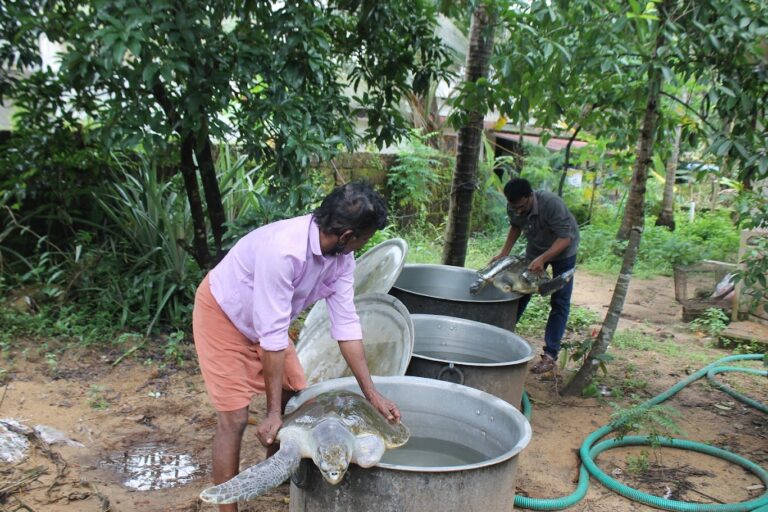 Beyond the protection of turtle eggs, local conservation groups in Kerala also rescue, transport turtles to veterinary facilities, and treat injured ones before release. Much of the work continues through volunteer effort, informal donations, and occasional support from nonprofits. Image by K.A. Shaji.
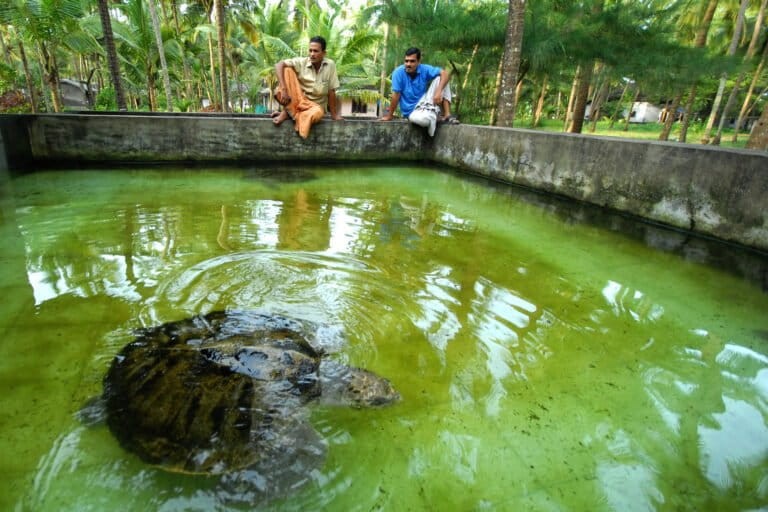 Volunteers share that maintaining a single turtle in rehabilitation requires a minimum of ₹10,000 per month for food alone. Image by K.A. Shaji.
“Tourism must be carefully controlled,” said Prajwal Bhat, a long-time conservation volunteer in coastal Karnataka. “If tourism increases without strong regulation, it can actually reduce nesting success.”
On the eastern coast, Odisha remains home to the world’s largest olive ridley arribada nesting events at beaches such as Rushikulya and Gahirmatha. Even here, scientists urge caution in linking turtle conservation directly with tourism infrastructure.
“Arribada timing is shifting, and climate-driven shoreline changes are affecting nesting locations. Tourism planning must remain flexible and conservation-first,” Choudhary said.
“Tourism revenue cannot substitute for long-term conservation funding,” wildlife activist Biswajit Mohanty said. “The ecological system must be secured before tourism expectations are built around it.”
Mohanty pointed out that speed boats procured to enforce fishing prohibition during turtle mating seasons were lying defunct. “The efforts of the government should have been to put in place a robust enforcement mechanism instead of turning the site into an ecotourism hotspot,” he said.
Conservation before tourism
Across coastal states, turtle conservation already depends heavily on community labour, while financial support remains limited. Hatchery construction, nest relocation, patrols, rescue operations, and rehabilitation require steady funding, yet most programmes rely on seasonal grants or voluntary contributions.
The turtle-trail initiative reflects an important policy shift linking conservation with livelihoods. Yet the ground reality across states suggests that many stretches of India’s shoreline are currently in a habitat-repair phase rather than a tourism-expansion phase.
Standing on the Kolavipalam shore, Rahman, the volunteer watching over the hatchery enclosure says, “If beaches recover and turtles return in good numbers, tourism will naturally follow. But if we build tourism first and the turtles do not come, what will visitors actually see?”
Read more: Climate change to redefine survival strategies for India’s iconic sea turtles
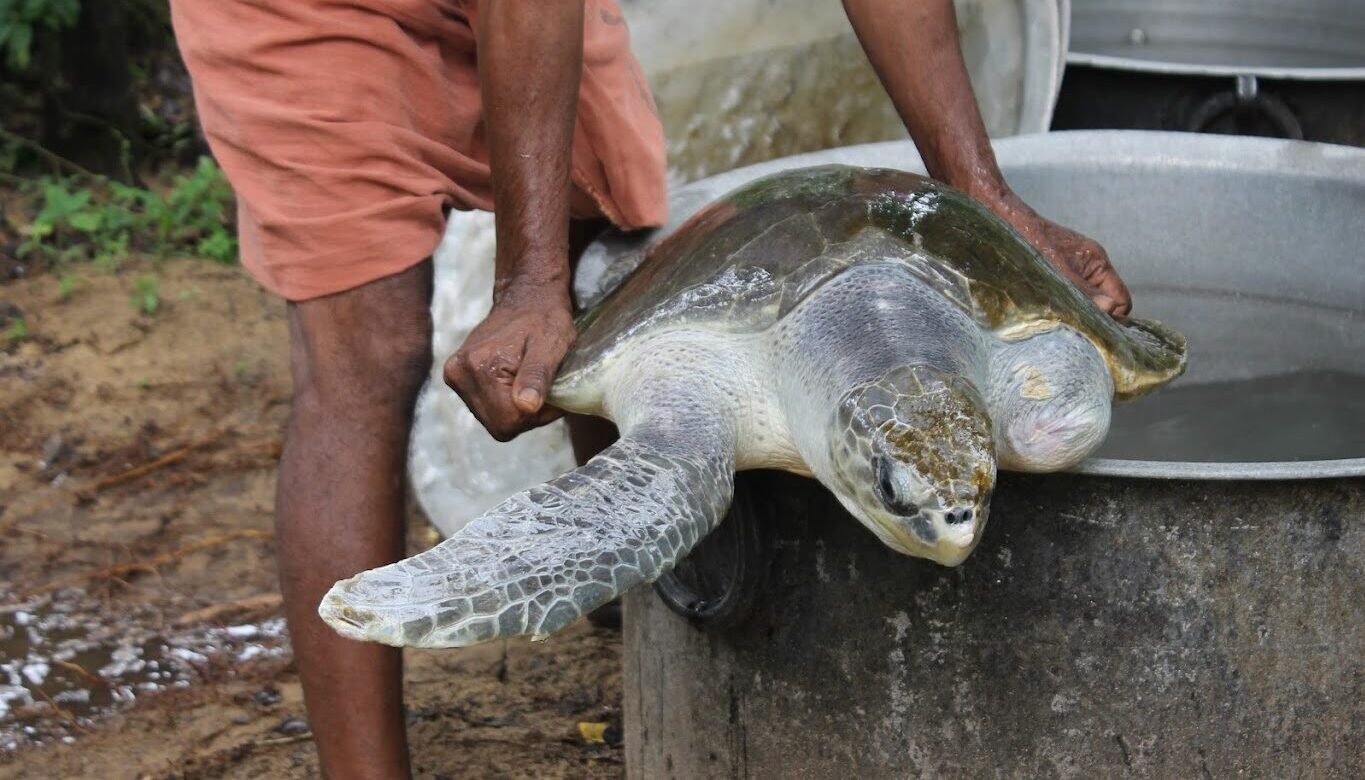
Banner image: An olive ridley turtle in rehabilitation. Across coastal states, turtle conservation depends heavily on community labour, with limited financial support. Image by K.A. Shaji.
