
It’s getting toward the pointy end of pre-season for the Brighton Bombers senior women’s football squad.
Before training, their strength and conditioning coach, Kelley, takes them through a meticulous warm-up: high knees, grapevine and sprints.
“It’s just to prevent injury, mainly,” says Lily, 20, who is sweating after the run-throughs.
“One wrong movement can cause a torn muscle or something like that.”
It makes sense. An injury can derail any athlete’s preparation.
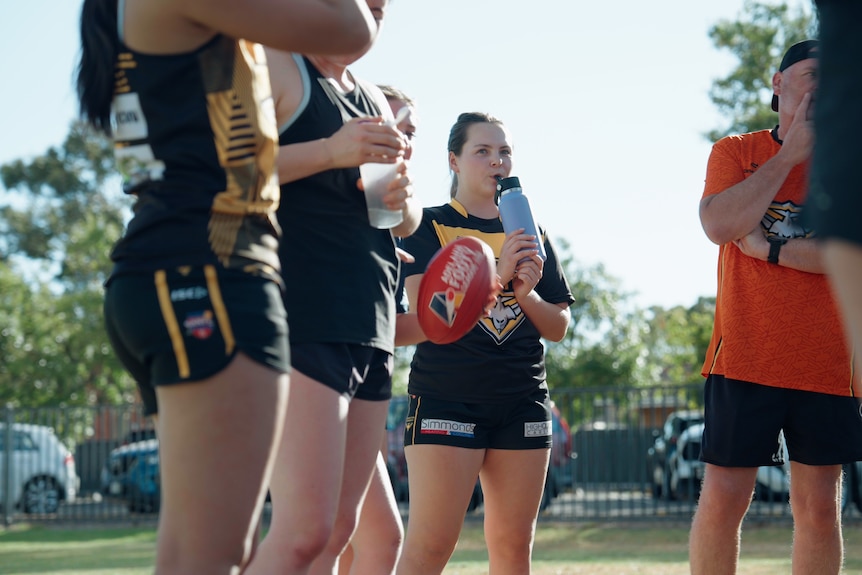
Milla, 17, (centre) says she would wear a helmet if everyone else was. (BTN High: Cale Matthews)
So can a concussion, and repeated concussions can have significant long-term consequences. So what do these players do to protect their heads?
“Nothing, if I’m honest. I’ve never worn a helmet or anything like that,” Bonnie, 19, admits.
“My parents have told me to before because I’ve had a few head knocks. But look, I just think it’s part of the game sometimes, so I don’t really do much to prevent it,” she says.
A potential solution
“We want to achieve for concussion what seatbelts achieved for road safety.”
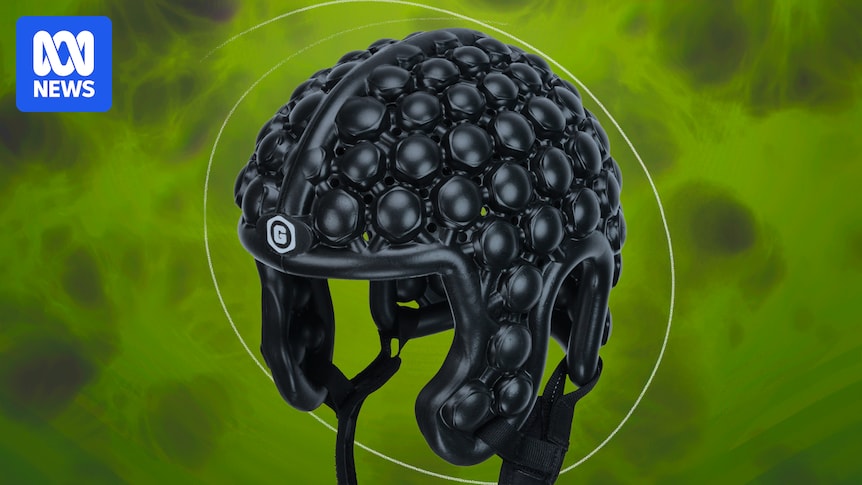
That’s the bold claim made by industrial designer Graeme Attey at the beginning of a promotional video for Australian sportswear company GameGear. In his hands is his latest invention, a helmet specifically designed to reduce an athlete’s chance of getting concussion.

Graeme Attey has designed a helmet aimed at reducing an athlete’s chance of getting concussion. (Supplied: Graeme Attey)
“It was actually back in 2012; it was a game of Friday night footy,” says Attey, reflecting on the origin of his design.
“Two guys just went head to head and down cold, both of them, and I thought, ‘That’s it. This is ridiculous,’ because I could just see that they don’t need to suffer these sorts of injuries.
“If you design a helmet that’s specifically made correctly for football, they shouldn’t be suffering such severe concussions.”
The AFL and NRL’s treatment of concussions has shifted dramatically in the past decade. In 2021, the AFL introduced a mandatory minimum 12-day return-to-play period after a player receives a concussion. This was extended in 2024 to a 21-day minimum for community football.
The AFL and NRL have changed their approach to concussion treatment. (BTN High: Cale Matthews)
Little focus has been paid to prevention, however.
“It’s probably been our biggest frustration all along,” Attey says.
“Initially, there was this issue of all the focus and money and everything … going into what do you do after someone’s concussed? And we were waving our hands saying, ‘But stop the concussions first before you treat them.'”
The result of Attey’s frustration is a helmet made-up of a lattice of connecting spheres that, according to independent testing undertaken at the NSW Crash Lab, can reduce the force transmitted to a player’s head during impact by more than 90 per cent.
“The reason I wanted to use spheres is because they have a progressive resistance to impact,” Attey says.
A concussion is a mild traumatic brain injury that occurs when force is transferred to the brain from a hit to the head or body.
Attey’s helmet is designed to reduce the amount of force that is transferred to the brain.
“What causes a concussion is head acceleration. So what you want to do is slow the acceleration of the head because that’s what is causing the concussion,” he says.
“If you take a circle and then you compress it, when an impact first strikes through the cross-sections of the ball, there’s not much resistance initially because it’s only sort of the peak of the ball, and then as it squashes down and down, it becomes more and more resistant to the force.”
Loading…What does the science say?
Across a range of sports, including Aussie Rules, soccer, rugby union, and a combination of those sports, the science appears settled: helmets are not associated with a reduced risk of concussion.
Attey says there’s a reason for this.
“It all started back in 1993 with World Rugby in the UK deciding that they would allow headgear to be worn in rugby games, but it was to protect the ears in a scrum,” he says.
These guidelines are still in place, and state that the only injuries that headgear should protect against are cuts and abrasions.
“So it actually stipulates it can’t work,” Attey says.
He says many helmets on the market have been made to adhere to these specifications, so it’s no surprise the science says they do nothing for concussions.
“You hear over and over again in the press, people in the medical field saying helmets have been proven not to work. There’s no point in wearing helmets, and yes, it’s true, but they were testing helmets that we already knew didn’t work,” he says.
“So, there should never be a conclusion that because that occurred, therefore, no helmet is ever going to work, because it’s just crazy.
“You know, no-one will get anywhere with that sort of attitude.”
World-first concussion trial approved
While the GameGear helmets have had promising results in a laboratory setting, the next step is to test them in the field.
Over the next couple of years, scientists from Monash University, with support from non-profit organisation Connectivity Traumatic Brain Injury Australia, will study 600 players aged 16 and over who will wear the helmets during elite and community football and rugby games across the country.
The study will look at real-world exposure data, biomarkers and clinical assessments to help determine whether these helmets significantly reduce a player’s risk of getting a concussion.
Adelaide University senior lecturer in exercise science Hunter Bennett is curious to see the results.
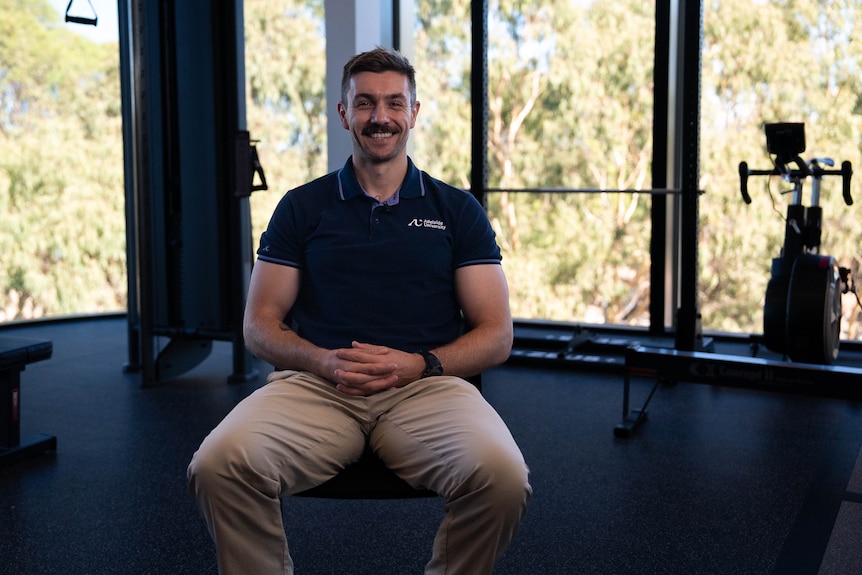
Hunter Bennett says everyone has a different threshold for concussion. (BTN High: Cale Matthews)
“This is actually a really interesting topic of research,” Dr Bennett says.
“What we tend to see in laboratory settings is that those helmets really do a good job of preventing or reducing the amount of force that’s transferred to the skull, and often to a pretty meaningful degree, or what you would think would be a meaningful degree.
“But then when it comes to research out in the field, we tend to see those helmets maybe not having as large an effect on reducing concussion as what we would expect.”
Dr Bennett says hits during a game can be unpredictable, and every individual will have a different threshold for concussion.
“Maybe your force threshold is different to my force threshold. Maybe that force threshold reduces if you experience multiple head knocks in a game,” he says.
“So maybe there’s sort of an accumulated effect where we receive 10 head knocks in a game, and even though not a single one of them is really large, maybe accumulated, those 10 could result in a concussion occurring.
“There’s so many things that occur throughout a duration of a game that just maybe the helmet does prevent some of those contributing factors to concussion, but it just can’t impact all of them.”
Attey says these variables are why the field trials are vital in determining whether his helmets will be an effective strategy in reducing concussion risk.
“Some guys will get a 100g [g-force] hit and be OK. Another guy will get a 60g hit and go down cold.
“We know the impacts will be reduced hugely out there on the field for any sort of head hit, but we just need to know how much overall, at the end of the day … that [will] reduce concussion.”
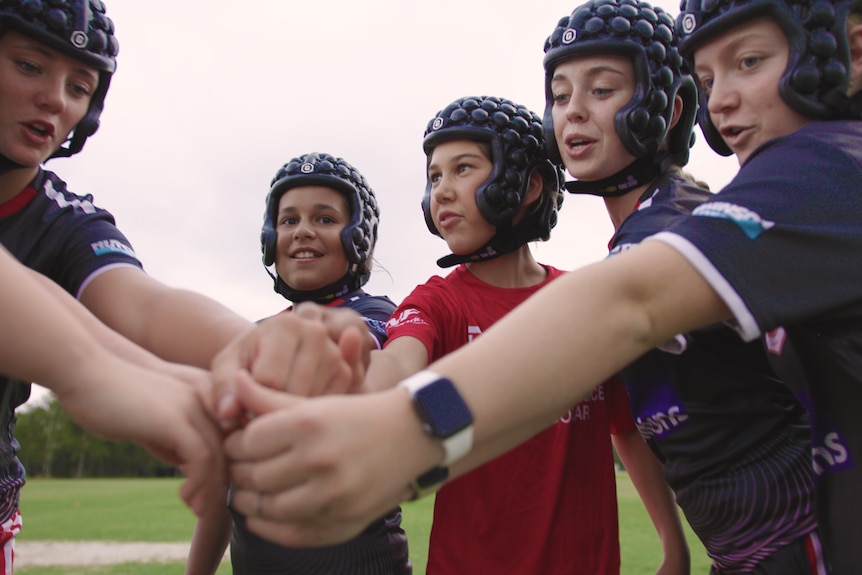
The helmets have a lattice of connecting spheres to reduce the force transmitted to a player’s head. (Supplied: Graeme Attey)
Should helmets be mandated?
If, at the conclusion of Monash University’s study, it is shown that these helmets unequivocally reduce a player’s chance of getting a concussion, Attey says they should be a compulsory part of contact sport.
Subscribe to the BTN Newsletter
“It should be mandated everywhere if it’s proven to reduce concussion because otherwise you can’t say you’re looking after the health and safety of the players.”
Dr Bennett agrees, but with some caveats.
“I think you would have to sort of question if these helmets have a really, really robust effect on concussion,” he said.
“You would almost make the sort of assumption that it’s almost the duty of care to mandate it.
“But then I’m sure there’s also going to be issues around funding, like these helmets aren’t cheap.
“Do players take on that cost? Do parents? What if parents can’t afford it? Then maybe it becomes an equity issue where only those players who can afford to buy these helmets can participate in the sport, and that’s going to have a negative effect from a general health perspective.”
No helmet is ever going to completely rule out a player’s chance of getting concussion, and we are certainly a long way off any helmet being mandated.
But for some of the players at Brighton, it might be the only way they would wear one.
“I would also look into it because I’ve had a few knocks as well and a few concussions, but I don’t think I would wear it straight away,” Sava, 17, says.
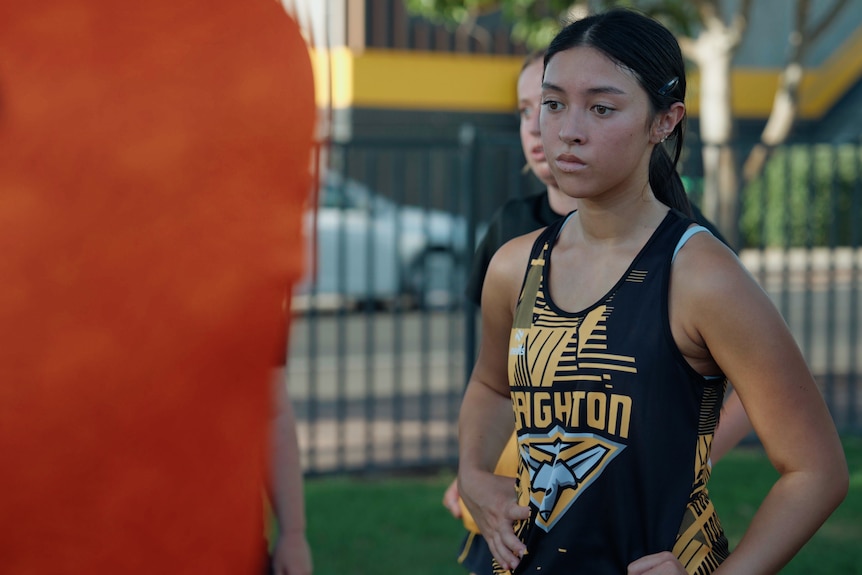
Sava, 17, says she would consider wearing the helmet. (BTN High: Cale Matthews)
“I feel like I’d have to get maybe one more and then be like, maybe?”
“I got concussed in 2021, so then after that, my parents made me wear a helmet for the rest of that season, but I took it off as soon as I could,” says Milla, with notable disdain in her voice.
“It was quite embarrassing, I think, to be wearing a helmet as a girl because no-one else was wearing a helmet, and it’s just, yeah, wasn’t very flattering.
“I feel like if everyone was doing it, I would probably be able to get on board. I wouldn’t feel so isolated.”