
Alagappan Muthu
and
Deivarayan Muthu
Multiple Authors
Feb 20, 2026, 07:59 PM
Mark Chapman openly admits his bias.
“Being a youngster watching the New Zealand team, I took inspiration from the left-handers as a fellow left-hander. I had a Gunn & Moore Purist as one of my first bats. Stephen Fleming was using that, so you take inspiration when you’ve got the same gear as well.”
Chapman has actually come to supply cricket equipment to others, having founded a company called ESCU sports, which specialises in wrist- and arm guards. He is still running it on the side but in the main, he is fighting to overthrow a deeply flawed view that the world has about his kind.
It dates back to the days of David Gower and persists because of Kumar Sangakkara. Rahul Dravid didn’t help when he said, “On the off side there is first god, then Sourav Ganguly.” For the past 12 years, initially with Hong along, now with New Zealand, Chapman has been doing his bit to make people understand that left-handers love the leg side too. And he picked Valentine’s Day to drive the point home.
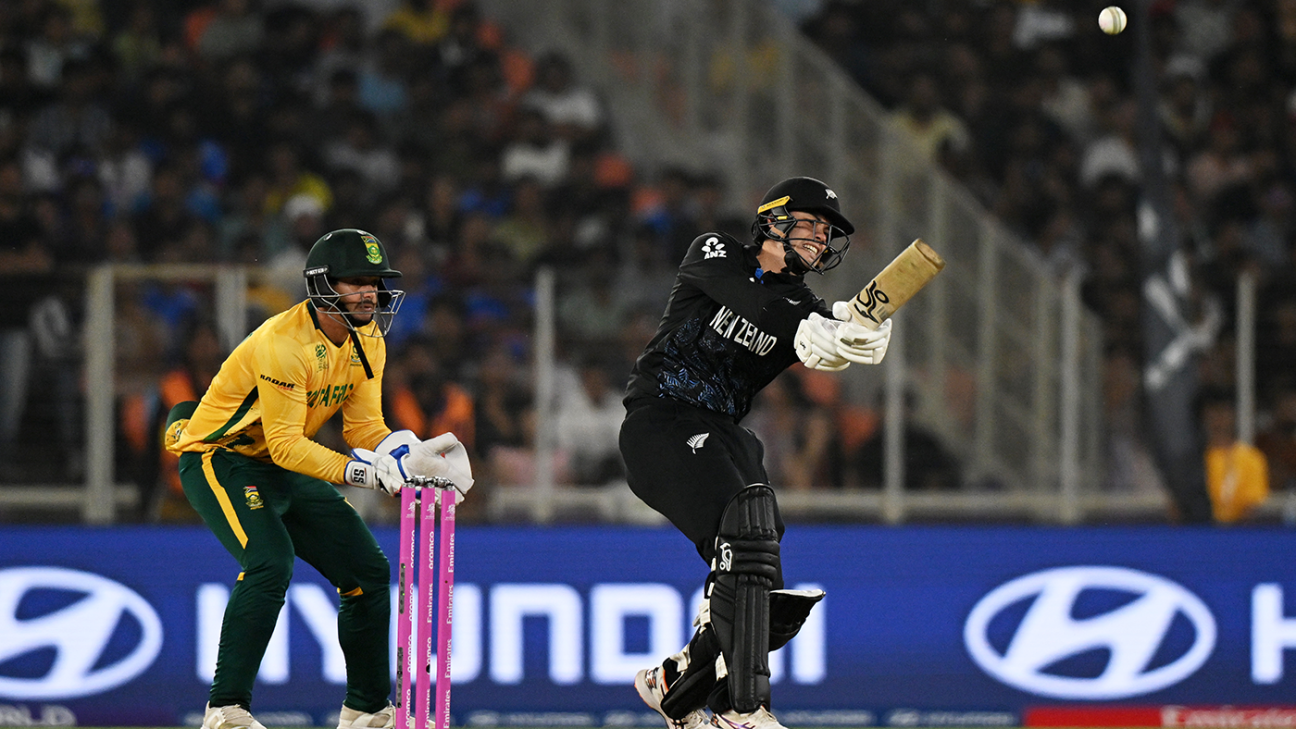
Against South Africa, in a match that didn’t have any stakes, which allowed both teams to go hard at each other without worrying about consequence, Chapman came in at 58 for 3 and raced away to 48 off 26. At one point, he was 19 off 9 and only three of those runs were farmed from the off side.
Stats graphic: Mark Chapman’s T20I wagon wheel ESPNcricinfo Ltd
There is this one shot he plays that starts out of utter stillness. And then a lot of things happen in not a lot of time. The weight transferring onto the balls of his feet. The backlift reaching sufficient height. Super-fast hands bringing it down in a flash. Wrists breaking on impact. Chapman was six balls into his innings when he unfurled it and sent Mitchell Starc 20 rows back in a T20I in Wellington in 2024. Last November, it was Romario Shepherd’s turn to be sent to the stands.
We’ve been calling Chapman’s shot the step-flick, and it follows the grand tradition set by Sanath Jayasuriya, who was almost always in a position to hit one for six over square. “Being a smaller guy, naturally you favour the leg side, I guess. I can take a few lessons off Glenn Phillips,” he says. laughing. “Unfortunately we’re not built the same way. But I guess something I’ve always sort of had is a little bit of bat speed. So you can put on a little bit of size, but it’s about making sure that you maintain bat speed as well, because I guess that’s where most of my power is generated.”
New Zealand leveraged his talent and forged Chapman into a middle-order antagonist. Half the innings he’s played for them have come from No. 5 or lower, where he is expected to put pressure on the bowlers. It doesn’t matter if the match situation is in their favour or not.
He hasn’t quite cracked the role – 54 of his 74 trips to the crease have yielded scores under 30 – but he’s had his moments. Many of them have come against the team he will face to kick off the Super Eight.
Chapman has made just over 1600 T20I runs for the Black Caps and nearly 40% of them have come against Pakistan. Influential people in the PSL still remember the series he had in Pakistan in 2023, when he pulled a second-strength team up from 0-2 down to 2-2. They have bet PKR 70 million (about US$ 250,000) in the PSL auction on him doing similar in 2026. Among overseas picks, only Daryl Mitchell and David Warner bagged a bigger payday.
“It was a really enjoyable tour,” Chapman says. “The things that stand out for me were just how much fun the group had. It was a bit of a different group, those tours, and being without the IPL players, so there were different opportunities for guys to put their hands up. Yeah, I look back on that tour with fond memories – both on and off the park. I took a lot of confidence from that.”
Stats graphic: Most T20I runs against Pakistan ESPNcricinfo Ltd
Growing up in Hong Kong, Chapman started playing cricket on the rooftops of the city. Hey, maybe that’s the origin story of the step flick. Someone probably dared him to hit the ball into the neighbouring high-rise.
There were other sports vying for young Mark’s attention. His dad was good at hockey. “But being left-handed, I sort of struggled a little bit because it’s only a right-handed sport.” At boarding school in King’s College in Auckland, he tried his hand at rugby. “There is this division called weight grade, where you play with guys that are the same size as you. Because I was pretty small, I did that to try and avoid getting injured, but I managed to [get injured] anyway.” So it was back to the bat-ball stuff. It was always going to be the bat-ball stuff. That’s why he was at King’s College in the first place.
“To be honest, when my dad mentioned boarding school, I wasn’t overly keen. I was just enjoying my life in Hong Kong.” Chapman was even semi-fluent in Mandarin. “The first couple of years were a bit of an adjustment. But after that, the opportunities in New Zealand, particularly to play sport, were endless. The opportunities in Hong Kong were great, but my parents were always planning on moving back to New Zealand.”
Chapman met some of his current team-mates on the schools circuit, making quite the impression on Lockie Ferguson. “I was about 15 maybe and he was a big, strong 18-year-old, charging at me. I managed to get one to the boundary. I think probably it would have just been a deflection, using his pace. But yeah, I hit the rope and then bounced up onto his car.”
Chapman learnt the hard way to put more trust in that side of his game. “I’ve had it in the past where I’ve probably gone too far down the hitting route. And you can compromise your basics and your techniques.” Now he relies on his finesse and still maintains a T20I strike rate of 143.2 for New Zealand. That puts him among the quickest scorers the country has ever had; quicker even than Brendon McCullum was over his career. “I think you need your fundamentals and your base in place first. That allows you to then expand from there. Then it’s striking a balance between your conventional batting and then adding your power game as well. Because the two do work together.”
A good Chapman innings almost always involves a lot of aerial hits, because as he says, being on the shorter side makes it easier for him to get under the ball. If he bends his knee enough, deliveries landing in the shorter side of the good-length area become immediately pullable, particularly against spin. Keshav Maharaj found that out last Saturday, when he was launched over wide long-on. That was Chapman’s 39th six for New Zealand against slow bowling in T20Is. Only three Black Caps – Phillips (60), Martin Guptill (59) and Colin Munro (43) – can say they have done better. This is why Chapman is key against Pakistan in Colombo.
A bad Chapman innings almost always involves a soft dismissal. “I’ve always said that in cricket, the outcome stares you in the face,” he says. “Even if you’re feeling really good one day, it might not work out. You might get a really good delivery. Or conversely, you might not have much batting rhythm, but then you get away with it on a certain day. But yeah, one thing that always confronts you is the number at the end of the day. I guess it’s trying to look past that at times and into the actual process as to what’s going in.”
New Zealand tend to trust their players more than many other teams do. Sometimes, as a function of their limited talent pool compared to other nations, it’s harder to get out of the team than to get in. Still, there are specialists for Chapman’s exact role coming through the Super Smash T20s. Bevon Jacobs, 23, is highly rated. Last month, he hit five fifty-plus scores on the trot, although keeping up that kind of form away from home has been a problem. Chapman, 31, will soon be facing competition for his place. But if he’s even half as good at flicking trouble away as he is at flicking a cricket ball, he should be fine.