
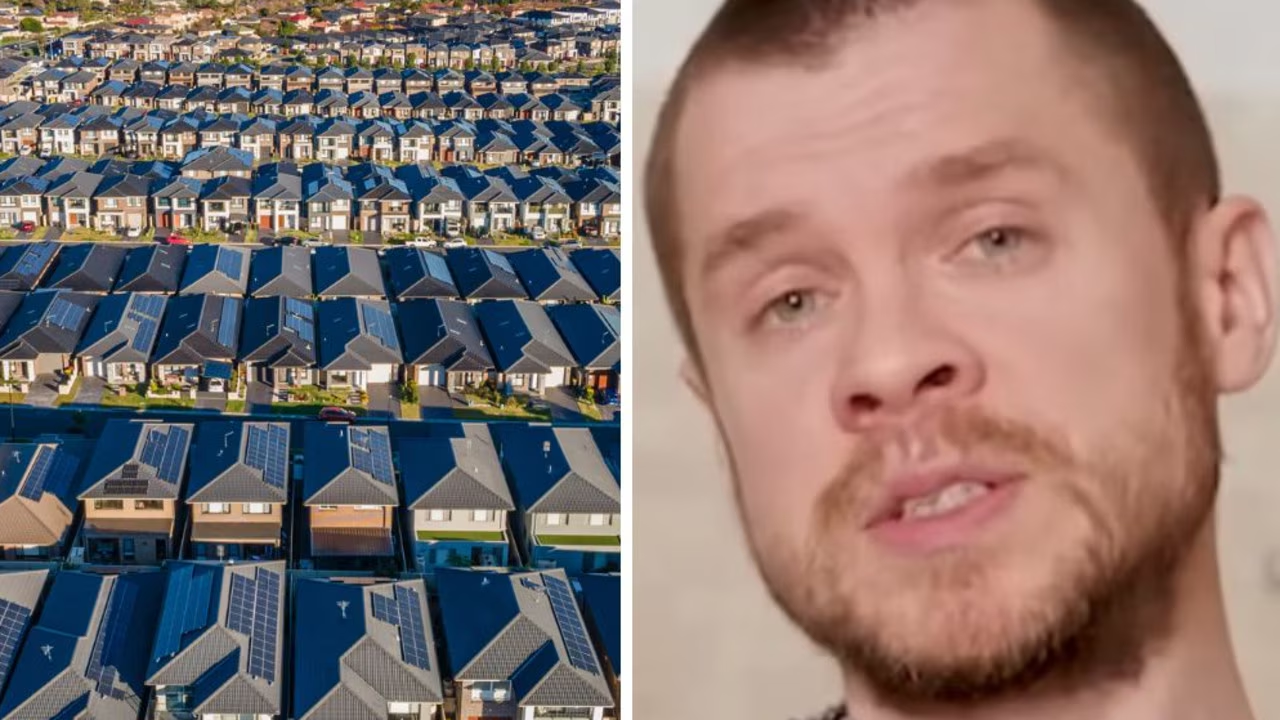
British economist and social media sensation Gary Stevenson is in Australia this month to carry out a mission he’s been dedicated to for years.
A rags-to-riches man, Stevenson built what he describes as life-changing wealth when working as a professional trader during the 2008 financial crisis. The 40-year-old has now turned his expertise into a social media juggernaut, capturing the attention of millions of similarly fed-up millennials who have seen their purchasing power diminish over the course of their lives.
Speaking to the ABC this week ahead of his Australia-wide speaking tour, Stevenson warned that the lucky country risks losing its tradition of “a fair go” as inequality deepens and housing becomes increasingly unaffordable.
“This is a country that tells people it believes in having a fair go,” he said.
“And it is a country which has, for a long time, provided affordable housing and good living conditions to ordinary working Australians.”
His ultimate goal is to reduce the gap between rich and poor, arguing that taxation reform is central to solving the problem. He asserts that modern economies need to take more from the wealthy and less from lower-income earners to help even out the equation without toppling the system entirely.
He also pointed to higher wages and improved housing affordability as essential to restoring living standards and overall morale amongst the next generation of workers.
“I want to come and show Australians what is happening in the UK, what is happening in Europe,” Stevenson said.
“Public services being shut down, poverty exploding.
“That will happen [in Australia] unless we deal with inequality.”
MORE: Most affordable suburbs for 2026 revealed
Despite his growing audience, Stevenson said influencing political leaders is almost futile, mostly because they largely belong to the same tax bracket he’s targeting.
“I think they’re scared,” he said.
“I think they’re kind of stuck in, what we would call in the UK, the Westminster bubble — their little politicians’ bubble.
“They’re scared about their donors.”
Like many other rogue political commentators have pointed out, Stevenson says there is little incentive for the wealthy and politically connected to support genuine reform that makes housing more affordable for first homebuyers.
“See, the problem with an inequality crisis is it feels good for rich people,” he said.
“And most politicians are in that community of rich people.
“Holding the politicians’ feet to the fire, forcing this country to do something about inequality so that your kids and grandkids will have a fair go at having a family and buying a house.
“I think they’re out of touch.”
He is also pushing governments to invest more in research and long-term planning to redesign tax systems to ensure stability continues beyond the lifespans of the currently rich and powerful.
But it’s much easier said than done.
MORE: Aus suburbs that joined the million-dollar club in 2025
“You need to have politicians who are willing to prepare in the long term to fix serious problems,” he said.
“Nobody is dealing with this growing inequality.
“They’re not even starting to deal with how we design the tax [system].
“If you want housing to be affordable, you need to deal with inequality, and you need to have a tax system that taxes the very wealthy more than ordinary working people.”
He says conversations with the political class have largely ended the same way, with many washing their hands of the issue because it’s simply too large a problem to fix.
“The frustration I get is, whenever I talk to politicians, they always say, ‘Listen, that’s too difficult, we’re not ready for it, we don’t have the tax policy in place, we’re worried about the next budget’,” he said.
He pointed to other cities with even larger wealth gaps and warned our leaders to heed the warning signs.
“Go look at Mumbai, go look at Shanghai, and look at what house prices are relative to wages in those countries,” he continued.
”The world will show you very clearly incredibly unequal countries have incredibly unaffordable housing which ordinary people cannot afford.”
Just how bad is it?
Australia’s soaring house prices and unaffordable rents have become so dire that it’s threatening to make the country’s biggest export its own young people.
More than half of Australians aged between 18 and 35 would consider moving overseas for cheaper housing, new Home in Place research shows.
A further 16 per cent say they “definitely would.” That’s because in Sydney, households need to be pulling in over $300,000 per year to comfortably pay off the average mortgage. Of course, that’s after they’ve plonked their life savings on a deposit for the opportunity to be beholden to the RBA for decades.
Analysts are describing the situation as a “national disgrace” as paramedics, aged care workers and nurses find themselves priced out of both ownership and rental markets close to their work.
The latest Anglicare Australia 2025 rental affordability snapshot showed decades of housing mismanagement, with property owners getting tax incentives and essential workers being unable to secure an affordable property.
The report analysed 51,238 rentals nationwide, finding that despite a 13 per cent lift in available properties, affordability remains dire for 16 types of essential workers.
The modelling assumes a single person working full-time on award rates is spending 30 per cent of their income on rent across all property types, including share houses.
According to the report, just 2.3 per cent of ambulance workers can comfortably afford their rent.
Anglicare Australia executive director Kasy Chambers pointed to Australia’s history of encouraging housing as an investment through tax breaks, which had created a monster, but also warned that overall rental supply was falling behind rising demands from recent population surges.
“These results are shocking, but they are also an opportunity for governments to change course and ensure that everyone has a safe, affordable home,” she said.
“The solution is clear. We need tax reform to stop pushing up the cost of housing.
“We need to build at least 25,000 new public and community homes each year – rentals that essential workers can actually afford.
“And we need stronger protections for renters so people are not left at the mercy of an unfair system.”