
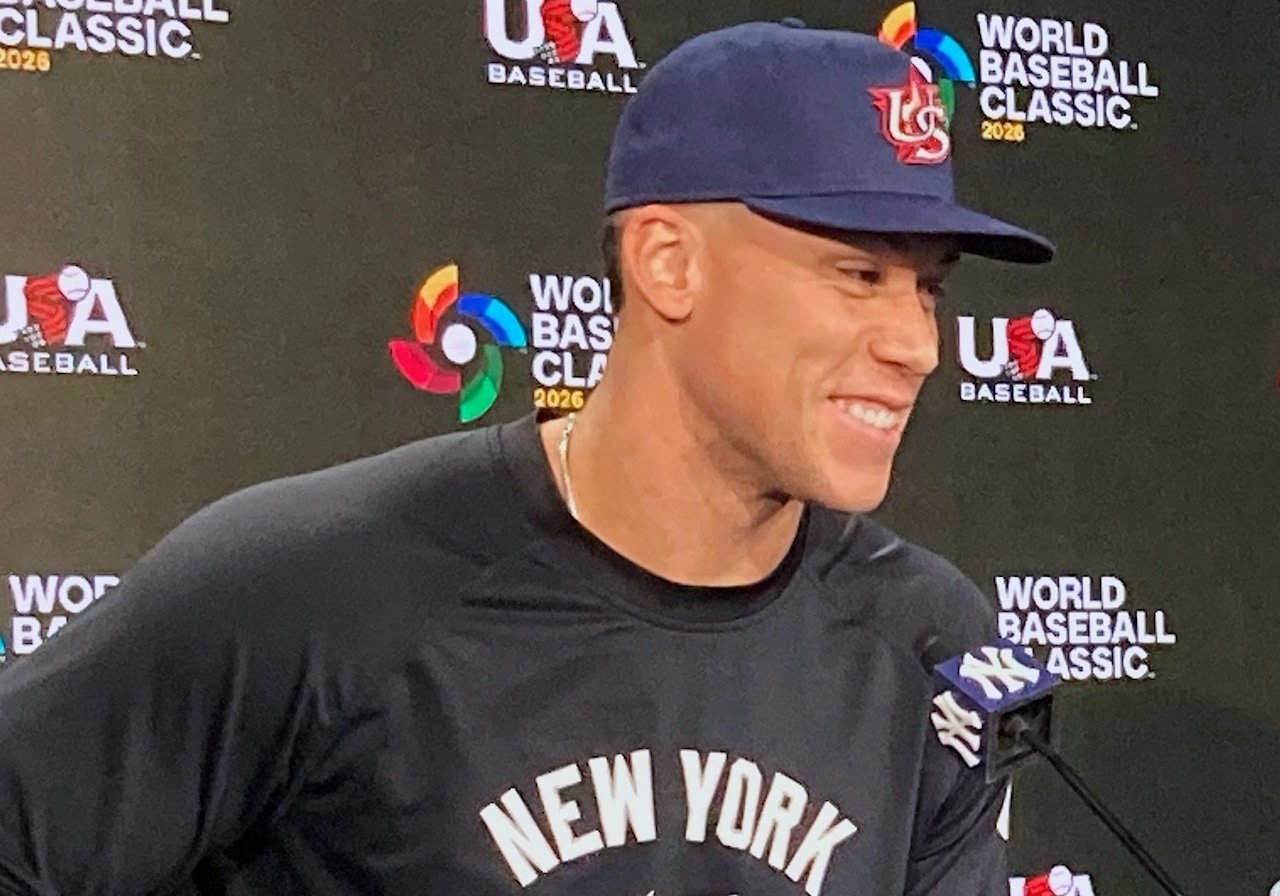
Mark DeRosa laughed Thursday morning when he was asked to describe one of the most remarkable athletic careers in New Jersey history.
“Start at the beginning,” DeRosa said of his own journey. “I grew up in Carlstadt and had an older brother (Kevin) … who went to our local high school and I kind of dreamed of following in his footsteps.”
It was a career that once seemed more destined for a future in football, but now, thanks in large part to the vision of his late father and his love of baseball, has him in charge of perhaps the greatest Team USA baseball roster ever assembled. We’ll find out just how great starting March 6 when Team USA’s journey begins against Brazil at Daikin Park in Houston.
DeRosa could have never dreamed his life would have taken him on this path. By eighth grade, though, it started to become a reality. He wanted to know if he was good enough to be among the best in the state as both a high school quarterback and baseball player. His father Jack was right with him.
“My father was kind of adamant on wanting to see where I stood both academically and athletically in the state of New Jersey, and if you’re going to find that out you’ve got to go up to Oradell Avenue,” DeRosa said.
That’s the street address of Bergen Catholic High School, an elite all-boys school in Bergen County .
The answer couldn’t have been more satisfying. DeRosa emerged as The Star Ledger’s Third-Team All-State quarterback after leading unbeaten Bergen Catholic to the North Jersey, Non-Public A championship in his senior season.
He was also a Bergen County first-team shortstop as a junior in baseball before slumping during his senior season.
He was good enough to play Division I football and baseball, but not good enough to dictate playing both sports.
His father was once again the voice in his head.
“I truly loved football,” DeRosa said. “That was my first passion. But my dad was always adamant about the baseball diamond. That was his first love and he was like, ‘Listen, there’s something special about the way you move out there on the field. I do not want you to give up on baseball.’ I thought I was going to take a football scholarship and take care of my parents that way by not making them pay for school.”
Most schools willing to offer DeRosa a football scholarship weren’t willing to also offer him an avenue to play baseball. The University of Pennsylvania was willing to let him play both, which is why today he also has a business degree from the distinguished Wharton School.
“I didn’t even know what that was when I was a senior in high school,” DeRosa said. “The Ivy League became so interesting because they were willing to let me do both.”
Just as was the case in high school, DeRosa received a lot more attention for his football prowess at Penn. In two seasons as the starting quarterback, he led the Quakers to a 16-3 record, including a 9-0 mark as a sophomore in 1994. He was part of a then Division I-AA record 24-game winning streak.
But by the time his junior year at Penn was over, he was all-in on baseball after being drafted in the seventh round by the Atlanta Braves, who had won the World Series the year before and were in the midst of winning 14 straight division titles.
“I guess it couldn’t have turned out any better than it did,” DeRosa said.
A lifetime in baseball
The odds of the 212th player picked in the MLB draft reaching the big leagues are extremely low. Only 16 of the 61 players selected in that spot since the draft started in 1965 have done it. Only one player — the legendary Bucky Dent — had more hits and played in more games than DeRosa, who finished his career with 100 home runs.
Once his focus changed from football to baseball, DeRosa became a jack of all trades. He played 16 seasons for eight different teams, thanks in large part to his versatility. DeRosa played every position except pitcher, catcher and center field.
“I definitely feel once I signed with the Braves and concentrated on one sport, I got exponentially better quicker than a lot of people thought I might,” he said. “But I never had any reservations about playing both.
“My heart was my heart, and my heart was on the football field. I loved everything about it. I think it helped me in baseball as far as being mentally tough and allowing me to create clubhouse chemistry. I felt like I brought a football mentality to the baseball diamond, so playing both sports ultimately benefitted me.”
By 2006, his second season with the Texas Rangers, he was an everyday player without an everyday position. He started 132 games that year at seven different positions and hit .296 with 40 doubles, 13 homers and 74 RBI.
He never made an All-Star team, but in 2009, he was chosen to play for Team USA in the second World Baseball Classic.
“I was blown away that I even got the phone call,” DeRosa said. “I got to be a BP (batting practice) group with Derek Jeter and David Wright and Jimmy Rollins. I was just kind of in awe of being around those guys for three weeks.”
He played like he belonged, hitting .316 with a double, triple and home run. His nine RBI led Team USA and were the third most in the tournament. The team lost to eventual champion Japan in the semifinals.
“The tournament was in its infancy stage then,” DeRosa said. “It was more like, ‘What a great opportunity to represent your country and be around the game’s greats and get away from the monotony of spring training for three weeks.’ That’s how I think it was viewed.”
Scratching the manager itch
DeRosa’s big-league career ended with Toronto after the 2013 season, but it didn’t take long for his second act to take hold at MLB Network, where he has now been for 13 years.
He admitted, however, that his passion for being on the field never left him and he relished the experience of managing Team USA three years ago so much that he openly campaigned to do it again this year.
“I’ve always had (the managing bug),” DeRosa said. “I didn’t think about it much as a player, but I was raised by my dad to watch the game like a manager. I played the game kind of like a manager. I was always interested in who was coming from the (bullpen) and who was pinch hitting and all the intricacies of the game. But it wasn’t something I always thought about doing. It just kind of happened organically that I’ve come down this road and now I’m super intrigued by this tournament.”
After Hall of Famer Jim Leyland led Team USA to its first and only WBC title in 2017, DeRosa took a collection of star MLB players back to the championship game in 2023. Team USA lost that thrilling game 3-2 to Japan with the tournament ending in an epic matchup between Shohei Ohtani and Mike Trout, who at the time were teammates with the Angels.
DeRosa told his players that they needed to match the intensity that countries like Venezuela, the Dominican Republic and Japan have shown during the WBC.
“It’s tough to show that every day over the course of 162 games, but in a three-week period you kind of have to do that,” DeRosa said. “You have to let your guard down and let it all hang out. I wanted to convey that to our guys. I think in a tournament like this it can only grow the game.”
The Olympic dream
The WBC has taught us that the rest of the world can play the game, too. Japan has won three of the six tournaments.
“There’s just a massive respect for the way they go about it,” DeRosa said. “Their attention to detail, but also just the super talent they have. Shohei is arguably the greatest player we’ve ever seen and what I watched (Yoshinobu) Yamamoto do last year in the postseason is the stuff of legend.”
DeRosa, however, is more concerned and perhaps impressed by his own roster, which he helped construct this time around.
“I think we focus on ourselves,” he said when asked if Japan had become the Team USA rival to beat. “I love the team that we have. Whoever gets in our way, I’ll have respect for them, but I plan on going out and beating them.”
The roster construction this time around started with Aaron Judge, the Yankees superstar. This will be Judge’s first WBC experience.
“We wanted him in 2023,” DeRosa said. “He was a free agent at the time, and he thought it would have been too much to deal with, but I knew had interest. And then last March when Andy Pettitte (as a Yankees instructor), he just texted me and said, ‘Hey, 99 just mentioned the WBC again, you might want to give him a call.’ ”
DeRosa left Judge a voice mail.
“Obviously if we’re building a dream team here for 2026, you’re the first call,” he told Judge. “If you’re interested in doing it, no pressure, but just give me a call back.”
DeRosa, a lifetime Yankees fan, said it was a “pinch-me moment” when he sat next to Judge at Yankee Stadium to announce him as the captain of Team USA.
“I was thinking about my dad who we lost in 2012 and my grandfather and how we watched every Yankees game when I was growing up as a kid. I went to probably six games a year. Don Mattingly was my guy. I’m up there thinking, ‘If my dad could see me now.’ Huge, huge chills.”
DeRosa is hoping this WBC leads to an international competition of the best players in the world in the 2028 Olympics in Los Angeles. In that scenario, the big-league players will be in mid-season form and the best starting pitchers in the game will be able to compete.
“Yeah, I think that’s where this thing goes,” he said. “I do believe if it could be moved to the middle of the season that the parent clubs would have less trepidation about their pitchers being involved. I also think guys would be more fired up to do it and you’d be getting the best version of them.”
As for DeRosa’s own future, it will be interesting to see if he remains at MLB Network or decides that it’s time to become a full-time manager in the big leagues.
“I’ve never been a guy who has looked too far into the future,” he said. “I just put my head down and whatever drives me is where I’m at. My son (Brooks) is a sophomore in high school (in Georgia) right now and he’s a really good ballplayer, so I love getting to see him play as much as possible.”