
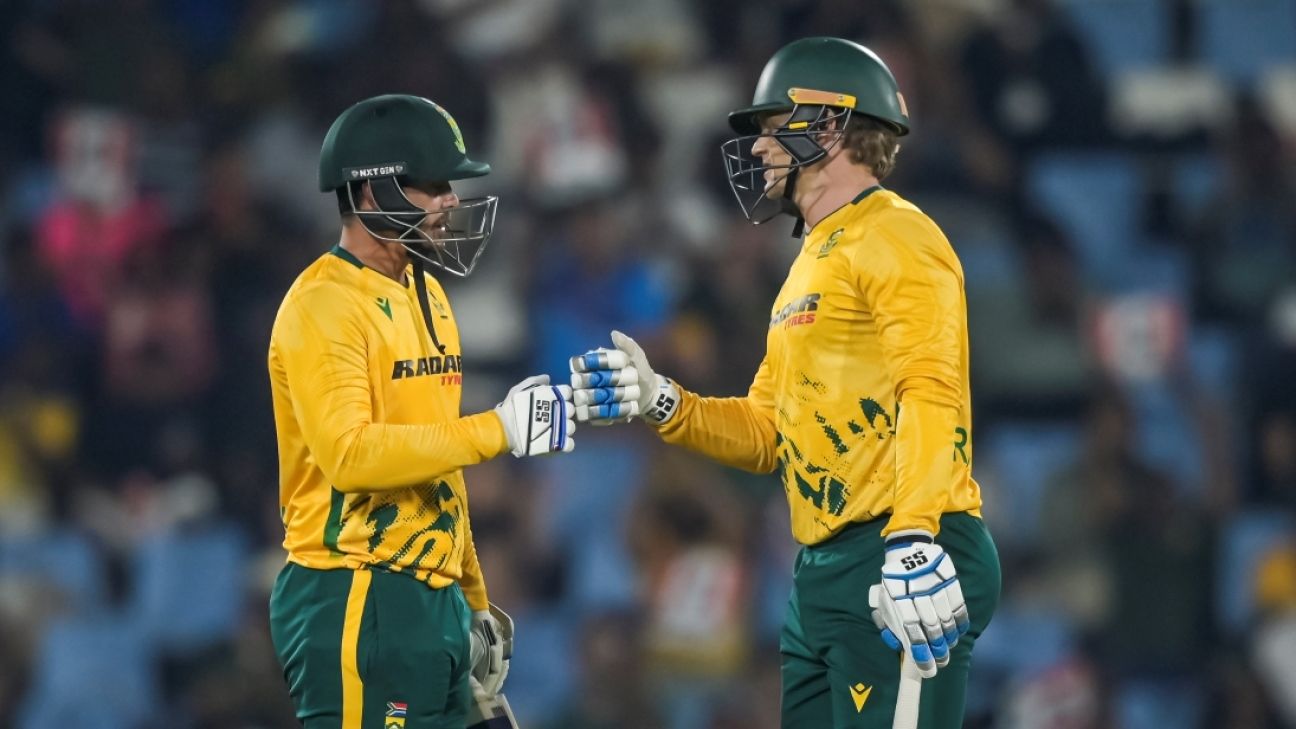
Some things in cricket seem to depend on physical skill or complicated calculations, others appear more instinctive, as though the person doing them was born with the blueprint.
In the madness that was the South Africa-Afghanistan game, Quinton de Kock pulled off one of the latter. Don’t remember?
Afghanistan were 121 for 4 in the 13th over, chasing 187, and you couldn’t cut through the tension in Ahmedabad with a hacksaw. Azmatullah Omarzai hit the ball to point and was watching it to see whether he had evaded the fielder but his partner, Darwish Rasooli, had already taken off for a run. Rasooli was more than halfway down when the throw came to the striker’s end and with both batters lurking near de Kock, he was unlikely to get a dismissal at his end. While he seemed to be casually collecting the ball, de Kock fired it at the non-striker’s where Keshav Maharaj ran Rasooli out. South Africa had their breakthrough.
Editor’s Picks
“You can’t teach that. You can’t prepare someone for those little competitive magic moments,” Kruger van Wyk, South Africa’s fielding coach who was also a wicketkeeper, told ESPNcricinfo. “He’s just got that naturally. “
There are many things de Kock can do that people say simply can’t be learnt. He is, in the words of South Africa’s head coach Shukri Conrad, “an enigma,” a wonderful complexity of natural talent and acquired skill that even he struggles to explain.
“To be honest, I don’t really know,” are the seven words de Kock uses most often in press engagements, and he says them honestly. He just does not know how to explain what is essentially gut feel, now enhanced by muscle memory over 14 years as an international cricketer.
Even more remarkable is that after he took a 15-month sabbatical between the 2024 T20 World Cup final in Barbados and October 2025, he has played less and got better. In 14 T20Is since his return, de Kock has scored 448 runs, including a century and three fifties, at a strike-rate of 167.79, significantly higher than his career strike rate of 142.01. Take away the five games where he was still finding his feet and the strike rate is up to 173.75.
Add the value he provides as a senior player, a mantle he seemed to accept at the latest SA20 where he was part of the champions Sunrisers Eastern Cape squad, and de Kock is arguably South Africa’s leader without the title (and remember there was a time when he was captain between 2019 and 2021 and hated it). Now, freed from some labels and seemingly also expectation, de Kock has found a new voice.
While it’s common to see a wicketkeeper directing traffic, de Kock does it with a conviction that seems contrary to his reluctance to lead. It also shows a different side of him; the side that South Africa is tapping into more. “Quinny has got fantastic cricket intellect. He’s always open-minded, and he’s always open to share some of his thoughts, his feelings and ideas and he’s got such a great feel for the game,” van Wyk said. “He’s got a lot of respect from the players too. I bounce a lot of things off him, and together with Aiden (Markram) and all of the coaching staff, we come to some important decisions. He’s always willing and open to share because he’s got so much experience.”
Despite Markram’s excellent form in this tournament, de Kock is the batter that South Africa’s line-up is built around. Against Afghanistan, he scored 59 off 41 balls and shared a 114-run second-wicket stand with Ryan Rickelton, to set South Africa up for a big score. Rickelton’s role is also interesting as he top-scored with 61, but he would not have played if South Africa’s original plan involving de Kock had come to fruition.
Quinton de Kock and Ryan Rickelton put on 162 in just 72 balls Gallo Images/Getty Images
The selectors have maintained that Rickelton, a left-hand opener and wicketkeeper, was competing for a place with de Kock, and he was left out of the original squad with Tony de Zorzi picked as the No.3. Rickelton was recalled only when de Zorzi failed to recover from a hamstring injury and he has since been asked to adapt to No. 3. With de Kock also playing ODIs again, Rickelton could lose his place in South Africa’s 50-over squad too, and also with Mumbai Indians, who acquired de Kock at the 2026 auction.
Rickelton, however, is seeing this trip as an education and, as much as we say de Kock has unteachable skills, Rickelton is learning. “Quinny just has this aura about him. He has a presence. He doesn’t really make a lot of noise behind the stumps but we all know where our eyes are going between him and Aiden,” Rickelton said after the Afghanistan game. “It’s just the sharpness of the game, what he sees from behind the stumps, the words he gives in the team chats or when there are drinks or wickets. He actually runs things a lot more than you think … We can all learn a lot from him just about how in tune he is with the game.”
And, especially in tune with the Indian game. India is the opposition de Kock has played against the most in T20Is (along with West Indies) and the country he has played more T20Is in, other than South Africa. Eight of his 19 T20I fifties have come in India. Against India, in India, de Kock has batted 11 times and scored six fifties. There’s no doubt he thrives in these conditions against this opposition, and with South Africa’s Super Eight campaign starting against India, there’s no-one else they’d rather have in their camp.