
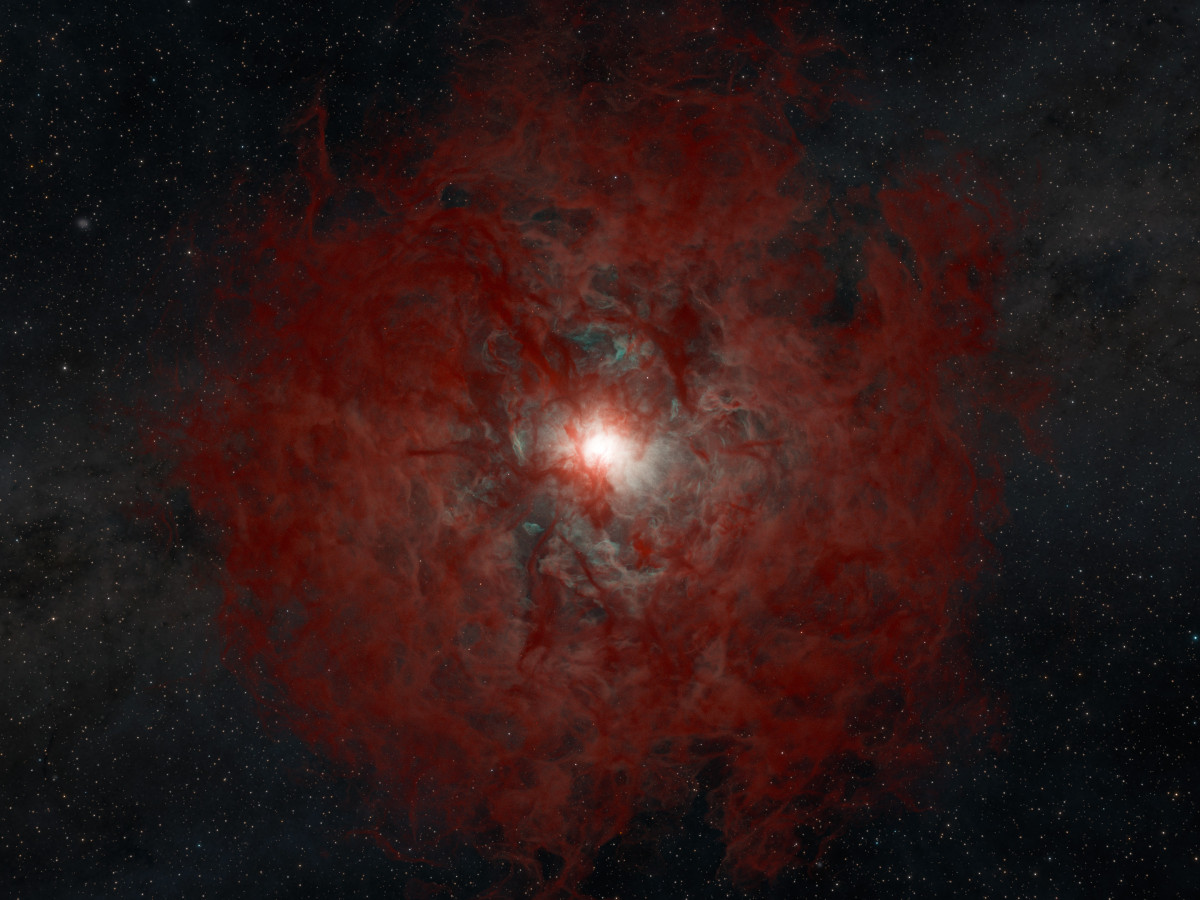
As stars approach the ends of their lives and run out of fuel, their core becomes unstable and it eventually collapses; if the star is large enough, this – we thought – triggers an explosion called a supernova; and, when this happens, the outer layers of the star are blown to smithereens, it gets very bright and hot, and then the core implodes to form either a black hole in big stars, or a neutron star in slightly smaller stars. Theory does allow, though, that the supernova event in some stars might “stall” through a lack of momentum, leading to the star skipping the supernova event entirely and immediately collapsing into a black hole. Now Kishalay De at Columbia University, gazing at a bright star in the nearby Andromeda Galaxy, has spotted this happening for the first time, and he tells Chris Smith all about it…
Kishalay – What we see is evidence of a star that used to be alive in our nearest galaxies called the Andromeda galaxy. It’s about two and a half million light-years away, and what we saw was evidence of a star that has been around for the last four decades, as far as we can tell, and around 2015 or so, it started to disappear in the light that it emitted. And so much so that in the next five years, by 2020, the star that was clearly there for many decades, essentially disappeared into darkness and what we can tell from our observations is that the star must have essentially died in that time period, and as it died, all the light that it was producing disappeared and we can no longer detect it today.
Chris – And the critical question then must be how big was that star to start with? So how can you get at that, and what’s the answer?
Kishalay – Yeah, so the thing to keep in mind is that stars, even the Sun, all of these stars, they produce their light because of nuclear reactions going on very close to their cores. So every star is essentially a nuclear reactor in its centre. So whenever you can measure how bright a star is, you can essentially relate that back to how big the nuclear reactor must have been at its core to be able to essentially back calculate how heavy the star must have been, how much nuclear material must there be inside the star to produce the amount of light that we are seeing. So based on those calculations, what we can tell is that this star must have started off as a star that was about 13 or 14 times the mass of the Sun. But by the time it underwent this death that we see from 10 years ago, the star was left behind with a mass of about five times the mass of the Sun, and this is something that we commonly see. Even the Sun loses every year some part of its own mass.
Chris – Is the unusual factor here then that, unlike what the textbooks tell us, where big stars of that sort of size, beyond that sort of size, would normally end their lives with a big explosion that would make them very bright, and you’d have seen that, this one just sort of diminished down to nothing and disappears. And so it suggests there’s another endpoint for big stars, which doesn’t have to involve an enormous explosion, a supernova.
Kishalay – Exactly. So again, going back to the conventional wisdom that astronomers have had, is that stars that are more than about 10 times the mass of the Sun, they must undergo these catastrophic deaths. Historically, these catastrophic deaths are marked by supernovae, and each individual supernova explosion can outshine its entire galaxy for a few weeks. But it’s always also understood that some of these are probably not undergoing supernova explosions, and instead collapsing inward because of gravity and turning into black holes. Except, finding those individual stars disappearing is a remarkably difficult task.
Chris – You don’t think that there was another star that had already turned into a black hole sitting next to it, and it somehow got close enough to just get eaten, and that’s why the light disappeared?
Kishalay – No, that’s an excellent hypothesis. This is something that’s discussed quite widely, but we think you’d first have to have a black hole that’s right next to it, and you’d somehow have to make it fall into a collision course into this star for it to sort of eat it directly. So I think in terms of the probabilities, I think it’s unlikely that something like this happened, but you’re right in that if this did happen, then it might produce a signature that looks similar to a star just disappearing into darkness.
Chris – How do you account for what you found? If we assume that it’s not eaten by a black hole or something like that, this star has genuinely, of its own volition, got to the end of its life and collapsed into its own black hole. Why did that star behave like that, whereas other stars of equivalent size, do have a humongous explosion that we can see for weeks?
Kishalay – Yeah, this is really one of the most important questions in astronomy today. So far, the majority of the work in this direction has been theoretical. So what we think and what is fairly well appreciated in the field today is that at the end of the star’s life, what is happening is that this nuclear reactor in the centre of the star has suddenly run out of fuel. It is no longer able to hold the star against falling against its own gravity. The traditional picture is that during this process, there are these subatomic particles called neutrinos, and these neutrinos are responsible for pushing out the rest of the star against falling in because of gravity, and that essentially produces what we see as a supernova. Now, why these neutrinos are able to do it and how that mechanism plays out is a big uncertainty. But what we do know is that there are situations in which, because of somewhat randomness, in which neutrinos can interact with real gas and the way it interacts with gravity, this supernova essentially fails to explode, in which cases one might expect that they would turn into black holes. There are essentially a few different channels in which this can proceed. One is that in many cases, we have direct evidence that when a star does blow up at the end of its life and produces a supernova, it actually leaves behind these things that we call neutron stars. So neutron stars are objects that are very massive. They can be about one and a half times the mass of the sun, but except there, all of that mass is concentrated in the size of a city like New York, maybe 15 kilometres wide. The other option is you can have a supernova explosion that also leaves behind a black hole. Or you can have the third possibility that a star doesn’t explode at all, and it just collapses into itself and leaves behind a black hole. I would say that in terms of our understanding of which stars undergo which process and how common each of these processes are is pretty much up for debate right now.