
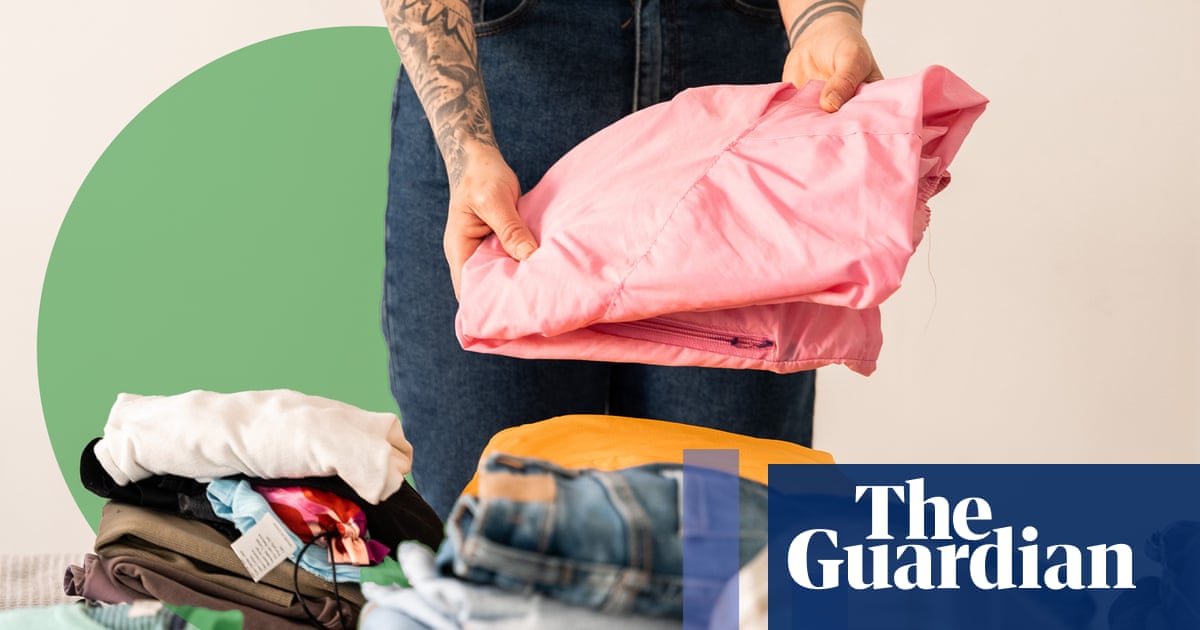
Wardrobes across the country are heaving with clothes as Australians purchase more new and secondhand items than ever before.
About 1.5bn items of new clothing were bought nationally last year – equivalent to 55 new garments per person – a report by Seamless, Australia’s clothing stewardship scheme, found.
Nationally, about half of unwanted clothes end up in landfill (53%), another 38% are reused locally or exported and 9% are recycled.
Reuse and secondhand sales are increasing, but not fast enough enough to stem the tide sent to landfill, equivalent to 229,000 tonnes annually.
According to Ainsley Simpson, the chief executive officer of Seamless, “normalised” overconsumption of clothing is already locking in a climate and water footprint that is out-of-step with a sustainable, circular future – contributing to about 14.5m tonnes of carbon emissions and consuming the equivalent of 1.8bn tonnes of water.
How best can we clear closet clutter without adding to landfill?
Eat your clothes?
It’s a complex problem that one New Zealand label has been unpicking and solving piece by piece.
Kowtow has spent years eliminating plastic and petrochemicals from its garments – not just fabric, but trims too, including zips, buttons and polycotton thread. They either remove them in design or have switched to recyclable or natural alternatives.
Now the ethical label is addressing what happens to its clothes at the end of their life.
“We made a really bold decision to go entirely plastic free with every single part of our production,” the label’s founder, Gosia Piatek, says. There are already repair and resale services that extend the life of each item. “The final step is to regenerate.”
A first for the fashion industry, Kowtow is turning its textile waste into biochar, a process that converts organic waste into charcoal which can be used to enrich soils.
It relies on the clothes being organic and free from plastic; when items are returned, any trims are removed and reused as part of the repair program. So far the scheme has turned a tonne of textile “waste” into a useful resource.
“In our workroom, we mix it with soil to grow tomatoes. This idea that we can now eat our clothes is pretty revolutionary,” Piatek says.
“By unmaking what we’ve made, we give back. This isn’t the end of a garment’s life. It’s the start of something bigger – a future where fashion becomes a force that restores, not extracts,” Kowtow’s head of sustainability, Tessa Bradley, says.
Re-wear, repair and share
Many people remain confused about what to do with their unwanted clothes.
According to Seamless’s stats, about 5.27bn items of clothing are stockpiled in people’s wardrobes, which equates to 193 items for every Australian. Another survey, led by RMIT, found most Australians owned clothes they had not worn for a year and a third hadn’t touched half of their wardrobe.
“First, choose to re‑wear, repair and share where possible,” Simpson says. “This includes donating good-quality items to established charity and resale networks to extend the life of garments and reduce the demand for new clothes.”
Charity stores are grateful for generous donations that help to raise funds for people in need, provided the clothes are clean and in good nick.
Matt McMahon, a specialist manager of customer experience at Salvos Stores, says: “A helpful guide is that if something is good enough to give to a friend then it’s probably good enough to donate.”
Where can I recycle?
Textiles have the lowest recycling rate of any waste material at 5% – mainly carpet recycling – the latest federal government data reveals. Australians produced an estimated 33kg per person in textile waste, with clothing making up the largest component.
Tailored recycling schemes remain relatively niche.
In South Australia, a collaboration between state and local governments as well as charity partners led to a series of statewide “set your clothes free” collection drives for unwanted clothing, footwear and linens in any condition. Almost 20 tonnes of unwanted textiles were recovered for resale and recycling at a single event.
Increasingly, Australians can also access pilots funded by Seamless, including postal return satchels (being led by Australia Post and R.M. Williams), workplace collections, charitable collaborations and local textile recycling hubs.
Some organisations also offer home collection services.
How can we change the system?
Julie Boulton, a sustainable fashion consultant, says: “We need to get rid of the idea that clothes are disposable items. They are not.”
System-wide changes are needed, she says, which includes holding producers responsible for what they put on the market and preventing clothes being made from environmentally damaging materials.
“We don’t need all of the stuff that is being made, a lot of which then becomes heavily discounted – forgetting about the true cost of making clothes – or sits unsold and unused.”
People purchasing clothes, often at the end of a long and unsustainable value chain, can be more considered in what they buy, and repair and reuse where they can.
Focus on what you need, rather than what you want, she says. “Don’t buy on impulse.”