
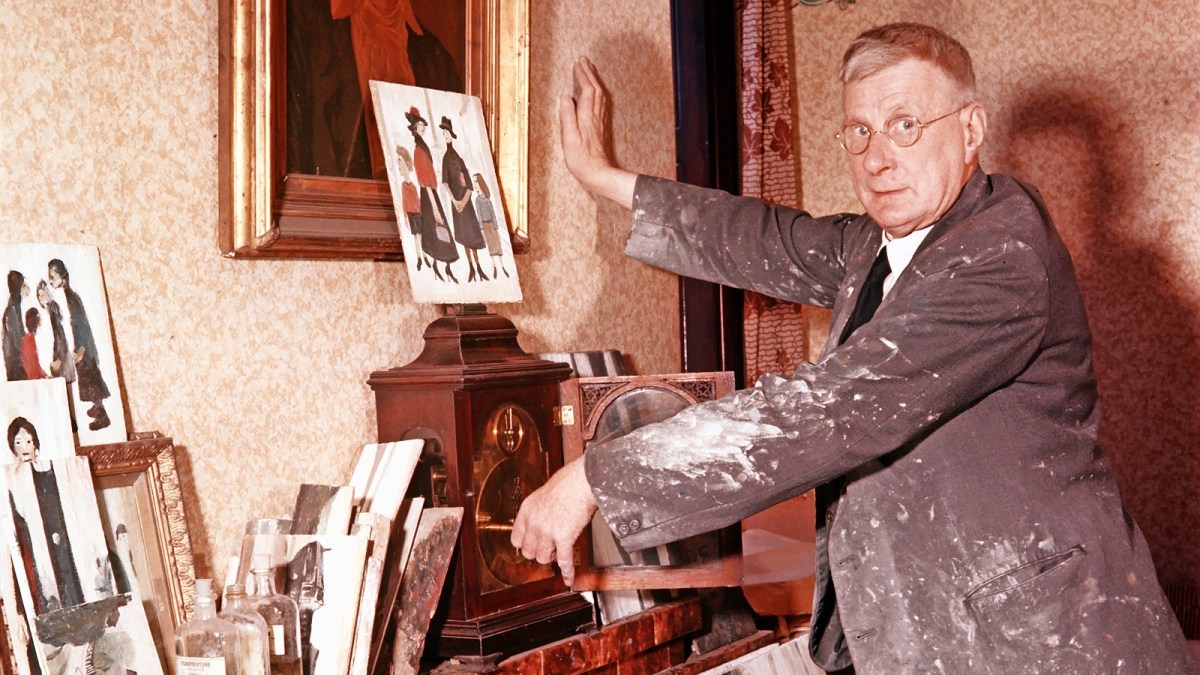
“I don’t know what kept me painting,” the artist LS Lowry once told an interviewer. “People didn’t make queues to buy them, you know. All the little figures in them — they took some doing.” However, painting, he went on, is “like a disease. It gets hold of you. You can’t stop.”
On Wednesday night, BBC2 will broadcast LS Lowry: The Unheard Tapes to mark the 50th anniversary of the artist’s death in 1976 at the age of 88. The tapes, the longest interview Lowry ever gave, are an extraordinary find. Angela Barratt, a young admirer of Lowry, visited the artist over four years in the early 1970s to record a series of interviews about his life.
Barratt worked in the administrative office of Salford University and often went to Manchester Art Gallery to look at the Lowrys. She wasn’t a journalist and had no certain plans for the reel-to-reel tapes, which lay forgotten in her Manchester home until their recent rediscovery by her son, Michael.
The tapes have been turned into a two-hander with Ian McKellen as Lowry and Annabel Smith as Barratt. It is brilliantly done. Banish any thoughts of lip-syncing as an act of awkward ventriloquism: such is the skill and conviction of McKellen’s delivery that it is close to possession. You have to pinch yourself that you are only hearing, not really seeing, Lowry.
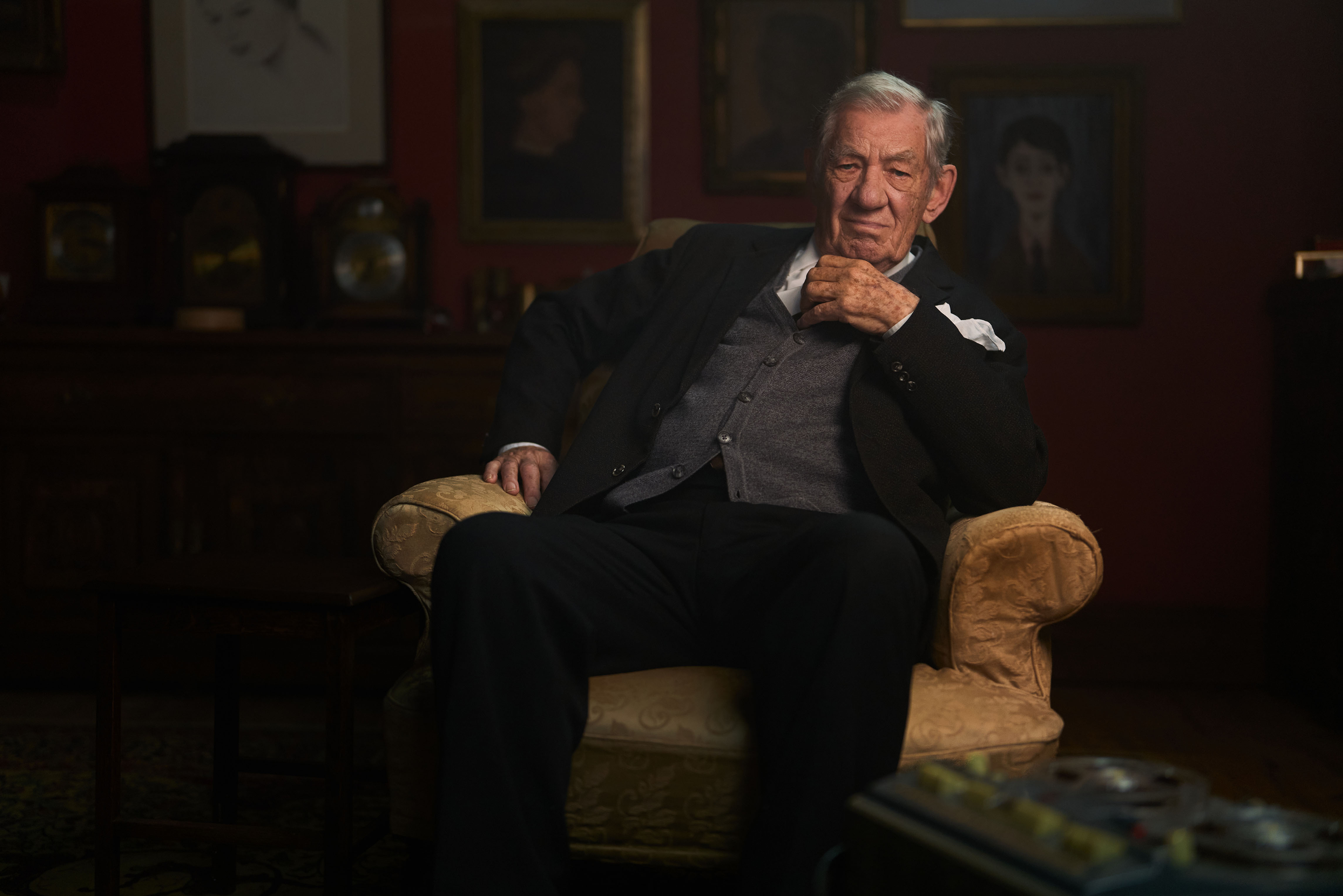
Ian McKellen plays the artist in Arena: LS Lowry — The Unheard Tapes (BBC2, Feb 25)
BBC/WALL TO WALL MEDIA/CONNOR HARRIS
Barratt is gentle and searching. Her guilelessness and genuine interest draw Lowry out. “I’m telling you my innermost soul, now,” he says at one point. She asks him about his parents. “My father used to have hysterics if I sold a picture. He couldn’t understand it.”
On the success that took so long to come: “I didn’t butt my head against the ceiling jumping up and down, you know. I think that it was a bit too late. I was past being interested when it all happened.” And on his determination to go on painting, even into his eighties: “It’s kept me out of the madhouse.”
To mark the Lowry anniversary, assorted festivities are planned. Muted ones, of course. He wouldn’t have wanted a fuss. Take inspiration from the holidaymakers in Lowry’s Lancashire Fair: Good Friday, Daisy Nook (1946) and wave a (small) flag, carry a (modest) balloon and give a pinwheel a spin. This week, in Berwick-upon-Tweed, where Lowry took his annual holiday, a newly acquired Lowry drawing will go on display at The Storehouse alongside other Lowry paintings from the town’s collection. In the autumn an important exhibition, the biggest survey of the artist’s work since the Tate Britain show 15 years ago, will open at the MK Gallery in Milton Keynes.
The Arena film kicks things off. If I have a quarrel with the documentary it’s not with the dramatised interview segments, which are riveting, but with the talking heads either side. They reflect on Lowry and class, Lowry and the north, Lowry and industry, Lowry’s psychology, Lowry v the snobs. We hear almost nothing about Lowry the artist: his methods, his means. In this anniversary year, can we look at Lowry — and his paintings — with new eyes?
• LS Lowry reminds us what football should be about
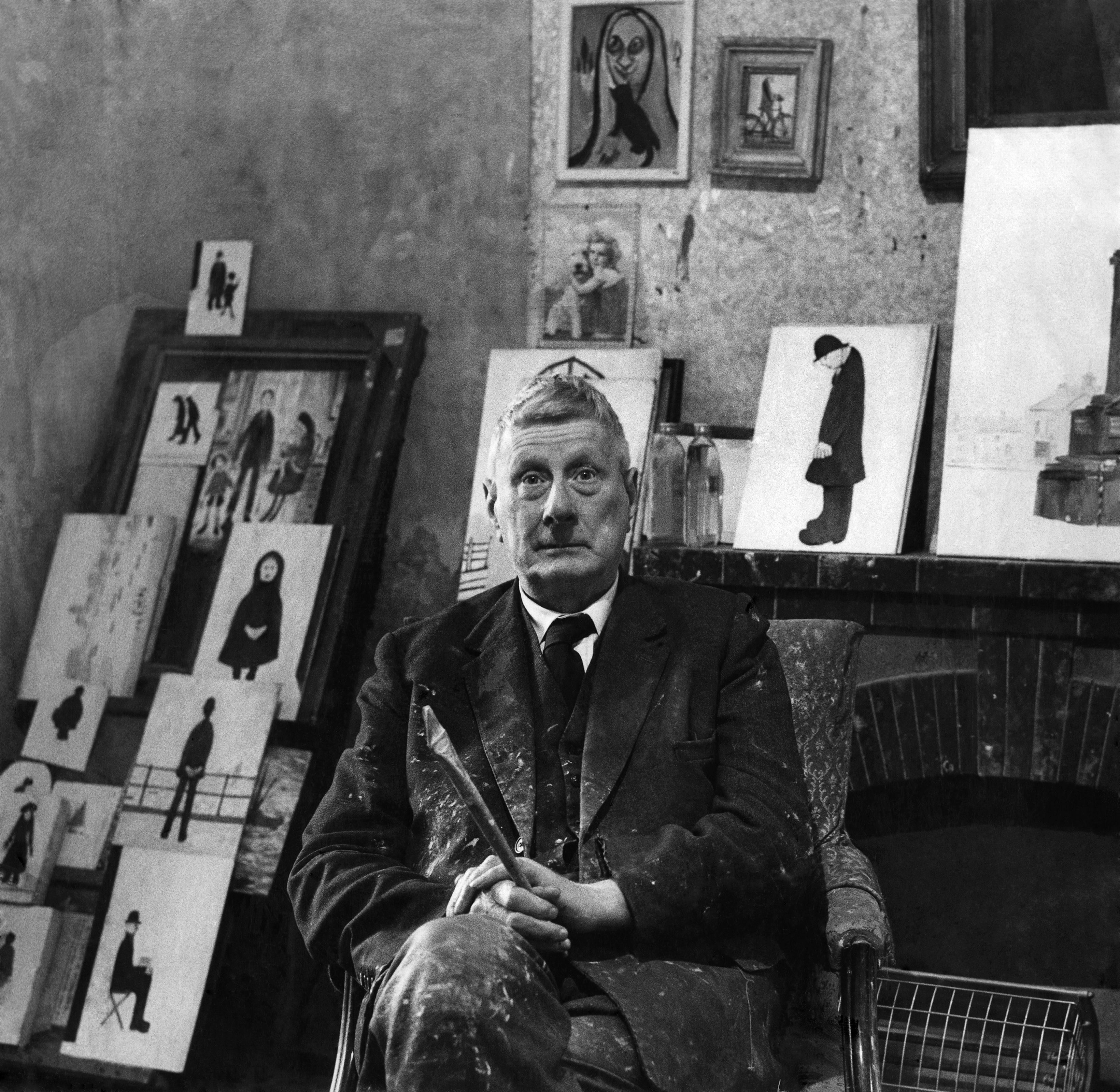
Lowry in October 1964
WATFORD/MIRRORPIX/MIRRORPIX VIA GETTY IMAGES
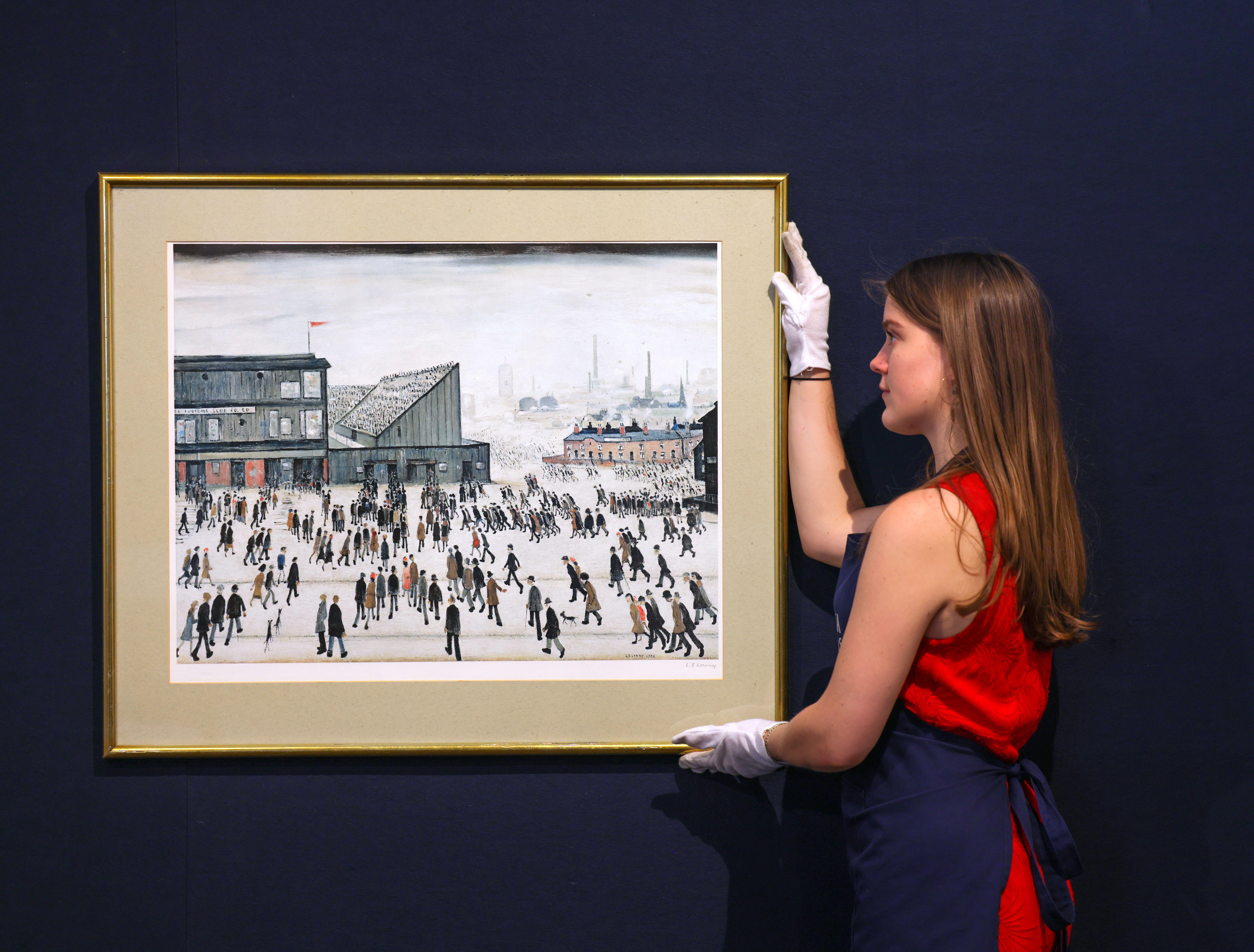
Lowry’s Going to the Match sold at auction for £7,846,500 in October 2022
PAUL QUEZADA-NEIMAN/ALAMY
Now is the moment to allow him to be Lowry the painter, as he wished to be, not Lowry the token northerner or Lowry the Salford mascot. You may well say, there speaks a soft southerner, probably with a poncey degree (yes and yes), trying to take the north out of Lowry, pushing the working class out as usual. To which I would reply, it’s not that the north, industry and class aren’t important parts of the Lowry story — they very much are — only that they are not the whole story.
• Read art reviews, guides and interviews
Lowry was an interviewer’s dream. He had his quips, his quirks, his nice, pugnacious turn of phrase. For biographers he was a trickier customer. He told the story he wanted to tell. He was private, evasive and inconsistent. For art historians and curators he presents a problem. He doesn’t fit. It is useful if an artist fits — a movement, a style, a set — when you are hanging a gallery, telling a story of modern art, putting together a coherent collection. Where do you shoehorn Lowry into the timeline?
His earliest paintings date from before the First World War and the latest were unfinished on the easel when he died on February 23, 1976. Lowry’s style and subject matter didn’t change much in 60 years. The same “matchstick” men, women, children and dogs (spot the rare fat man in The Removal, 1928), the same dark verticals of chimneys, lampposts, railings and steeples rising through a compressed townscape and into a smutted sky. The same resolutely limited palette: ivory black, Prussian blue, yellow ochre, flake white and a vermillion used to great effect on rows of red-brick, back-to-back terraces.
Fifty years after his death, Lowry’s status is far from settled. His paintings are recognised, popular and loved. He commands high prices at auction — Going to the Match (£7,846,500), Piccadilly Circus, London (£5,641,250) — and is a forger’s favourite. But then the factory gates slam shut. The art world admits him only on sufferance. It took decades of badgering by his champions to get a Lowry out of the storeroom and onto the walls of the Tate’s permanent collection. Since the big Tate rehang in 2023, there is, finally, a Lowry on display. A small one — Coming Out of School (1927) — hanging in a corner. Why not the big Industrial Landscape (1955)?
Lowry is a different proposition from, say, Alfred Wallis, the St Ives rag-and-bone man who in his Ancient Mariner dotage started painting ships and seas. Wallis’s spare, flat, tilting style can be convincingly termed “naive”: untutored, instinctive, free from artistic convention. But Lowry wasn’t some undiscovered “primitive”. He had been to Manchester Art School, where he studied under the French impressionist Adolphe Valette. He grew up reading Charles Dickens, Thomas Hardy and the poems of John Donne. He copied out the maxims of La Rochefoucauld. Some primitive! His mother Elizabeth had had aspirations to be a concert pianist.
In the chapter on 20th-century British art, Lowry is a stubborn-bugger sidenote. Not a bright young thing, not a Bloomsbury, not a war artist, not a modernist or a neo-romantic or a kitchen-sinkist, nor a Scottish colourist, a pop artist, a minimalist or an anything at all.
To add to the problem of sets and styles there is a still greater issue: snobbery. The wrong sort of people like Lowry. People who don’t, as a rule, like modern art like Lowry. When Lowry’s name appears in Mike Leigh’s play Abigail’s Party it’s as a tease. Laurence is proud of his Lowry reproduction. He shows it off to Angela along with a poster of Van Gogh’s chair. Laurence wants to be seen as a man of taste, a man who knows something about art. Not like Beverly, his wife, with her cheap, pornographic (she says erotic) picture upstairs in the bedroom.
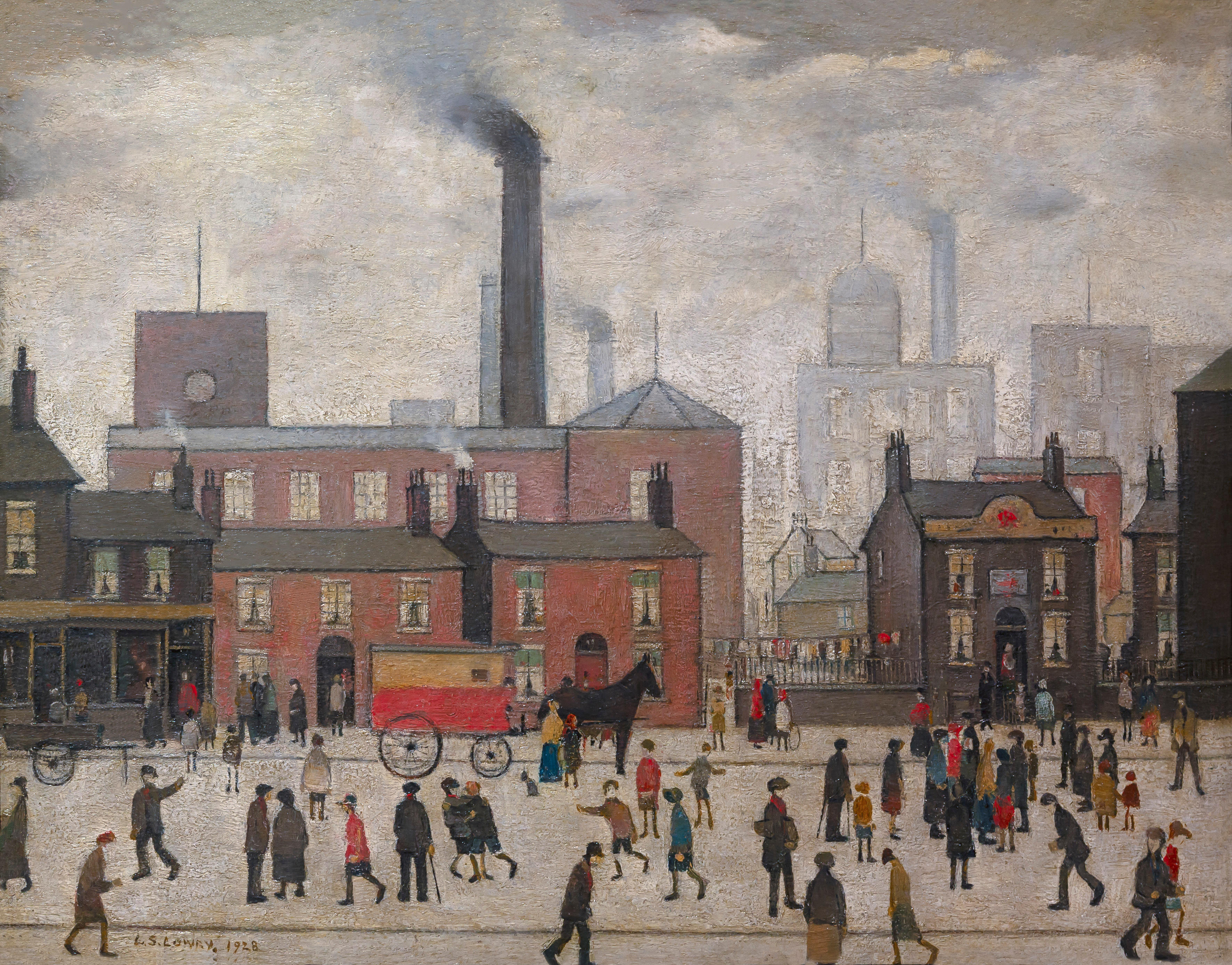
Coming Home from the Mill, 1928
THE LOWRY ESTATE
Are we meant to sneer at Laurence, an estate agent with an executive briefcase, for liking Lowry (and Van Gogh’s chair — basic) just as he, in turn, sneers at Beverly? Shouldn’t we at the same time feel ashamed for sneering at Laurence, who is at least trying to care about art? (Or to be seen to care about art by his neighbours?) It’s complicated.
One of the ways of handling Lowry is to pretend he isn’t a painter at all but a sort of social anthropologist documenting the daily life of a remote tribe of people called “northerners”. Or, more specifically, “working-class northerners”.
Tate Britain’s 2013 Lowry exhibition, which, to give it its due, did much to raise the status of Lowry, was called Lowry and the Painting of Modern Life. Not Lowry the painter of modern life but the painting of modern life. It’s the documentary thing again: Lowry the reporter, Lowry the chronicler of the last rasp of the Industrial Revolution and of the working class at work (or at any rate on their way to and from work) and at play.
More complicated still, Lowry was not actually working class. He was, to adapt George Orwell’s gradations, the son of lower-middle-class parents who aspired to be middle-middle-class but found themselves slipping, genteelly and with bad debts, from Manchester’s Victoria Park, a better sort of suburb, to Pendlebury. It was, Lowry remembers in the Barratt interview, “absolutely, completely industrial. I’d never seen a landscape like that. I’d never seen a landscape like that at all. When I saw the mills — my god.”
Lowry’s father, Robert, was a clerk and Laurence Stephen Lowry was a rent collector for more than 40 years. Lowry may well have nodded when Mr Pancks, the rent collector in Dickens’s Little Dorrit, tells Arthur Clennam, “You’d be poor yourself if you didn’t get your rents.” He never wanted anyone who came to interview him to know about the day job.
• Long-lost LS Lowry pictures found in art folder
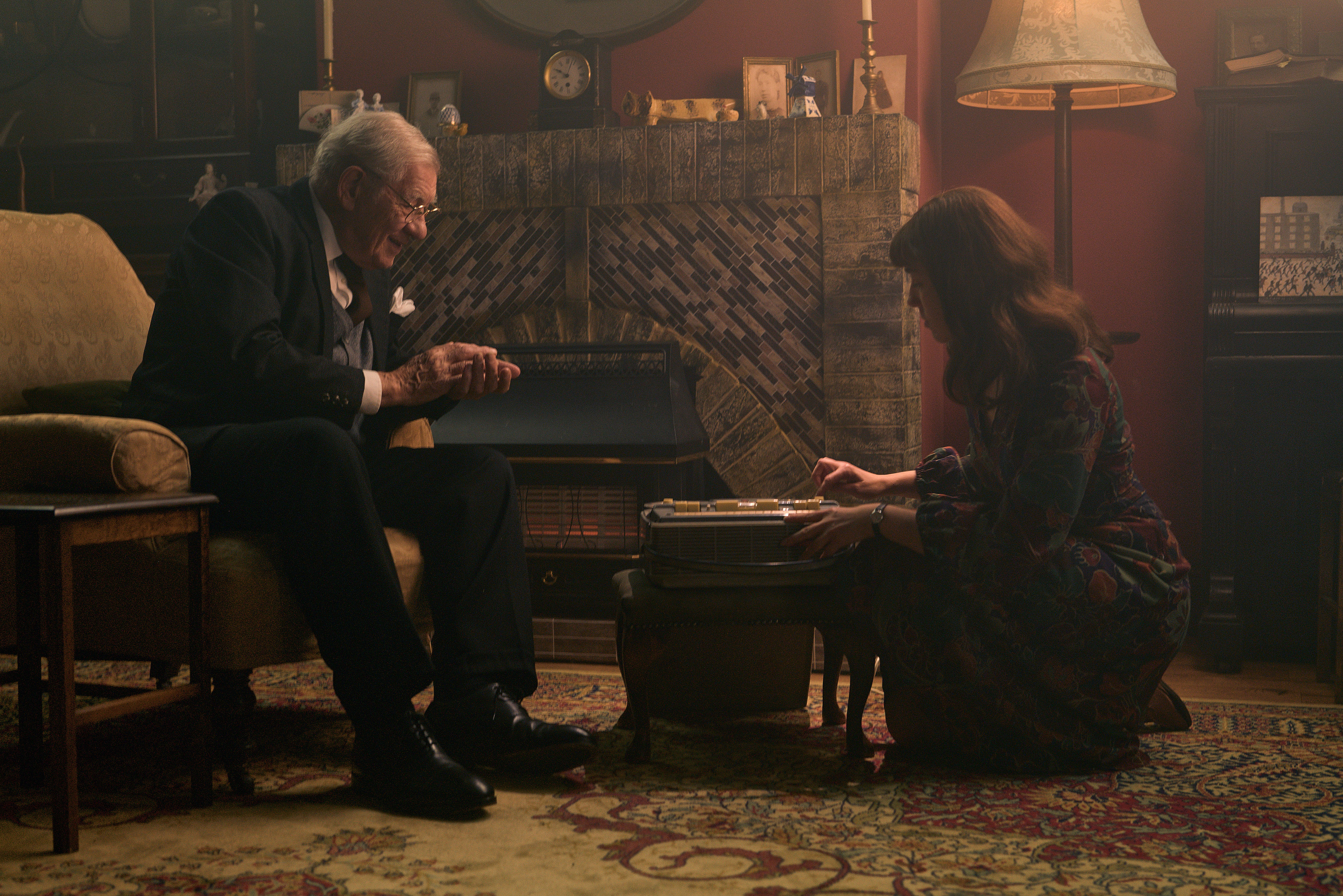
McKellen with Angela Barratt: this two-hander is brilliantly done
BBC/WALL TO WALL MEDIA/CONNOR HARRIS
Lowry used to talk of a road to Damascus moment on the road from Pendlebury to Bolton. He told different versions of the story in different interviews. “I didn’t like it at all for a long time,” he told Barratt. “I couldn’t get used to it. And then I got fascinated by it. I began to think after a time, has anybody ever painted this scene? And I found they hadn’t, so I said I’d do it as well as I can. I’ll try and put this on the map.” In another version of the story, he talks of having seen Hindle Wakes, a play by Stanley Houghton in which the actress Sybil Thorndike played a mill worker in a fictional Lancashire cotton town.
“I began to look at the industrial scene,” Lowry said. “The thought came to me… nobody has done this, I’ll have a shot at it. I’ll have a go at getting this established as a legitimate subject matter.” Was there not a way he too, like the playwright, could translate the life of the mills, the mines and the streets into art?
His scenes are works of artifice and imagination. Lowry was no plein air painter. He painted at home, generally at night and mostly by lamp and later electric light. His paintings are stage sets and the people who pass across them merely players, making their exits and their entrances on matchstick legs. (Between the Depression, the dole and the ration, there wasn’t much scope to be plump.) Lowry was not a social realist. He wasn’t motivated by the condition of the working class and certainly not by their “plight”. He was, inasmuch as he could be roused on politics, a Tory. “A good Conservative,” he said.
When Lowry painted A Protest March (1959) it wasn’t out of solidarity with the marchers but, I would hazard, in response to the perspectival challenge of painting a phalanx of protesters proceeding down the narrowest of streets. He was, however, sympathetic to individuals: down-and-outs and hard-luck cases, what were then called “cripples”.
• Stubbs, Lowry or Turner: who painted Britain best?
His interest is principally pictorial. How to recreate the atmosphere, the movement, the peopling of city streets in paint and on pieces of board? They are deliberate paintings. Look closely at the distribution of the figures, the balance of gathered bodies and empty space, the dense but differentiated markings to indicate a crowd and the passages where the white ground paint, like day-old snow, shows through. The viewpoint is almost always removed, slightly raised and set apart. Lowry is never in the midst. If he is going to a football match — he sometimes did — he is lagging far behind. The Arena interview gets across his loneliness and focus. “I’m all right by myself… I never thought for a second about getting married… I’ve had a very blameless past. I’ve never been in love.”
His style hardly changed over 60 years but Lowry was no stuck-in-the-mud Sunday painter. There is variety in his paintings, an unheralded incident — a gesture, a shout, a gawker, a lounger — or some strangeness to arrest the eye, and dashes of ambushing colour set against a landscape of smoke and soot. They took some doing.
Arena: LS Lowry: The Unheard Tapes is on BBC2, Feb 25, 9pm, and iPlayer. Lowry in Berwick is at The Storehouse, Berwick Barracks, to Mar 22. LS Lowry is at the MK Gallery, Milton Keynes, Oct 24 to Feb 28, 2027