
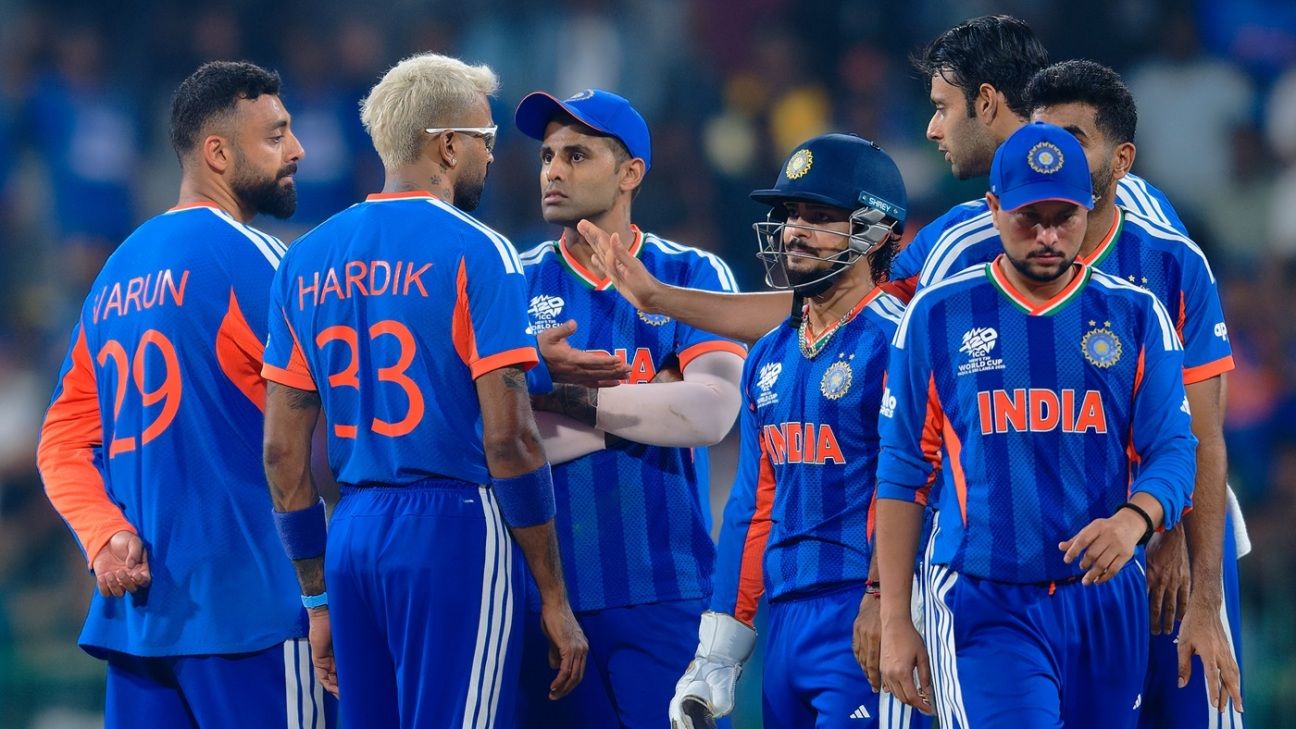
It is the final over of the chase with Netherlands needing 26 off five balls. Zach Lion-Cachet swings at a Shivam Dube delivery but ends up slicing the length ball high into the night sky. At long-off, Rinku Singh charges in. From cover, Suryakumar Yadav calls loudly, while furiously trying to wave Rinku away.
Both are certain the catch is theirs. Logic favours Rinku – he’s running in – but instinct pulls Suryakumar in. They collide and the ball spills out. But there’s no letting off steam from either. Instead, they slap high-fives, pat each other and move on. Two balls later, Lion-Cachet is gone anyway, and India close out a 17-run win, their fourth to round off the group stages.
That dropped catch feels strangely emblematic of India‘s T20 World Cup so far – a campaign that has been anything but clinical, yet comfortably in control. They’ve been nudged off script, tested in phases, and forced to improvise beyond the batting template they’ve painstakingly built in the lead-up. Yet, they have found ways to win comfortably. It has been perfectly imperfect, and effective.
Editor’s Picks

1 Related
Against USA, India were one wicket away from a blowout when Hardik Pandya holed out first ball to leave them 77 for 6 on a grippy, two-paced Wankhede surface. Fortunately for them, Suryakumar showed immense restraint and didn’t tee off until the start of the 16th over. He eventually top-scored with 84 off 49 to haul them to 161 when 135 looked increasingly difficult.
Varun Chakravarthy struck twice in two balls Getty Images
Then Namibia’s Gerhard Erasmus forced them to dig deep with his slingy offspin on a Delhi surface with enough grip to put brakes on India’s scoring rate. He took 4 for 20, and India’s lower order collapse – they lost 5 for 4 off the last 11 balls – meant they didn’t get the finish they were after. And yet, they made 209.
Ishan Kishan’s early rampage in that game, and again against Pakistan in Colombo – on a surface that produced the joint-most overs of spin in a T20 World Cup fixture – has cushioned India against Abhishek Sharma’s sequence of three ducks. While Kishan struck 77 off 40, the rest of the batters combined to make 95 off 80.
That Abhishek’s form has spiralled into something resembling a crisis says as much about his stature in this format as it does about the numbers themselves. Five ducks in his last eight innings is an untidy blot, and the advice – technical, tactical, philosophical – has poured in from every direction.
Yet, it’s hard to find a discernible pattern to his dismissals. Over the past two training sessions in Ahmedabad, there have been enough signs that this is just a temporary phase. Inside the dressing room, there has been little appetite for over-analysis. Perhaps, that is the most telling part. Because if Kishan’s surge has already set the tempo at one end, the thought of an in-form Abhishek alongside him is scary for the opposition.
play
2:51
T20 World Cup 2026 – Do India need to split up an all-left top three?
Varun Aaron and Sanjay Bangar on India’s conundrum
Abhishek’s early dismissals have had a ripple effect. They have exposed Tilak Varma sooner than intended to offspin, and the returns have been subdued – 26 off 31 balls. Through the middle, Tilak and Suryakumar have often been forced to apply the handbrake after the powerplay. India’s scoring rate between overs 7 and 10 sits at 7.12 – the third-lowest among the Super Eights sides – with South Africa setting the benchmark at a brisk 10.37.
And yet, even with the recalibration, India powered their way to 209 against Namibia, 175 against Pakistan – comfortably 30 above par – and 191 against Netherlands. Each time, the margin of victory has merely underlined how India have romped home despite being far from perfect. For all the talk of slowdowns and adjustments, their overall strike rate of 148.75 is still the fourth-best among the teams in the Super Eight.
The answer to this perhaps lies in India’s bowling attack.
“I take a lot of pride in our bowling unit. With our high-risk-high-reward approach, even if we end up making just 175-180 our bowling is still good enough to win games,” Suryakumar said. “The way we’re playing, if we get a start, we all bat with the same template. If we don’t get the start, it’s important to understand the requirement of the team.
“That time if team feels, whether Tilak or me or anybody, need to bat at 150-200 strike rate, we will. But at that time, if No. 3 or 4 gets out, pressure comes on the lower order and their job is to give lower order firepower and finish. Factoring in all that, we sometimes take a back seat to ensure we bat longer. If one of us click, the job is done.”
Gautam Gambhir in a serious conversation with Tilak Varma and Suryakumar Yadav PTI
There’s a reason Suryakumar trusts his bowlers to the hilt. He has two trump cards in Varun Chakravarthy and Jasprit Bumrah who he can deploy almost like cheat codes. There has been no rigid template to their usage, but the mere presence of eight dependable overs between the pair has distorted opposition thinking. Batters, wary of being strangled later, have felt compelled to chance their arm against others, equally skilled.
The numbers underline that control. India have the second-best bowling strike rate in the competition and are the only side conceding at under seven an over. What makes it more striking is that they have achieved this without Bumrah having completed his quota in two of his three outings and Varun not bowling out in any of the four games.
Instead, India have experimented by slipping in overs from Rinku, Tilak, Abhishek and Dube, even handing Washington Sundar a game to keep him match-ready. It is this depth, not just in terms of personnel, but also the safety net Bumrah and Varun provide that has made India’s bowling attack the best in the competition.
On Sunday, South Africa will be up against two bowlers, who have their best records against them. Arshdeep Singh and Varun have claimed more wickets against South Africa than against any other opponent – 23 and 22 respectively. Varun has picked up at least two wickets in each of the eight matches he has played against them. When the sides met in December, he was named Player of the Series.
It isn’t as if only India are still searching for their perfect game. South Africa were one strike away from potentially crashing out against Afghanistan. Pakistan have stumbled to stay afloat. Sri Lanka were jolted by Zimbabwe. England were pushed to the limit by Nepal, and, in phases, unsettled by Italy.
India’s high-calibre attack has allowed them to cruise in third gear so far. But the Super Eight will bring with it a different kind of pressure. As Varun said after receiving an ‘Impact medal’ after the previous game, “asli tournament next match se chaalu ho raha hai. Uske liye ready hona hai (the real tournament starts from the next game, we have to be ready for that), dogfight is very important.”