
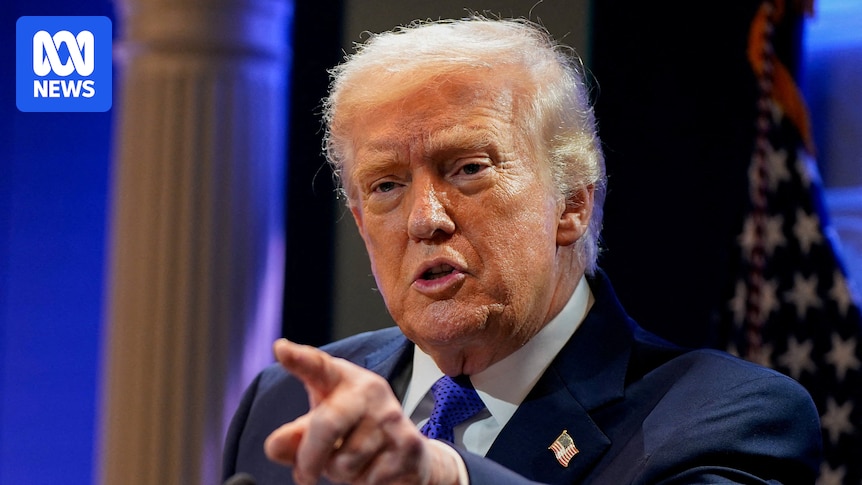
US President Donald Trump says he will raise a temporary tariff to 15 per cent on US imports from all countries, the maximum level allowed under the law, after the US Supreme Court struck down his previous tariff program.
The move on Saturday, local time, came less than 24 hours after the US president announced a 10 per cent across-the-board tariff on Friday after the court’s decision.
The ruling found Mr Trump had exceeded his authority when he imposed an array of higher rates under an economic emergency law.
Bombshell ruling by US Supreme Court kills tariffs
The new levies are grounded in a separate but untested law, known as Section 122, that allows tariffs up to 15 per cent but requires congressional approval to extend them after 150 days.
No US president has previously invoked Section 122, and its use could lead to further legal challenges.
Trade experts and congressional aides were sceptical the Republican-majority Congress would extend the tariffs, given polls that show growing numbers of Americans blame the duties for higher prices.
Trump eyes other ways to impose tariffs
In a social media post on Saturday, Mr Trump said he would use the 150-day period to work on issuing other “legally permissible” tariffs.
The administration intends to rely on two other statutes that permit import taxes on specific products or countries based on investigations into national security or unfair trade practices.
“I, as President of the United States of America, will be, effective immediately, raising the 10% Worldwide Tariff on Countries, many of which have been ‘ripping’ the U.S. off for decades, without retribution (until I came along!), to the fully allowed, and legally tested, 15% level,” he wrote on Truth Social.
The Section 122 tariffs include exemptions for certain products, such as critical minerals, metals and energy products, according to the White House.
The Supreme Court’s decision, authored by Chief Justice John Roberts, concluded the law Mr Trump had used for most of his tariffs — the International Emergency Economic Powers Act — did not grant the president the powers he claimed.
The chief justice was joined in the majority by fellow conservatives Neil Gorsuch and Amy Coney Barrett, both Trump appointees, and the court’s three liberal justices.
Mr Trump reacted with fury to the ruling, calling the justices in the majority “fools” and describing Mr Gorsuch and Ms Barrett in particular as “embarrassments,” while vowing to continue his global trade war.
Some foreign leaders applauded the decision. French President Emmanuel Macron said the ruling showed it is good for democracies to have counterweights to power and the rule of law.
German Chancellor Friedrich Merz said he expected the decision would ease the burden on German companies. He said he would use his upcoming US trip to reiterate that “tariffs harm everyone”.
Loading
Reuters/ABC