
Normal text sizeLarger text sizeVery large text size
It didn’t look too bad on the telly. There was young Will Ashcroft, chasing the ball into a pack, as he is prone to do, surrounded by players much bigger than his 182-centimetre, 82-kilogram self. Suddenly he was on the ground, sandwiched between two Geelong Cats players, his right leg planted in one direction as the ball bounced off in another. So par-for-the-course did it seem for Aussie rules that the camera moved on, following the ball down the field. It took a few beats for the cameraman to realise something was happening behind play and to pan back. There, lying on the ground, holding his knee, was the Brisbane Lions midfielder. Moments later the physios swooped in, and a few moments after that Ashcroft hobbled off the ground, pain etched across his face. It was July 22, 2023, midway through the fourth quarter of a round-19 AFL match at the Gabba, the Lions’ home turf. The day Will Ashcroft ruptured his anterior cruciate ligament. The worst day of his then-19-year life.
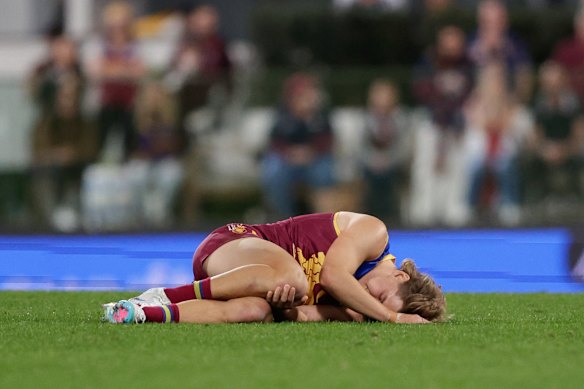
Ashcroft holding his knee in round 19 of the 2023 season. His ruptured anterior cruciate ligament meant 10 months off football.Credit: AFL Photos via Getty Images
You might say this means Will Ashcroft has had a pretty blessed life, and you wouldn’t be wrong. Eldest child of former Lions triple premiership player Marcus Ashcroft and PE teacher Bekky, Ashcroft has been marinated in sport his whole life. Indeed, been a star his whole life: winning at school swimming and athletics, captaining his Gold Coast school’s rugby union team, moving south in year 10 to Melbourne’s Brighton Grammar, where two years later he was footy co-captain and best-and-fairest. Leading the U18s Aussie rules team, the Sandringham Dragons, to grand final victory in 2022, captaining the U18 All-Australian team that year.
Drafted to his father’s old club, the Brisbane Lions, for a hotly anticipated 2023 debut, playing every match in the first half of that season, gunning for the 2023 Rising Star award. Then: a fleeting moment of bad luck, one necessitating a knee reconstruction and the best part of a year off footy.
Read more: This is the part of parenting no one warned me about
But here’s the thing about Will Ashcroft. He’s been preternaturally determined his whole life, too. Even accounting for natural talent and familial advantages, those who know him say he’s always been unusually focused, competitive, disciplined. He launched his own training app at 17, for goodness sake, to help fellow teens get fitter, healthier and draft-ready. Teens less advantaged than himself. Most athletes start thinking of this kind of career extension near the end of their playing life, not the beginning.
“When he did his ACL, I knew it wouldn’t be through lack of preparation,” says Ben White, the Aussie rules coach at Brighton Grammar when Ashcroft arrived. Ashcroft was on the younger side of his year 10 cohort, arguably too young to select for the firsts, which would mean playing with and against year 12s. “But he was just so professional, and wanted it so badly, he was able to do everything we asked of him,” says White, “and that got him into the team.”
All this means that while Ashcroft never took success for granted, nor did he think that if you did the hard yards, you wouldn’t be rewarded. So as counterintuitive as it sounds, tearing his ACL in his first season as a professional footballer provided him with an important life lesson: that even when you do everything required of you, then 50 per cent more because you’re that kind of kid, bad things can happen. Control really is an illusion.
“It was probably the toughest moment of my life at that point,” Ashcroft concedes as we chat in the backyard of his Brisbane home. “Not just because it was football but because of the naivety I had around injury, and the bad things that can happen to you.”
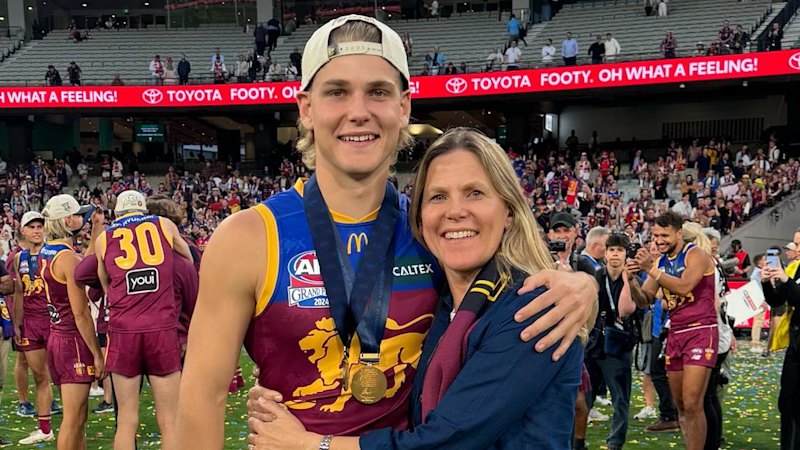
Good things can come from bad, though; as life coaches like to say, it’s not what happens to you but how you deal with it that counts. In Ashcroft’s case, within 10 months he was ready to play again, and a few months later, he’d not only helped the Lions secure the 2024 grand final but won the Norm Smith Medal for best on ground. The following year he did it all again: playing such a pivotal role in the Lions 2025 grand final win that he again won the Norm Smith. This makes Ashcroft only the third player in AFL history, and the youngest, at 21, to win consecutive Norm Smith medals.
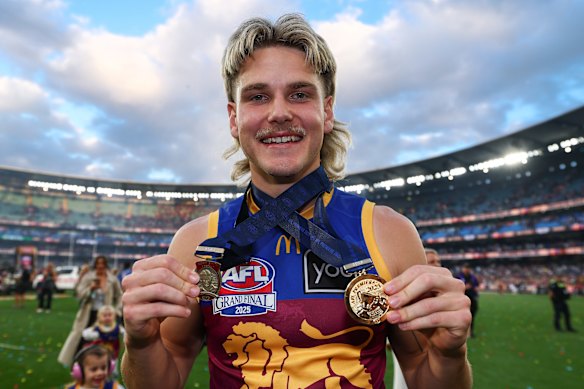
Ashcroft is the youngest AFL player to win consecutive Norm Smith Medals, in his case in 2024 and 2025. Only two others have achieved the feat.Credit: Getty Images
“I’ve done my own ACL, and I tell you, the demons can take two years to get over,” says Mark Wheeler, talent lead manager at the Sandringham Dragons when Ashcroft played there. “To get through the process and get back to the mindset that he could win the Norm Smith only months after returning to play – that’s the dedication bit. That’s the Will I knew.”
There’s a lot to learn from the Will Ashcroft story. About how a top athlete gets built. About the multiple micro-advantages that come from being part of a football family, and part of a close, stable family unit. About where the fierce determination to succeed comes from – because there are plenty of former players whose kids don’t reach great heights. And in a sport that talks ad infinitum about footballer fathers and their footy-playing sons, about the role of a mother, specifically Bekky Ashcroft, in helping shape a kid with talent. In her case, three kids: middle child Levi, now 19, joined the Lions last year, and also played in the grand final, while daughter Lucy, 16, is a top netballer and footballer, already in the Lions Academy and expected to be drafted to the AFLW in 2027.
“They were raised knowing that professional sport is 95 per cent very difficult and 5 per cent glory – if you’re very lucky,” says no-nonsense Bekky, who multitasks talking to Good Weekend with her brisk morning walk. “They’ve all known that from a young age. It’s not the public perception of sport but it is the reality.” Another reality: with the equivalent of only two full seasons under his belt, Will Ashcroft is shaping up as one of the out-of-the-box talents of his generation of AFL players.
Will Ashcroft has cut off his mullet. It’s one of the first things I notice when I arrive at the Brisbane home he bought in 2024 and shares with brother Levi and best mate Jimmy Creighton. It’s late 2025, and we’re sitting in the small backyard where there’s a pool, a sauna and an ice-bath – the accoutrements of the professional athlete’s life. I notice some tattoos poking out from his shorts, among them a lion’s head with the years 2024 and 2025 under it. No explanation needed. There are others, too, but he doesn’t want to talk about them. This naturally makes me more intrigued but Ashcroft isn’t budging. This is a young man who knows his mind.
The mullet was one of his defining characteristics, flowing long and blond down his neck as he chased the ball, weaving between players, kicking for goal. His generation is different enough to his father’s for him to agree without embarrassment that yes, he did occasionally dye it. “I was due for a change,” he says when I express surprise about the chop. “Hopefully I timed it so it’ll grow out for the next season.”
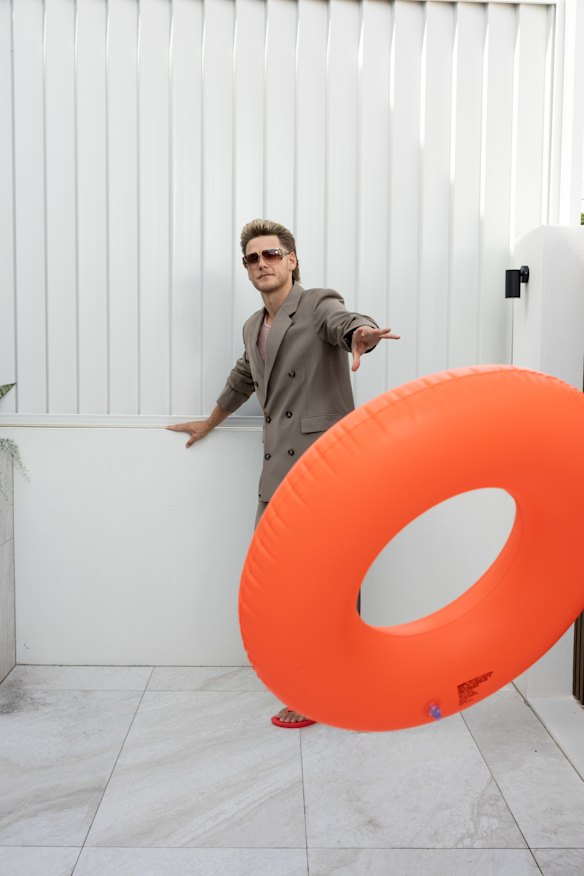
Ashcroft, who cut off his famed mullet over summer, is partial to fashion.Credit: Paul Harris
It’s a neat and tidy home, reflecting Ashcroft’s penchant for things being just so. Dishes left on the benchtop and shoes in the hallway displease him; he drinks only occasionally, and his control reaches new heights when it comes to cooking steak (on the barbecue, then finished off in a pan). “I’m very competitive but Will takes it to a whole new level,” says Creighton with a laugh. “Sometimes you want to relax but with Will, there’s always something to do.”
Letting his hair down involves playing golf with Levi and other Lions (the brothers hit off single digits), chilling at the beach, competing on PlayStation and playing guitar, which he learnt at school and is determined to get better at. After the grand final, he went to Hamilton Island with his then-girlfriend of 18 months, Summer Finn, to Melbourne for the races, and to Tassie for – you guessed it – golf.
He’s into fashion, too, sharing looks he finds on social media with mates like fellow Lions Charlie Cameron and Kai Lohmann. When I ask whose style he admires, he thinks for a minute, then names Canadian Shai Gilgeous-Alexander. When I look up the National Basketball Association star later, I find images of him in a white fur coat with dark shades, multiple silver necklaces and a skull cap. This is hard to square with the 21-year-old in front of me, who’s dressed for the Brisbane summer in a striped T-shirt and shorts, utilitarian Apple Watch on wrist. That’s OK, though; at 21, we’re all trying to work out who we are, what style fits us. And while I can’t see Ashcroft in a white fur any time soon, I like that he likes how it looks on Gilgeous-Alexander.
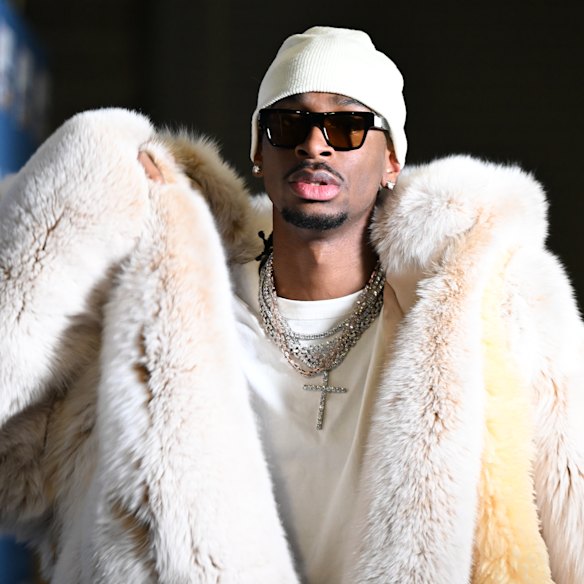
Cool cat: Shai Gilgeous-Alexander of 2025 NBA champions Oklahoma City Thunder. Ashcroft and his Lions mates are big fans of the basketballer’s style.Credit: Anadolu via Getty Images
I ponder whether today’s players are more in touch with their metrosexual side than previous generations and whether this could signal a shift away from the all-too-regular reports of bad behaviour that beset the league. You know, the cases of homophobia, racism and sexism that periodically show up in the news. Then comes the AFL scandal of the summer, of Brisbane Lions co-captain Lachie Neale stepping down from his leadership role after a very public – and rumour-laden – breakup with wife Jules. I’m reminded that fashion is simply fashion. Human relations? They’re an entirely different, and infinitely more complex, thing.
I wonder how the public airing of private issues affects team morale. When I ask Ashcroft about the Neales’ split in January, he says with media-trained aplomb that it’s a personal matter for Neale and his family. “We’re getting around him and moving forward.”
Then comes news of two other Lions relationship splits over summer, including Ashcroft’s own. By late January, Ashcroft’s ex is making social media posts like “Happiness suits me better”, and accompanying another post with the Taylor Swift song, We Are Never Ever Getting Back Together. When asked by a follower on Instagram “where’s will [sic]“, she replies, “on his high horse”.
All this is dutifully reported by the media. As Jules Neale posts images of herself living her best post-split life, it becomes clear that today’s wives and girlfriends will not go quietly. Social media has changed all that, giving them a power previous generations of AFL partners never had. Coach Chris Fagan speaks publicly about the importance of character and accountability among his tribe, and Ashcroft tells Good Weekend he doesn’t want to discuss his ex-girlfriend’s posts – they’re her thing, not his.
I can’t help but shudder with relief that social media wasn’t around when I was 21, falling in and out of love, trying different partners on for size. Making mistakes, learning right from wrong. Growing up without social media – and without the floodlights of fame.
As pre-season training gets underway and the March 2026 season opener approaches, one thing becomes crystal-clear: the Lions have left any winners′ glow firmly back in 2025.
Elsewhere over summer, Will Ashcroft spent a week working with a trainer at Aspetar, a sports medicine facility in Doha, Qatar. It was his idea to go and the Lions supported it, a reward, perhaps, for the Norm Smith wins. “A lot of it was around turning on and activating different muscle groups that turn off when I move,” he explains when I ask what he did there. “My raw numbers are all about power and speed but this was about how to make that more efficient. My quads are dominant, so how to switch on my glutes, that kind of thing.”
This commitment to doing more than the norm was apparent to Ben White when Ashcroft arrived at Brighton Grammar. “I’d regularly see him in the gym by himself, rolling, stretching, doing strength work,” White says. “He was highly motivated from day one to make the AFL.” Ashcroft would pepper White and other staff with questions – “he was very keen to get feedback on how he could improve” – an attribute his mother says has long been there. “He was always very curious, and he’s an exceptional listener, you don’t need to say something twice,” she says. Marcus adds that their eldest “doesn’t think he knows everything” and was mentally tough from an early age. “He likes to work on himself every day, especially when it comes to his footy,” Marcus says. “When you have that mindset and don’t take anything for granted, you’re half a chance.”
Loading
Marcus and Bekky, who both grew up on the Gold Coast, made a conscious decision not to have kids until Marcus’s playing days were over. “It can be a selfish thing to do, this football life, so we wanted to wait,” he says. By the time their kids came along, he was football GM for the Gold Coast Suns. The Ashcroft kids were in and out of the Suns rooms, meeting players, kicking the ball around with pros, some of whom were billeted with the family upon arrival in Queensland. Ashcroft and Levi idolised Gary Ablett jnr, went on family holidays with their father’s former teammates Chris and Brad Scott, and attended every grand final Ashcroft can remember “until I played in one”. All this counts in inestimable ways, says The Age’s chief football writer, Jake Niall, who points to similar advantages Nick and Josh Daicos would have had, growing up as the sons of Collingwood great Peter.
Ashcroft agrees immersion from a young age probably played a role in his development, albeit a hard-to-quantify one. “Seeing what they do pre-game, post-game, their preparation, review,” he reflects. “You’re not taking a whole lot in at that age but you do get accustomed to what it might be like if you get there.”
That helps explain why he’s never felt debilitating nerves around football but did feel them in solo pursuits like athletics, and is seen as a big-game player who lifts in important matches. “I love the pressure and the stakes,” he says of finals time. “The smell of the grass, the crowds, the atmosphere … every contest, there’s a bit more of a price on it.”
The other thing about the Ashcroft kids was they did all types of sports. Athletics, swimming, gymnastics, rugby union, golf – whatever was on offer. “The skills people think are a fluke, I always say they’re the result of playing many different sports as they were growing up,” says Bekky, who swam and ran at state level but says she was never at the level of her husband or kids. As a PE teacher, her advice at parent-teacher interviews is to hold off specialising too early. “Get your kids exposed to as many different types of things for as long as possible.”
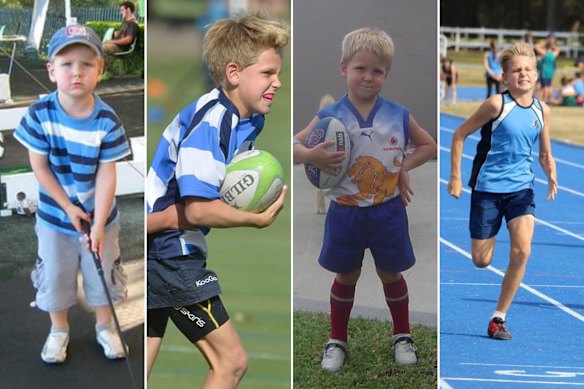
Ashcroft played many different sports as a kid, which his mother credits with helping finesse his sporting skills.Credit: Courtesy of Will Ashcroft
It’s good advice that’s increasingly recognised in sporting circles. Roger Federer is another who played a lot of sports before focusing on tennis – and that didn’t work out too badly for him.
Ashcroft’s ability to barge into a pack and extract the ball cleanly might well reflect his multisport background, and Niall says many of the best players today have just this dexterity. But it also reflects practice. As White notes, being clean with a ball is not something you’re born with; it comes about through tireless repetition of the act.
There was tough love, too. Ashcroft recalls an athletics meet when he was 10 or 11: “I had 100- 200- and 400-metre events, and I didn’t want to run.” He’d played rugby on the Friday, footy on the weekend, and by the Monday of the meet, “I was cooked.” His mum was hearing none of it. He ran. “Little moments like that I remember where it was good to be pushed.” It was Ashcroft himself, though, who chose Aussie rules. “If you get pushed too hard and told what to do, you burn out,” he says. “You have to find it yourself.”
‘If you get pushed too hard and told what to do, you burn out. You have to find it yourself.’
Will Ashcroft
The Ashcrofts moved to Melbourne in 2019 when Marcus got a talent pathways role with the AFL, pitching their kids into a much bigger, more competitive Aussie rules pond. Then came COVID-19, which hit during Ashcroft’s final two years of school. Many kids were psychologically thrown off course by that unprecedented time, but Ashcroft remained focused on his singular goal of getting drafted, taking gym gear home to train with. “Will was certainly one of the players who didn’t let up,” says White.
Not letting up also defines Ashcroft’s relentless advocacy for brother Levi, then in year 9, to be selected for the firsts when Ashcroft was in year 12 and footy co-captain. “From day one of the preseason, he was asking whether I thought Levi would make the team,” White says with a laugh. “Then it got to the start of the season, and he asked again. That question never stopped.” Levi made the team – of course he did – in a stop-start season punctuated by lockdowns.
Between school and getting drafted to the Lions, Ashcroft played for the Sandringham Dragons, with brother Levi following him there in due course. Some saw the brothers as a bit FIGJAM (“f— I’m good, just ask me”) but Mark Wheeler admired their focus. “As a 15- or 16-year-old [Will] was probably acting more like an 18-year-old,” says the Dragons’ then talent lead manager. “He was elite in his training, on and off the field, right down to weighing his own food.”
At the same time, Ashcroft started a sports management course at Deakin University and launched Wash Performance, a training app for kids aged between 13 and 18. The idea was to create a digital “coach in your pocket” that helps kids get fitter and healthier, off social media and, if it’s their thing, get drafted. “When I was young I was in the best programs, went to a great school, had really good experiences and exposure to AFL clubs because of what Mum and Dad provided, but not all kids have that,” says Ashcroft. “Kids who might live remotely, or not have enough money to be in the best programs or the best schools, don’t have the facilities but want to improve.” Ashcroft is the face of Wash, with Jimmy Creighton its head of operations and online coach. The app is about to be relaunched, suggesting it’s not yet a serious money-spinner, but new investors and plans to expand it into other sports suggest they think it one day could be. Either way, it’s a savvy play that speaks to its founder’s leadership chops, desire to help others and build a business – and eye already on the longer term.
Bekky Ashcroft wasn’t meant to be in Brisbane on Saturday for round 19 of the 2023 season. During Ashcroft’s first season with the Lions, the family stayed in Melbourne, as Levi and Lucy were still at school. But for some reason – call it mother’s intuition or just dumb luck – she made a last-minute decision to fly up for the match. She recalls watching from the stands as her son’s ACL ruptured. “We’ve been around footy long enough to know that when that type of thing happens, it’s pretty devastating,” she says. She went to the rooms after the match. “He was with the medical staff, inconsolable.”
They were told they’d have to wait until Monday to get a scan, but her son was having none of it. By 7.30am the next day they were driving to Redcliffe, north of Brisbane, “the only place that would do a scan on a Sunday”. They got the call confirming the worst on the drive back and had to pull over for a moment to process it. A day later they were en route to Melbourne, where within the week, Ashcroft would have reconstruction surgery, a few weeks after which he returned to Brisbane for the long recovery.
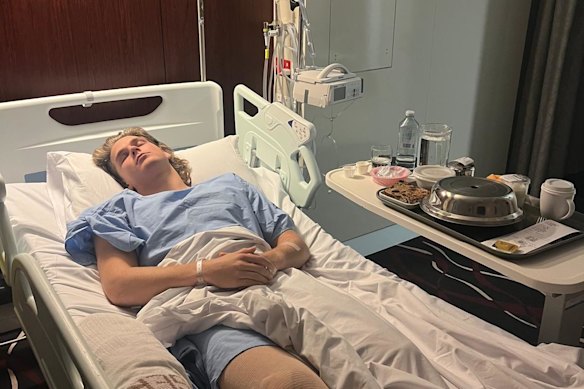
“It was mostly just anger,” says Ashcroft of his feelings after his ACL injury.Credit: Courtesy of Will Ashcroft
It must have been excruciating, watching his team march towards the 2023 grand final, then lose it, without being part of it. I ask Ashcroft what feelings were roiling around his head at the time. “It was mostly just anger,” he says candidly. “I had a vision in my mind of what my first year would look like. I was going to do this, achieve that, play every game, hopefully play in a premiership, win the Rising Star award. Things I was so locked in on … then it was all gone, bang. I thought, ‘This is not fair, I shouldn’t be in this position.’ ”
Marcus recalls how difficult it was for the family to be in Melbourne while Ashcroft was recuperating more than 1700 kilometres away. “The mental battles he went through, it was hard to be away from him for those.” It was Bekky who broke Ashcroft out of it. “I said to him, ‘You can be angry all you like, but there are people who get a tickle in their throat, or a headache, and go to the doctor and get a terminal diagnosis.’ ” You don’t have a terminal diagnosis, she told her son. “Yes, it’s one of the worst things that can happen to an AFL player, but let’s go see some people who have received a really bad diagnosis, and see what real anger and sadness looks like.”
So began Ashcroft’s relationship with the Children’s Hospital Foundation in Brisbane, which extended after his rehabilitation to the auctioning-off of his 2024 grand final boots. Inga Tracey, head of strategic marketing and communications at the foundation, says the boots auction was Ashcroft’s idea, raising more than $6000, and that he’s one of their most engaged ambassadors, visiting every few months. “He’ll bring in posters and footballs, have a chat, play Uno,” she says. “We deal with the sickest kids in Queensland. Most of them are bed-bound and it might be the only fun thing they get to do in a week.”
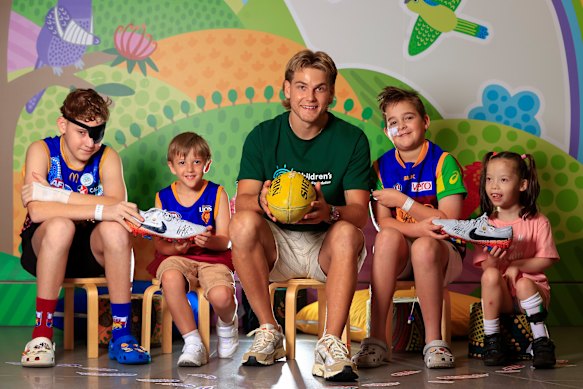
Ashcroft with (from left) Cooper Hateley, Taj Juster, Sam Matthews and Malika Toghill at the Queensland Children’s Hospital ahead of the auction of his 2024 grand final boots to raise money for sick children.Credit: Adam Head
I tell Ashcroft his mum sounds pretty wise, getting him out of his head like that. He agrees. “Dad’s approach to football and life is very go, go, go, and I probably got a lot of that from him,” he says. “What Mum does really well is put all that into perspective. She helps me look at things from a different angle and appreciate things outside football.”
Jimmy Creighton was there for his friend during the ACL injury, too. Creighton knew something about injury: he suffered a C2 avulsion fracture playing football when he and Ashcroft were teens, and spent six months in a neck brace. “He and his family helped a lot,” Creighton says. “Will and I would swim, go to the gym together, play basketball. That really set up the friendship.” Creighton returned the favour when Ashcroft did his ACL, flying to Melbourne the weekend after his surgery. “I helped him put his shoes on, we’d go to cafes,” he says. “I just wanted to distract him from what he was feeling at the time.” Knowing how quickly life can change is something the two now share.
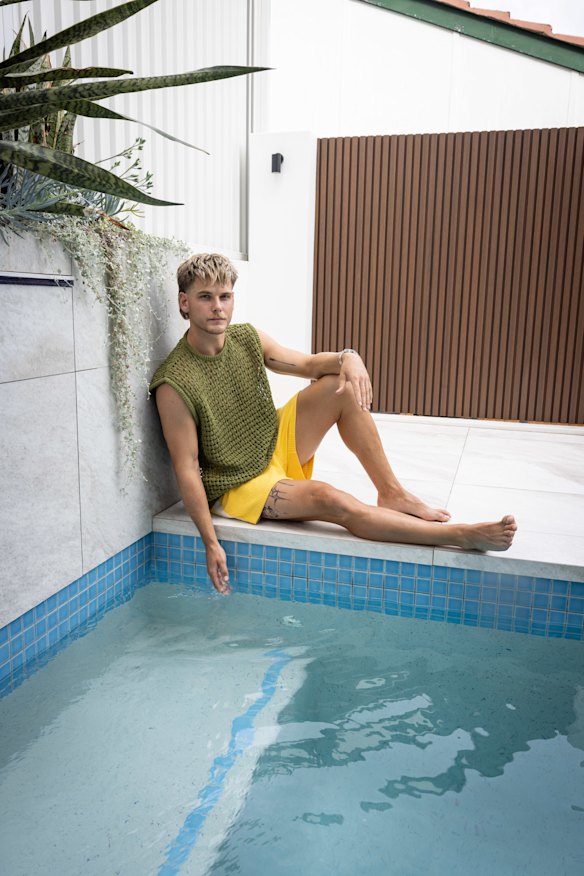
Ashcroft’s mum helped get him out of his self-pity after his ACL injury, reminding him, “there are people who … go to the doctor and get a terminal diagnosis.”Credit: Paul Harris
Marcus Ashcroft, who played in the Lions’ 2001, 2002 and 2003 premiership-winning team, was about as happy as a father can be when the siren rang on the 2025 grand final. The Brisbane Lions had beaten the Geelong Cats 122 to 75, and where, in 2024, one of his sons was on the winning team, this time it was two. “When I was a player, I thought winning a grand final was the be-all and end-all,” he says, emotion in his voice. “This was 10 times better.”
Marcus, Bekky and Lucy joined the crowd surging onto the ground after the win. Close family friend Chris Scott, coach of the losing Cats, sought them out. “Through his pain, in the middle of the MCG, he came over to congratulate Levi and Will,” says Bekky. “Football is a game but the relationships you get from it – they transcend the result.”
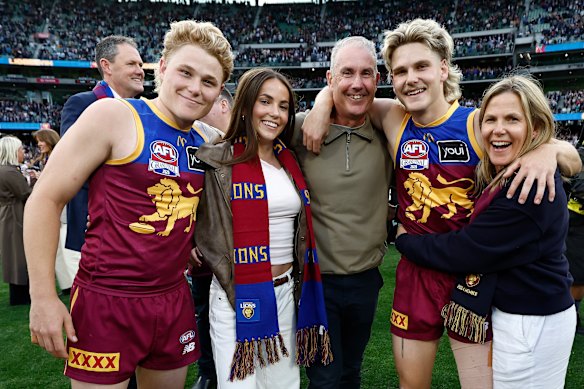
Family affair: Levi (left) and Will Ashcroft with sister Lucy, dad Marcus and mum Bekky after the Lions’ 2025 grand final win.Credit: Getty Images
In the wake of that win, Ashcroft’s contract with the Lions was extended through to 2030. He also joined Always Human, the sports marketing agency that put Matildas star Mary Fowler on the Paris Fashion Week runway and in the pages of Vogue. That self-initiated move has already netted him ambassadorships with Kayo Sports and Rexona, with others in the pipeline. He’s posting more on social media, too, showcasing his training, his meals, the odd fun day out. His 91,500 Instagram followers is nothing like Bailey Smith’s 418,000 or the 551,000 who follow Christian Petracca’s cooking account, but it’s growing. If the 2026 sportsperson is as much brand as player, Ashcroft appears ready to capitalise on it.
With so much having gone his way over the past two years, I wonder what keeps Will Ashcroft awake at night. His answer speaks to a sweet earnestness and the central role of family in his life. “Making everyone proud,” he says. His family, his close friends, those who’ve helped him since he was very young. “I feel an obligation, to be honest, to pay them back, to try to do my best for them.”
Loading
I ask his father what he worries about for his eldest son, a young man so determined, so controlled, so in a hurry to achieve. Making sure he has balance in his life, Marcus says, and that he “gets through safely and develops into a nice young man at the end of it”. He thinks Ashcroft’s “learning to understand that” but worries about the pressure today’s players put on themselves. “Unfortunately with social media and such, it’s always the extremes – you’ve either done really, really well, or really, really badly. In reality, there’s so much grey in between,” he says. “Being able to appreciate that and not go to the depths of despair when you think you’ve let the team down.” One of his jobs as a parent, he says, is to help with that.
For Bekky, who’s seen the long tail of concussion and other ailments in her husband’s generation, the foremost worry is always around the risk of injury “that affects the rest of their lives”. Making sure her kids are good people first, good footballers second, is also right up there. “Yes, you got drafted and are living your dream, but it’s actually only one very small part of your life,” she tells them. Prepare for the rest of life, too.
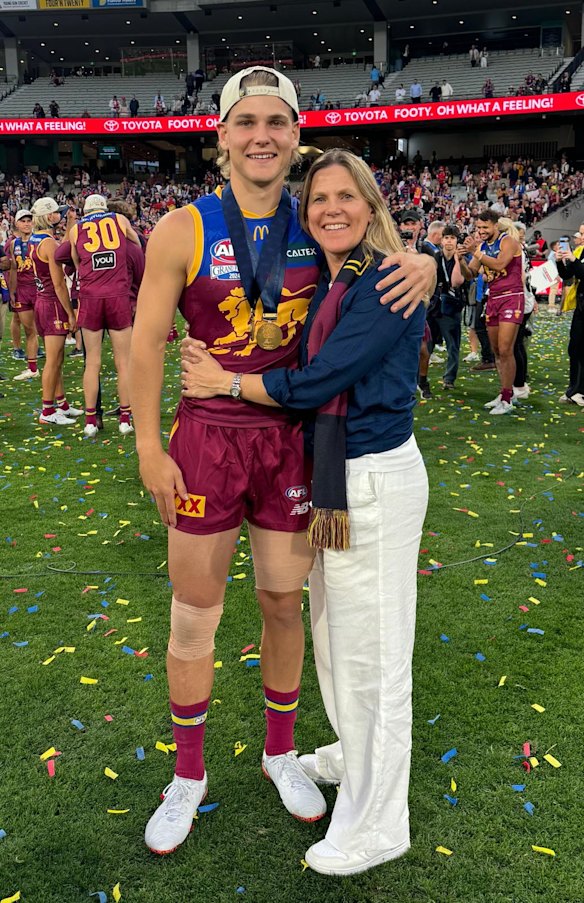
Ashcroft is close to mum Bekky, who says she’s focused on raising good people first, good footballers secondCredit: Courtesy of Will Ashcroft
Ashcroft will never forget the conversations he had with his mum at the end of the 2025 season. “My mindset was to celebrate, then move on to the next thing pretty quickly.” His mum made him stop and reflect back to their time together in the hospital room after his ACL surgery. Remember how hard it all was, and appreciate how far he’d come since. “She was in those moments with me, checks me on them. She makes sure I’m not in my head and that I’m being appreciative before I move on to the next thing.”
Good job, Mrs Ashcroft.
Get the best of Good Weekend delivered to your inbox every Saturday morning. Sign up for our newsletter.