
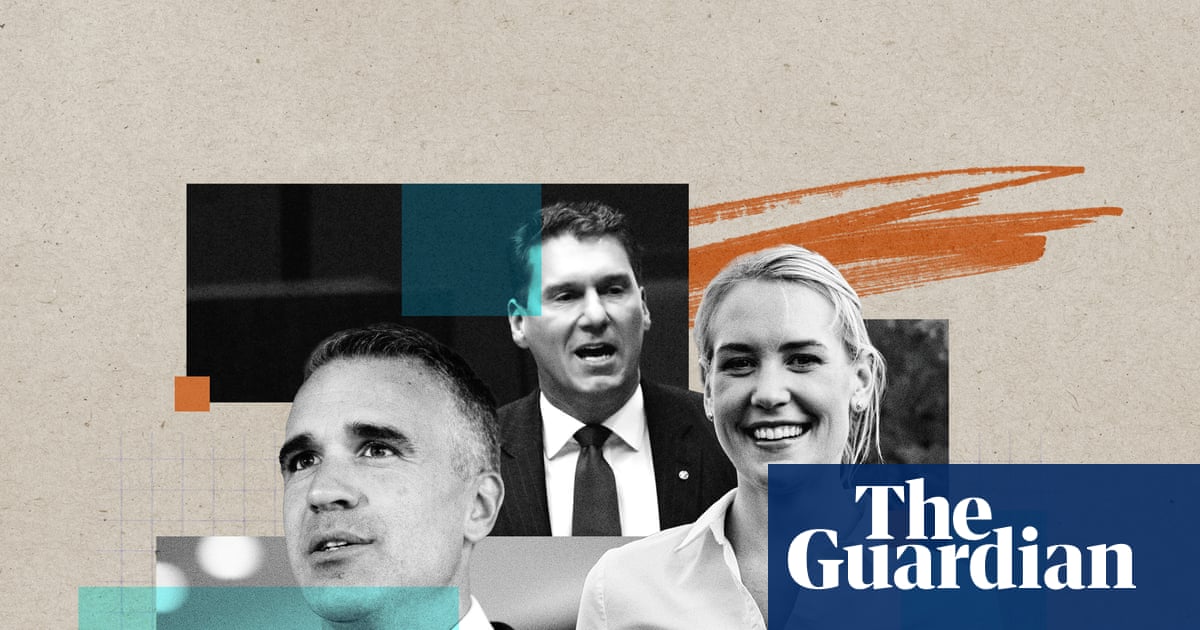
Ashton Hurn entered her campaign launch to the strains of Ain’t No Mountain High Enough.
Hurn, who stepped into the leadership of South Australia’s beleaguered Liberal party in December – about 100 days before the 21 March election – has consistently used mountain metaphors for the task ahead of her.
The seemingly insurmountable obstacle she faces is the utter domination of the Labor party, with the latest Newspoll showing the Liberal primary vote at 14%, a level that could leave it without a single seat. The poll taken last week put One Nation’s primary vote at 24%, with Labor on 44%.
The craggy valleys Hurn faces include a party that got smashed at the last election and has lost more seats since; the conservative faction dominating the party machinery; a very popular premier; the taint of the turmoil in the federal party; and the menacing threat of One Nation.
“Someone asked me what mountain. And it’s probably Mount Everest … it’s not Mount Lofty,” she says, referring to a popular weekend hiking trail in Adelaide.
“You just do it one step at a time.”
As the One Nation vote has surged, so has interest in SA’s election. Will it be the harbinger of a federal shift?
Rob Manwaring, a political scientist at Flinders University, says state elections usually don’t have a great deal of bearing on federal politics. “This is different, though, because for the first time we’ll get a stronger sense of how the One Nation vote might fracture and splinter the far-right vote overall.
“It tells us something about the total disarray and carnage in the Liberal party.”
Peter Lewis, the executive director of Essential – which produces the Guardian Essential report – says its data shows One Nation’s vote in SA running lower than in other states, particularly Queensland and NSW.
“On one level the national One Nation vote is hypothetical because the [federal] election is so far away,” he says.
But “SA is the interesting first test of whether intention translates to actual ballot box endorsement”.
Labor domination
Polling has consistently shown Labor, under the popular, footy-playing premier, Peter Malinauskas, heading for a colossal win.
The current 47-seat House of Assembly has 28 Labor, 13 Liberal and four independents MPs; two seats are vacant. On at least one analysis of the polls, even before the shocking Newspoll, the Liberal party might not retain a single lower house seat, potentially leaving One Nation as the official opposition.
‘There’s a risk when people rush to simplistic, populist policy that might make … complexities worse rather than better,’ says Peter Malinauskas. Photograph: Matt Turner/AAP
“I’ve probably spent less time thinking about One Nation than you might think,” Malinauskas says.
“I’m more interested in what they represent as a phenomenon globally where the rise of populist parties and populist politics has combined with polarisation in a way that concerns me … The world is becoming a more complex place and there’s a risk when people rush to simplistic, populist policy that might make those complexities worse rather than better.”
He warns against dismissing legitimate concerns of those drawn to One Nation, but in a speech on Wednesday took aim at its anti-immigration policies, asking: “Who’s going to feed you and bathe you and wipe your bum when you’re 90?”
Asked what concerns him, Malinauskas nominates hospital ramping – a key election promise was to fix it, which hasn’t happened “despite a record investment in health”, he says.
Ramping is sure to be high on Hurn’s list, too; as the opposition health spokesperson, she took that fight up to the government. She also names energy bills, housing and the health system more broadly as areas where Labor has failed.
Other issues have plagued Malinauskas’s premiership, although none large enough to dent that popularity. Three ministers have resigned; he was tangled up in the cancellation of Adelaide Writers’ Week; the algal bloom hit on his watch and some complained of inadequate communication; he battled issues at Whyalla steelworks and with a planned green hydrogen plant; and presided over sporting events and developments that some say had too high a price (for the parklands in a couple of cases, unease at the Saudi-backed LIV golf tournament in others).
Malinauskas says the government has taken decisions “consciously and understanding the challenges” and says the state currently has “the biggest economic opportunity we’ve had since world war two” with full employment, the fastest growing wages and a high standard of living. He can also be proud of the state’s renewables uptake.
His social media ban, ultimately adopted at a federal level, led the hosts of The Rest Is Politics podcast – Alastair Campbell and Rory Stewart – to call him a “mutual hero”.
Crisis after Liberal crisis
The SA Liberal party has forever been caught in a delicate (and sometimes indelicate) power balance between the conservatives and the moderates. In recent years, a more hardline conservative element led by the federal senator Alex Antic has staged what one senior Liberal has called “a takeover” of the branches.
While that rumbled on in the background, a cluster of mini-crises has hit the parliamentary party.
The former leader David Speirs won his seat of Black in 2022 with just over half the primary vote – then quit after being arrested on suspicion of drug offences (he later pleaded guilty to two counts of drug supply). Labor scooped up Black at a byelection, but there’s a chance Speirs will have another crack as an independent.
‘I’m aware of the task at hand, and it’s a big challenge, but I’m also just determined to do a good job at it,’ says the SA Liberal’s new leader, Ashton Hurn.
Labor also picked up Dunstan after the former premier Steven Marshall retired.
Troy Bell, a Liberal turned independent in the seat of Mount Gambier, was found guilty of 20 charges of theft and five of dishonest dealing with documents and sentenced to up to five years in prison. His seat has been empty since September.
Another Liberal turned independent, Fraser Ellis, is contesting Narungga while appealing after being found guilty of four counts of deception over misused travel allowances.
And then there’s Nick McBride in the seat of MacKillop, who quit the Liberal party warning of “dark forces” within and is hoping to hold his seat while facing charges of aggravated assault against his estranged wife, which he denies.
Speirs was replaced as leader by Vincent Tarzia, who was elected in August then quit in December, delivering a hospital pass to Hurn.
Hurn, an accomplished, eloquent, well-respected MP with a young child, was left looking at what some see as a glass cliff. “This is something that of course I didn’t look for, but it’s something that my colleagues have encouraged me to do,” she said when elected.
She rejects the glass cliff characterisation. “For me, my colleagues saw in me someone who’s a leader, who can give it their all,” she says.
“I’m aware of the task at hand, and it’s a big challenge, but I’m also just determined to do a good job at it. There’s no point looking back and wishing for something else.”
Preferences – it’s anyone’s guess
One Nation’s new upper house lead candidate, Cory Bernardi, says the party will contest every seat and claims it would “be the strongest voice of opposition that this government has ever faced”.
On Friday, the same day the Newspoll was released, a YouGov poll in Adelaide’s Advertiser also had One Nation ahead of the Liberals on primary votes, but by a much narrower margin, 22% to 20%, with Labor on 37%. Calculating the two-party-preferred vote against the Liberals, it gave Labor a 59% to 41% lead.
Manwaring says it is hard to know how preferences will flow, as voting patterns become more volatile and people increasingly do not follow how-to-vote cards.
Cory Bernardi in 2019. The former Liberal senator is the latest high-profile politician to join Pauline Hanson’s One Nation. Photograph: Mike Bowers/The Guardian
The One Nation vote will be stronger in regional and rural areas, and more complicated in seats with sitting independents.
Manwaring says One Nation has a history of “terribly weak party machinery”, a lack of discipline and candidates who defect. Pauline Hanson has outstanding personal brand recognition – but it’s not her name on the ballot paper.
“Pauline’s got a big profile because she’s been in politics for 30 years,” Hurn says.
“But a vote for One Nation guarantees a Labor government.”
Where One Nation could make a real difference is in the upper house. Half of the Legislative Council’s 22 seats are up for grabs, and there is a grab bag of independents and minor parties slogging it out against the major parties and the Greens for the scraps.
Insiders think Bernardi will very likely get in, with another One Nation MLC – Carlos Quaremba, the state party president who was the lead candidate until Bernardi came along – also a strong possibility.
Lewis agrees with Manwaring that SA is not the comfiest home for the party.
“If you wanted a live test of your viability [as One Nation], you probably wouldn’t choose SA,” Lewis says.
“There’s a very popular incumbent, a traditionally more moderate conservative base, a less populated rural area.
“But maybe it becomes a bit of ‘New York, New York’ – if I can make it there, I’ll make it anywhere.”