
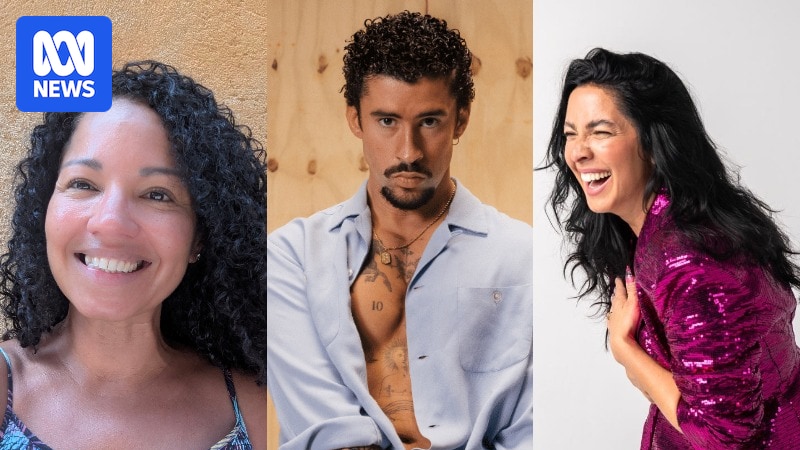
When she was seven years old Erika Cramer was kidnapped by her father and taken to live in his homeland of Puerto Rico.
“Being taken from your mom and your dad forcing you to stay in a country that you hadn’t known anything about was horrible,” she says.
“But it kind of was amazing because I learned so much.”
As an adult she moved to the outer Sydney suburb of Mt Druitt. The culture shock was immense, and deepened when she went looking for people who shared her experience.
“I started a Facebook group called Puerto Ricans in Australia. I was the only member,” she said.
Then she heard the music of Benito Antonio Martínez Ocasio — Bad Bunny — a rising reggaetón star.
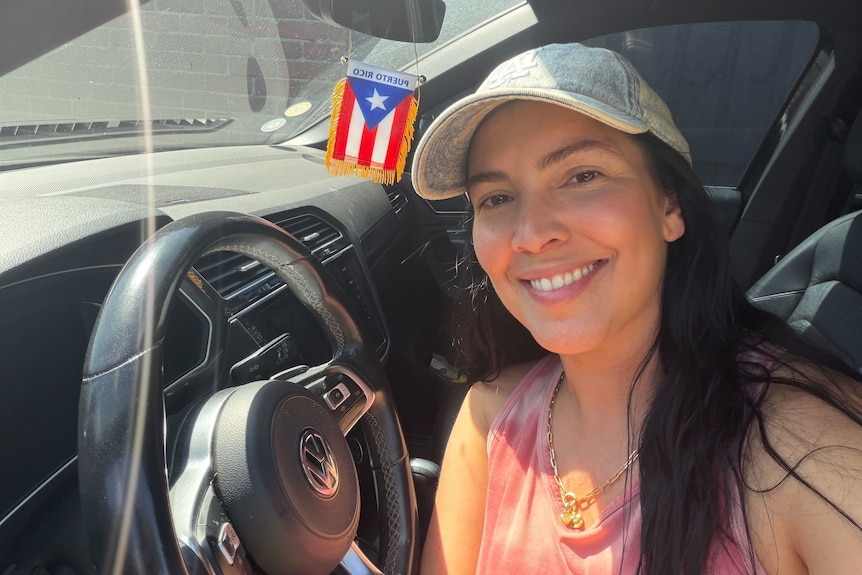
Erika Cramer struggled to find fellow Puerto Ricans when she moved to Australia. (Supplied)
As hundreds of millions witnessed at this month’s Super Bowl, Bad Bunny isn’t just Puerto Rican, he wears his identity loudly.
For an isolated woman seeking connection with her culture, he felt like family.
“A lot of people are like ‘oh, he’s sexy’ and I’m like, ‘No! He feels like a younger cousin,'” Ms Cramer says.
“I don’t feel that with any artist. I think it’s from the music and the instruments and the stories and the culture.
“He brought every age group together and it’s so different and unique.
“I think the lyrics matter as well. He talks about the island and he talks about our people in a good way.”
Bad Bunny’s global moment — and why it matters
Between a history‑making Super Bowl performance and a Grammy win for Album of the Year, Bad Bunny is having a big month.
His next stop is Australia where he’ll play two enormous stadium shows in Sydney’s west — a long way from the Caribbean island he so proudly represents.
The concerts form part of a world tour behind Debí Tirar Más Fotos, the deeply Puerto Rican album that he launched with a 31‑show residency in San Juan, injecting an estimated $US400 million ($576 million) into the local economy in the process.
His success is on a scale we rarely see from any artist, let alone one performing almost entirely in Spanish.
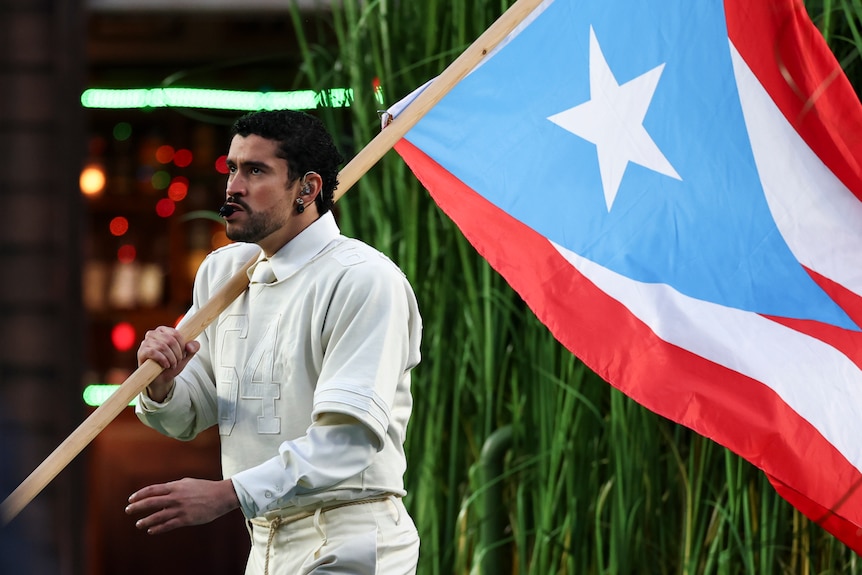
Bad Bunny waves the Puerto Rican flag at his Super Bowl half-time show. Flying the flag was illegal in the US from 1948 to 1957. (Getty: Ishika Samant)
Bad Bunny’s rise is often reduced to numbers — he holds 12 Guinness World Records after all — but the real phenomenon lies in how he has brought Puerto Rico to the global pop stage without softening or sanding down its edges.
“Music is deep at the heart of Puerto Rican identity,” says Dr Yadira Pérez, a Melbourne‑based anthropologist and proud Nuyorican — New York‑born Puerto Rican.
“When people think of Puerto Rico they think of salsa and merengue. Before that we had classic Bomba and traditional music.”
Bomba and Plena — styles rooted in resistance, storytelling, and community — have long been central to Puerto Rican culture. Bad Bunny threads them into modern reggaetón and pop in a way that feels less like fusion and more like continuity.
While fellow Puerto Ricans like Jennifer Lopez, Ricky Martin and Daddy Yankee have maintained a visible pride in their heritage, Bad Bunny makes Puerto Rico not just visible but unavoidable in his music.
“He’s really brought it into the mainstream,” Ms Cramer says.
“He brought in those Bomba elements — the old school outfits and the instruments — but he made them global.
“It’s beautiful because it feels like it’s a piece of you. It reminds you of your culture and your family. Your grandparents and all the stories you’ve heard with your family growing up, it really reignites that.
“It is kind of like building a family memory for all Puerto Ricans around the world, even if you weren’t a part of his family.
“He really brought back that culture and reminded us of who we were and what we stand for and what our music is about.”
A bigger stage with no compromises
In Western pop, success has often meant stripping out the very traits that make an artist singular — even when those traits are deeply cultural. That’s why Bad Bunny’s rise — without sanding down his identity — feels unprecedented.
“As an anthropologist I’m amazed when people can stay at the boundary of different cultures and languages and yet still be themselves,” Dr Pérez says.
She believes his ability to unite and celebrate what makes him who he is resonates across cultures.
“It’s not only his courage but his realisation that power lies in community,” she says.
“If you can connect community and bring them along with you then that’s success. That’s one of his superhero powers — that he brings the community along.
“I think, even if he hadn’t reached the global platform, his pride and his community being centre stage would have still been success for him.”
It isn’t only preservation that makes him compelling, he’s equally focused on the present.
“His ascent is now because the context demands it — the political climate, the humanitarian climate,” Dr Pérez says.
“He speaks about colonisation, but also the vulnerability of islands and humanity with shifting environments. Puerto Rico has faced hurricane after hurricane.
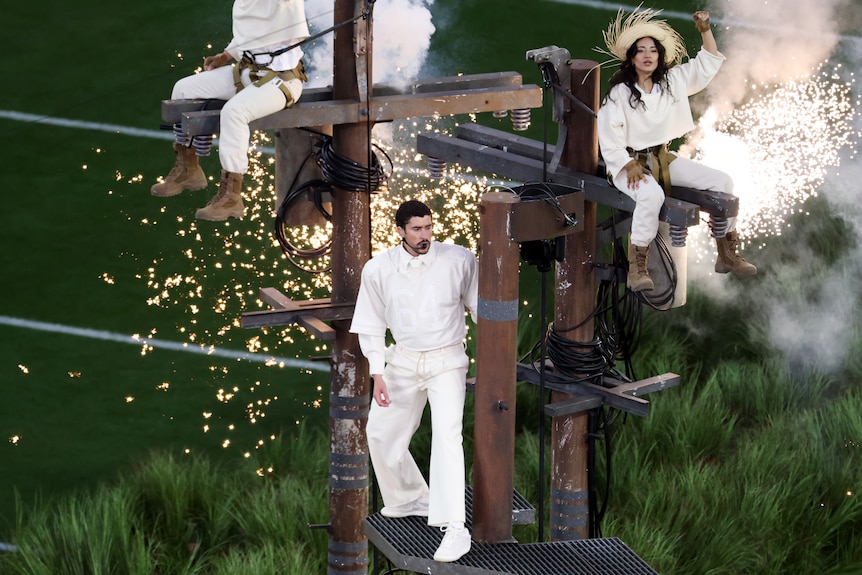
Bad Bunny referenced Puerto Rico’s unstable electricity supply issues in his Super Bowl half-time show. (Getty: Ishika Samant)
“People are looking for places where heavy cultural and political issues can be discussed without isolation or division. His album brings out these issues in ways that have us move our bodies, come together.
“It’s a way of being that’s needed now. We can be different, think differently, and still centre community and land rights and the re‑evaluation of colonial relationships.
“We’re longing for that — to dance, to connect, and also ask ‘How are we going to belong responsibly?'”
That longing — to connect across borders while holding on to who you are — sets the stage for his arrival in Australia.
From San Juan to Sydney
Australia’s Latino population is small — about one per cent — but Dr Pérez says the themes in Bad Bunny’s music land far beyond diaspora circles.
“There’s resonance for Latin American and Caribbean descendants because of themes of migration, belonging, identity,” she says.
Loading Instagram content
“But it’s not just us. His music speaks to being connected to places and lands elsewhere, and to the things that shape us. That’s a migrant experience, but also a global human experience.
“There’s also this permission in his songs to be uniquely you — to be specific, not generic. Bring your differences and connect.
“Australians love music, they respect artists, and witnessing an artist say ‘bring your edges, bring your differences’ is powerful.”
Bad Bunny’s refusal to play by pop’s rules extends to his public image.
“Yes, he’s Puerto Rican, but he’s also someone pushing the boundaries of gender roles and masculinity,” Dr Pérez says.
“He’s from a small island — Puerto Rico has fewer than four million people — and he brings culture, music, and invites people to re-examine roots while making space for who they are, leaving behind homophobia, leaving behind colonial baggage.
“Australians look at him and see important conversations that are relevant here too. These aren’t abstract ideas — they’re current, real.”
Both women see Bad Bunny’s success in Australia as a perfect opportunity for people who live here to learn more about Puerto Rico.
“We’re not in South America and we don’t eat tacos,” Ms Cramer says, referencing the most common misconceptions she hears about her homeland.
“But the [Latin] music they hear, most likely a lot of it is from Puerto Rico. Come and enjoy and dance and figure out the culture with us because it’s so much nicer when there’s more people involved.”
Meet the Latin-Australian artists spitting bi-lingual bars
She hopes Bad Bunny’s tour may also inspire some of her fellow Latinos to be more visible and proud.
“I think we have to represent as Latinos and take people with us and not be shameful about our accents or about our difference,” Ms Cramer says.
Bad Bunny’s appeal is, in the end, an invitation — a reminder that identity doesn’t need to be diluted to be shared, and that distance from home doesn’t diminish its strength.
His music offers a place where people can recognise themselves fully, without apology, continents away from the places that shaped them.
“Why continuously struggle without hope?” Dr Pérez says.
“Why isolate ourselves because we’re different?
“There’s permission to bring layered identities to the party — migrants, Australians, people on Indigenous lands, people from colonised worlds.
“We don’t think the same, but here we are dancing and moving. We’re not expected to solve everything at once — but we should be in discourse.
“But first let’s dance. It’s powerful.”
Bad Bunny plays the Sydney Showground Stadium this Saturday and Sunday.