
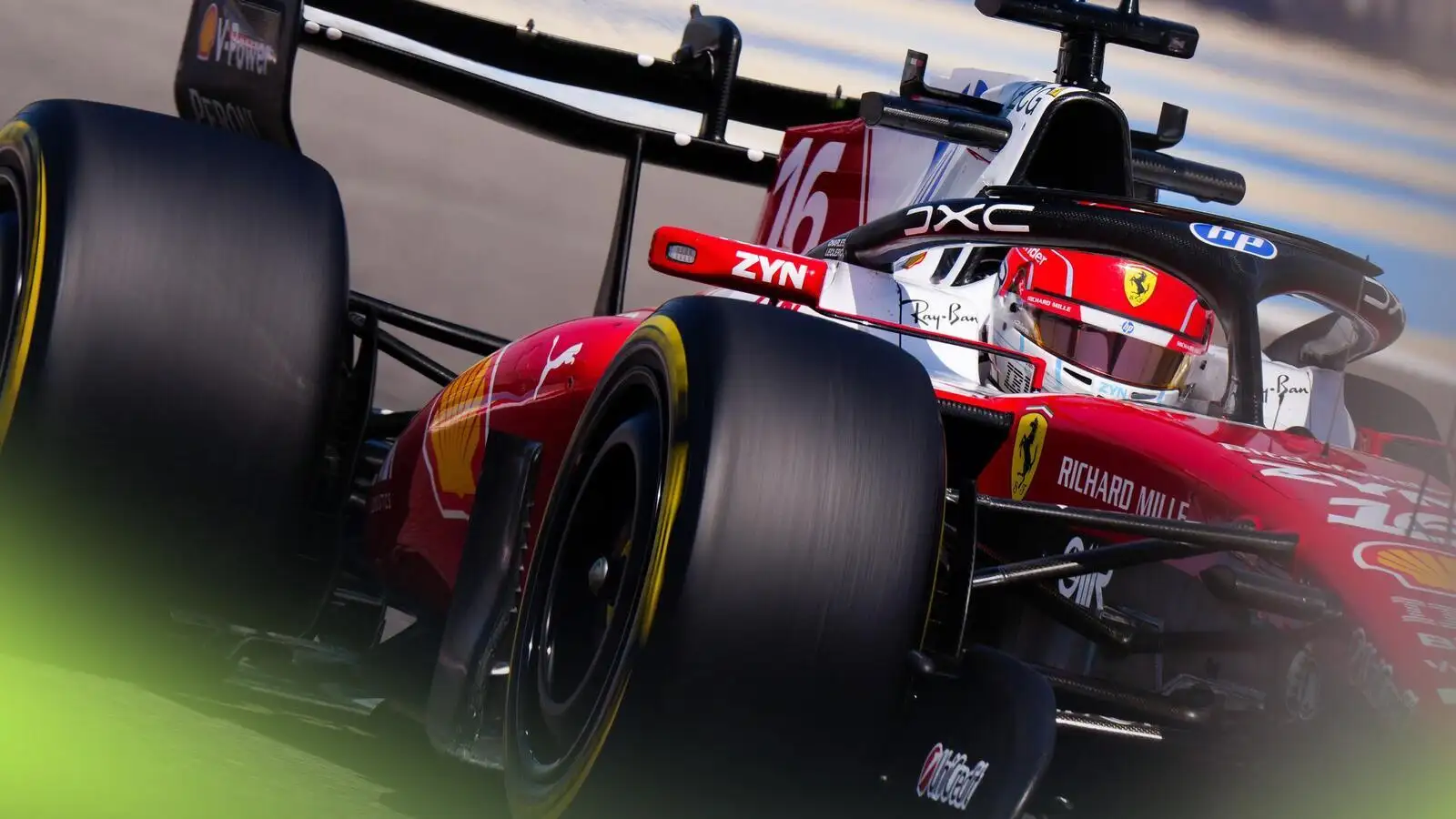
Formula 1’s 2026 revolution has finally broken cover in Bahrain and the telemetry and revealed some eye-opening facts.
For the first time, the speculation can be stripped away and replaced with hard data — a straight, unfiltered lap-time comparison with 2025.
F1 2026 vs 2025 lap time telemetry breakdown
Want more PlanetF1.com coverage? Add us as a preferred source on Google for news you can trust.
Let’s dive into the telemetry and compare the all-new generation of F1 cars with those from last year, the final year of a four-year regulatory cycle.
By now, we are likely all well-acquainted with the technical overhaul the 2026 season brings: three times more electrical power resulting in a 50:50 split between the V6 and electric motors, a completely fresh aerodynamic philosophy, and perhaps the biggest change for us fans: Overtake and Boost modes.
These two modes act as a replacement for the now-traditional DRS system and, in theory, this should make the act of overtaking on track significantly easier, which one would hope leads to more captivating races.
From 2026 onwards, every driver will be permitted to use active aerodynamics (on both the front and rear wings) alongside Boost mode during every lap of the race, while Overtake mode is unlocked specifically when you are within one second of the car ahead.
So, how do these radical changes look through the lens of telemetry data?
In the graph below, you can see a comparison between the best 2026 pre-season lap set on the final day by Charles Leclerc, and the fastest 2025 pre-season lap by Carlos Sainz in the Williams.
What stands out immediately is the staggering difference in top speed on certain straights and through the corners.
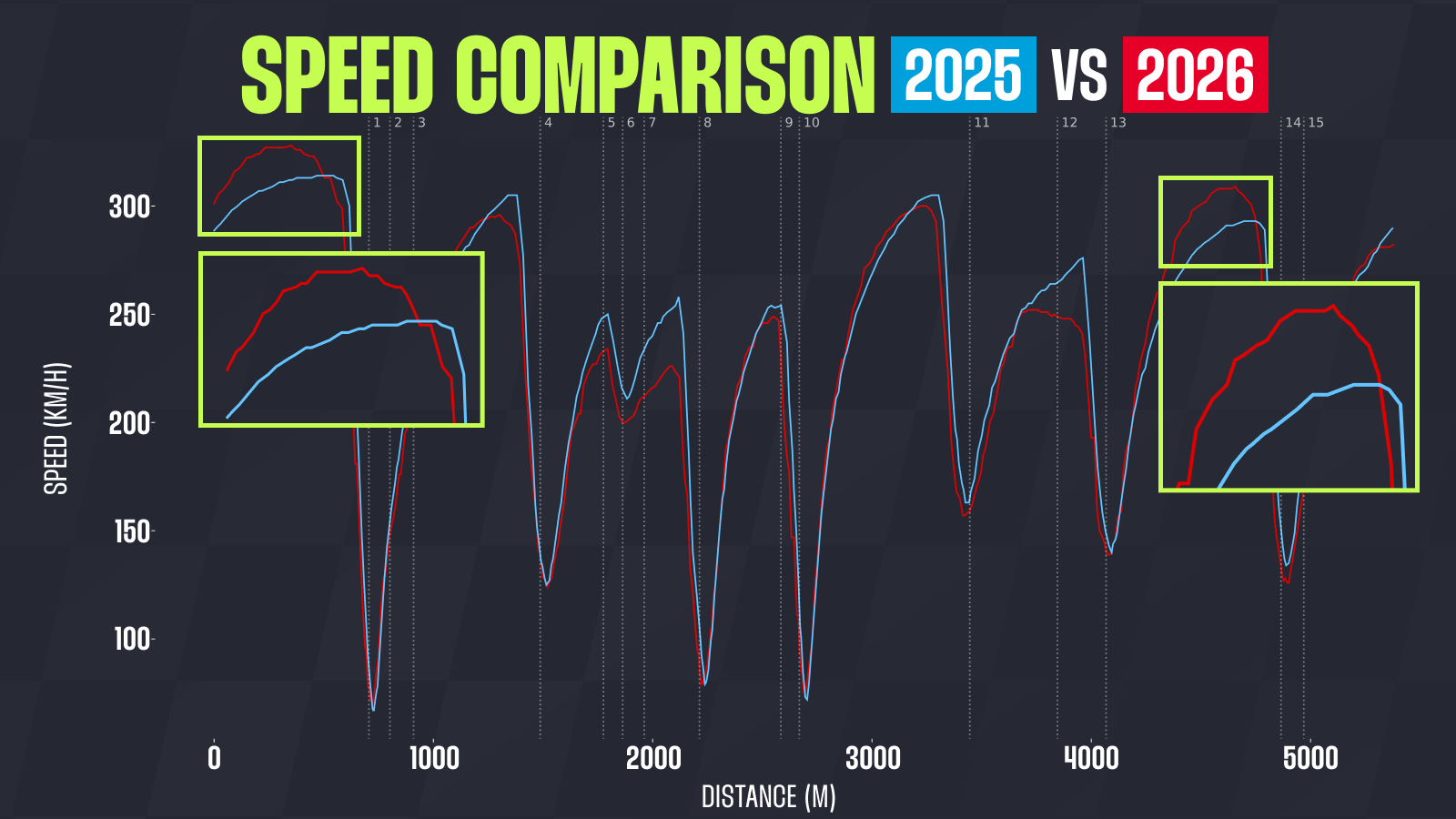
The 2026 car accelerates incredibly on the start-finish straight, while its top speed is also notably higher compared to the 2025 car. This is equally evident on the straight between Turns 13 and 14.
The primary reason for this heightened acceleration is precisely the “boost” from the three-times more powerful electric motor, which turns the car into a rocket ship when activated.
Furthermore, the smaller dimensions of the car and significantly reduced drag allow it to reach these higher peak velocities.
For the sake of comparison, Sainz reached a maximum of 314 km/h on his lap in 2025, while Leclerc in the new generation clocked 328 km/h.
Interestingly, Audi pushed this figure as high as 341 km/h.
However, one must also pay close attention to the exact point where Leclerc hits his maximum speed.
We can see that the 2025 generation reaches its peak only at the very end of the straight, just before the braking zone.
In contrast, the 2026 car hits its top speed roughly halfway down the straight, after which its velocity begins to dwindle. Essentially, just before entering the corner, the 2025 car actually holds the speed advantage.
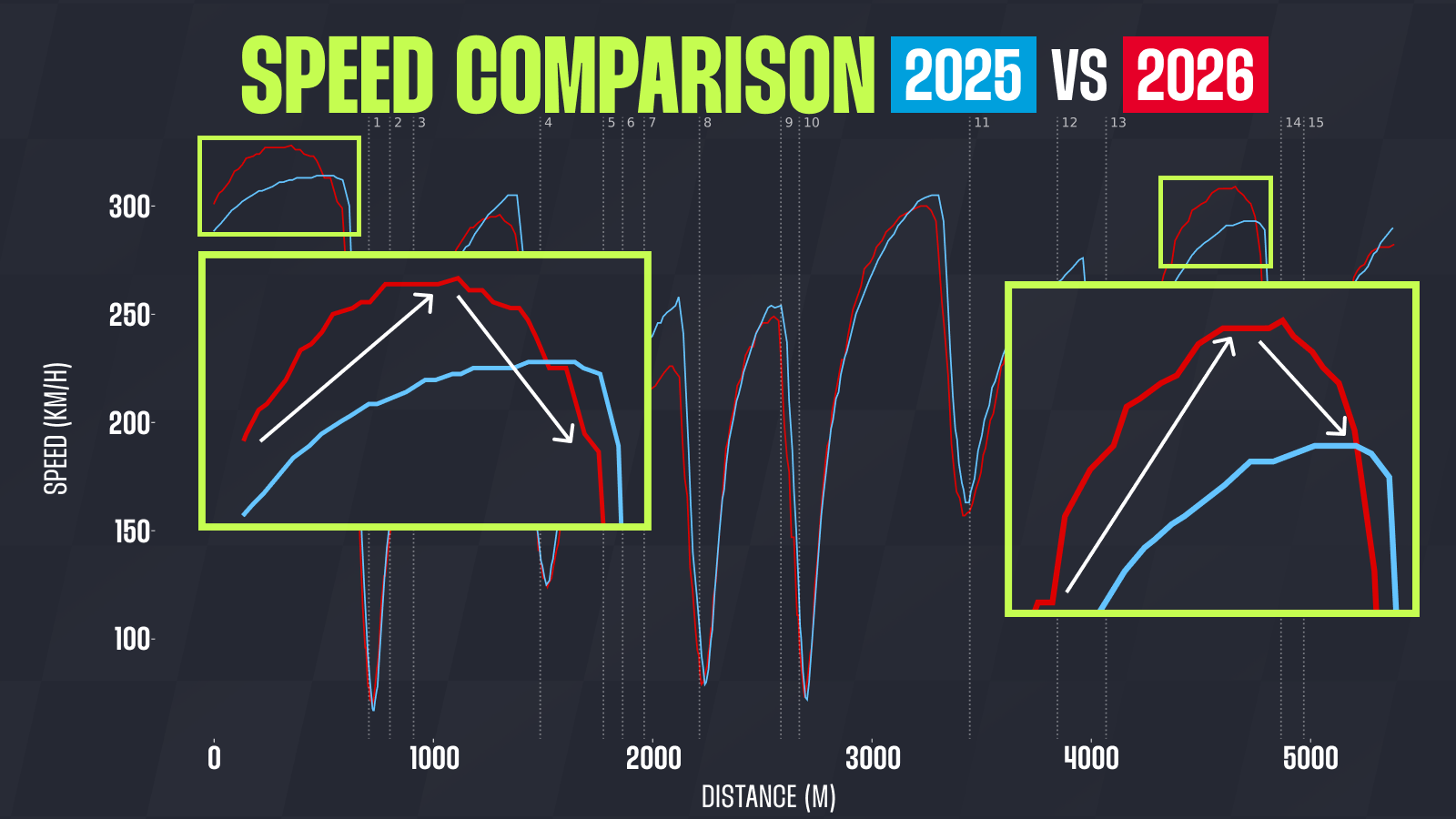
This phenomenon is known as “clipping,” and the root cause is that, from the midpoint of the straight, the battery is depleted.
When that happens, a portion of the V6 internal combustion power is diverted to recharge the battery, which drastically kills the top-end speed.
This brings us to the next major divergence between the two generations, which becomes clear if we include throttle and brake application in our analysis.
To keep their batteries topped up, drivers will have to constantly employ “lift and coast” tactics.
Effectively, drivers are now rolling off the throttle earlier and leaving the initial slowing down to the ERS system, which harvests energy from the rear wheels and converts it into electricity.
Only after a short delay do the drivers then hit the brake pedal to prepare for the corner.
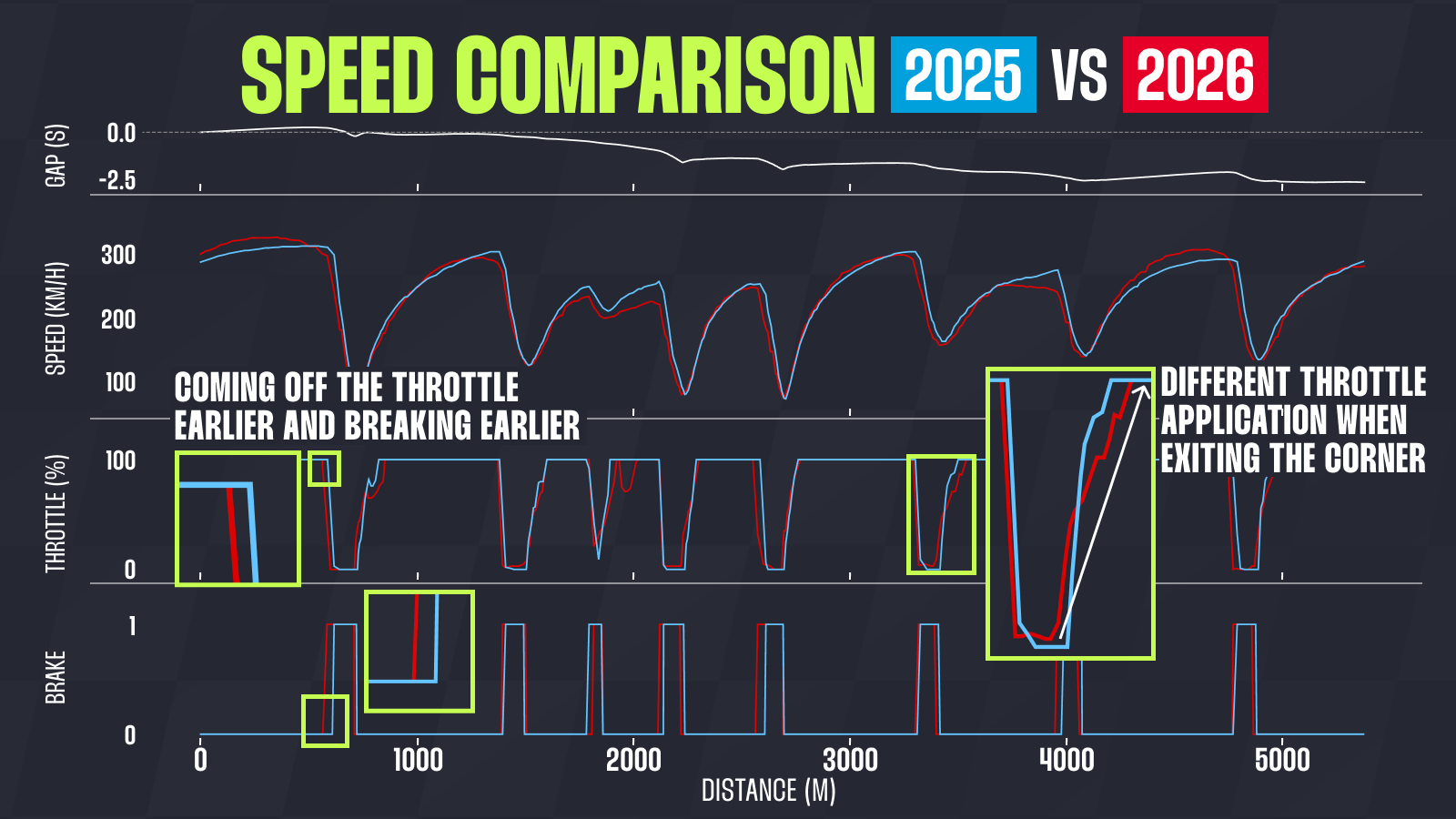
This pattern is visible at almost every turn on the Bahrain circuit, though the difference is most pronounced when entering T1, T11, and T13.
Beyond this, we can observe that the throttle application when exiting a corner is also different – it now takes noticeably longer for a driver to reach full throttle.
The main culprit? Significantly less downforce at the drivers’ disposal due to a completely different aerodynamic philosophy.
The previous generation of cars relied on the “ground effect” as their primary source of downforce, which is no longer the case as floors under the new regulations must be almost entirely flat – similar to the 2021 generation of cars.
In theory, a lower amount of downforce and the “inwashing” effect that the FIA wants to impose on teams results in less “dirty air” trailing the car, meaning the driver behind can follow more closely.
During pre-season testing, we saw some truly ingenious solutions which suggest that, thanks to the brilliance of F1 engineers, the FIA technical regulations might not be perfectly watertight.
Consequently, during the upcoming season, we can expect even more clever designs to claw back downforce, though certainly nowhere near 2025 levels.
Because of this, cars are noticeably slower through high-speed corners in the new 2026 season, something the telemetry data firmly confirms.
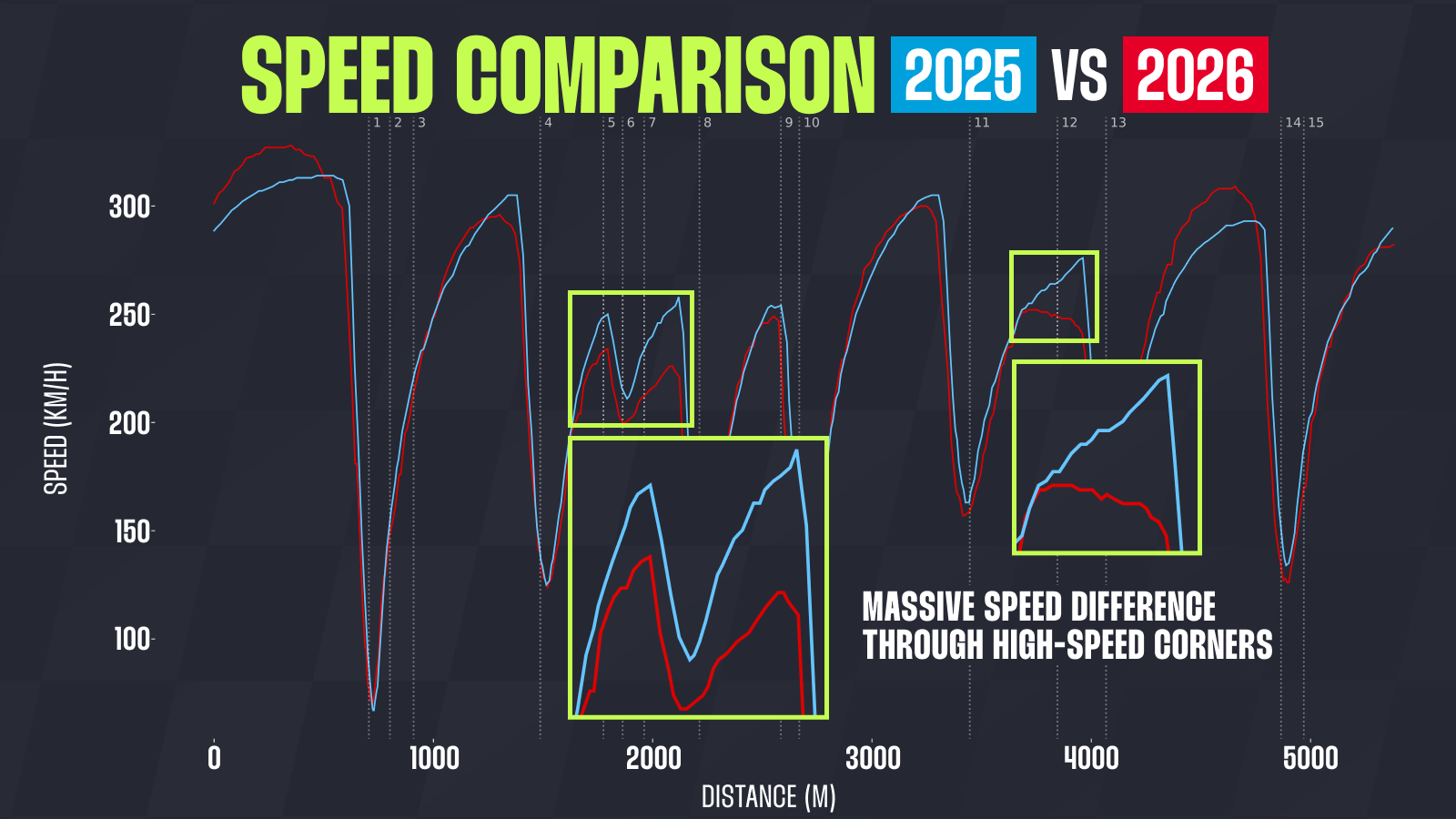
Just look at the speed disparity in T12, as well as in the high-speed “S” section of turns 5, 6, and 7. In these parts of the track, the new generation looks like a lower tier of racing compared to its predecessor.
We have already written in detail about the phenomenon at T12 and Fernando Alonso’s famous quote that even their team chef could drive the car in such a manner.
The core issue is that this speed difference occurs even though both drivers are at full throttle.
Teams have identified T12 as an ideal spot for battery harvesting; this means that even while the driver keeps his foot down, a chunk of the V6 power is diverted to the battery rather than driving the car forward.
Under the rules, as much as 250kW can be “stolen” from the roughly 400kW V6 for charging, leaving the driver with only 150kW of power – an incredibly low figure for F1.
Notice how the speed through T12 constantly increases for Carlos Sainz, whereas for Leclerc, it is on a shallow but constant decline.
All of this leads us to the ultimate question: will these changes actually make the racing more entertaining?
As is often the case, opinions and answers to this will likely vary. We are definitely getting a different brand of racing; whether it will be to everyone’s personal taste remains to be seen.
During the last generation, overtaking happened almost exclusively in the DRS zones, usually the longest one on the track.
Now, however, cars hit their peak speeds mid-straight rather than at the end, and the primary overtaking aid will be a massive surge of electrical energy.
More analysis from F1 pre-season testing in Bahrain
F1 testing conclusions: Bring back V10s, fresh Aston Martin hope, secret Ferrari weapon
Ferrari unveils radical exhaust flap ahead of F1 2026 aero fight
An early assumption is that we might see overtakes in rather unconventional spots compared to previous years, and that drivers will find it easier to defend, potentially making battles last longer.
Potential “wheel-to-wheel” duels lasting longer is surely a plus, but the biggest fear is that fans might feel more disconnected from the fight – in other words, they won’t quite know why or how someone managed to pass or defend.
The electrical system and energy management hold immense power over the racing, and unfortunately, the viewers don’t have a clear window into what is actually happening behind the steering wheel.
How the whole situation will unfold when 22 drivers are on track together, adding variables like tyre degradation and raw car performance is still impossible to predict.
What is absolutely certain for now is that it will be different, and as spectators, we will simply have to get used to this new era of the sport.
Want to be the first to know exclusive information from the F1 paddock? Join our broadcast channel on WhatsApp to get the scoop on the latest developments from our team of accredited journalists.
You can also subscribe to the PlanetF1 YouTube channel for exclusive features, hear from our paddock journalists with stories from the heart of Formula 1 and much more!
Read next: F1 testing 2026: How each team performed over six days of running