
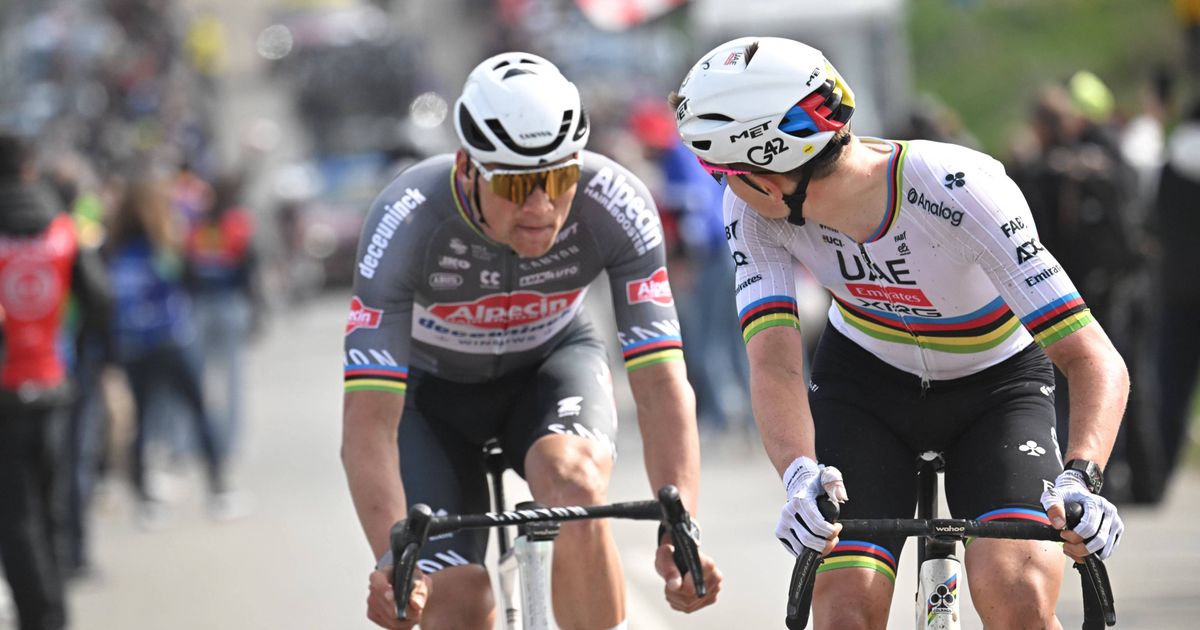
The Belgian’s reasoning goes beyond form or physique. It is about hierarchy. “Tadej, we’re here for you. We believe in you. But don’t forget: we mainly count on you in July.” Even if never stated as a restriction, Gilbert suggests that message inevitably lingers. And in a race defined by chaos, hesitation is costly.
Tour shadow versus Monument instinctPogacar’s Roubaix debut proved he belongs. Second place at the first attempt in a fast, relatively dry edition immediately shifted perceptions about what kind of rider he could be on the pavé. Yet Gilbert draws a distinction between showing you can compete and being completely unencumbered.
“But I want to see it again when we get an edition with really bad weather in Roubaix,” he said. “Last year was a fast edition in good conditions. Then you can get away with a bit more.”
That caveat matters. Roubaix in sunshine is brutal. Roubaix in the rain is something else entirely. When the cobbles turn slick, and the race becomes survival, technical commitment and risk appetite often decide more than watts.
And that is where Mathieu van der Poel enters Gilbert’s thinking. “If Van der Poel enters a corner and it’s ‘crash or win’, he will always be able to take more risk.”It is not simply a comment on bravery. It is a comment on freedom. Van der Poel’s spring is constructed around the Monuments themselves. Pogacar’s year, however expansive, is still anchored in July. One rider builds towards Roubaix as an end in itself. The other must weigh it against the Tour de France.
That structural difference, Gilbert argues, changes who can truly be favourite.
A rivalry defined by margins
The contrast also sharpens the broader dynamic that has shaped the Classics in recent seasons. Between them, Pogacar and Van der Poel have monopolised the biggest one-day prizes, forcing everyone else into narrower windows of opportunity.
Pogacar has already stood on Monument podiums across every terrain. Van der Poel has turned Roubaix into personal territory. Their duels are rarely decided by weakness, but by moments.
Gilbert’s analysis suggests that at Roubaix, the decisive moment is often a choice. How deep into the red do you go? How much do you risk in a greasy corner at 50 km per hour? How much does July sit in the back of your mind?
If the edition is fast and dry, Pogacar’s explosive power and race intelligence keep him firmly in contention. If it begins in Compiègne under grey skies with rain hammering the cobbles, Gilbert believes the balance shifts.
Because in that scenario, Roubaix rewards instinct over calculation. And for Gilbert, Van der Poel’s “crash or win” edge remains unmatched.
The debate, then, is not whether Pogacar can win Paris-Roubaix. He has already shown he can contend. The question is whether he can ever be completely free to ride it on his own terms.
And that, according to one of Belgium’s greatest Classics riders, is why he will never quite be the favourite.