


Updated February 22, 2026 — 11:23pm,first published 11:01am
Save
You have reached your maximum number of saved items.
Remove items from your saved list to add more.
Save this article for later
Add articles to your saved list and come back to them anytime.
Got it
AAA
The Coalition will challenge Prime Minister Anthony Albanese to take further steps that stop the return of so-called Islamic State brides to Australia, seeking the introduction of laws that criminalise the actions of NGOs or advocates who help people linked to terrorism come back into the country.
New Liberal leader Angus Taylor sought to turn up the pressure on Labor after Home Affairs Minister Tony Burke insisted on Sunday that the government was not assisting the 34 Australian women and children linked to Islamic State who are trying to return, aside from what was legally required.
The proposed laws signal Taylor’s first move to “shut the door to people who do not share our values” – the pledge he made when he seized the Liberal leadership this month as polls indicated Coalition voters were switching to One Nation.
Burke and Albanese have taken a hard line on the women and children who have been trying to leave the deteriorating al-Roj camp in north-east Syria, but point to legal requirements and bureaucratic processes to explain why the group has received Australian passports.
“We do not want the individuals in Australia,” Burke said on the ABC’s Insiders program. “Legally, you can’t stop a citizen from entering your country. Legally, if a citizen applies for a passport and the authorities don’t think thresholds are reached to be able to block it, then a passport gets issued.”
The Coalition is also pressuring the government to use temporary exclusion orders to deny the group re-entry. The orders are designed to protect Australians from national security risks.
One of the women will be prohibited under such an order from entering the country because she was deemed by intelligence agencies to pose a higher risk than the rest of the group, Burke said on Sunday, but none of the other 33 group members had met the threshold for an exclusion order.
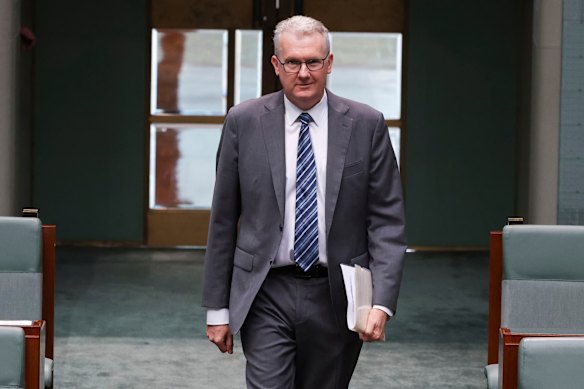 Home Affairs Minister Tony Burke.Alex Ellinghausen
Asked if that meant they did not pose a threat, he said: “That’s right … If at any point the agencies decide that a further brief should come to me, I would deal with that immediately.”
Burke said agencies had been following the women and children for a long time, and each had different histories and states of mind.
“One of my concerns with how the opposition have handled this, is they’ve effectively said the minister should be able to make it up… as though somehow in a national security portfolio you should ignore your national security intelligence and law enforcement agencies.”
Still, he said: “We do not want them to come back.”
When asked if he was acting to stop their arrival, Burke said the government was making sure it was doing “nothing to help them at all”.
“Other than a temporary exclusion order, there isn’t a legislative power to be able to stop an Australian citizen from entering Australia,” he said. “So, effectively, that question goes to are we breaking the law, and the answer’s no.”
Related Article
Coalition home affairs spokesman Jonno Duniam said the opposition was willing to work with the government to write new laws as needed to prevent the group’s arrival.
“These are people we don’t think should be back in this country and that pose a risk to our country. Now, if the government are serious, and the minister himself said it again today, ‘We don’t want them back here’, do something about it,” he said.
The bill floated by the Coalition on Sunday would make it a criminal offence to facilitate the re-entry of people linked to terrorist hotspots or terrorist organisations, or who have committed terror-related offences.
This would target the non-government organisations and advocates who have been trying to help the women and children leave Syria as their situation there worsens, such as the charity Save the Children and Dr Jamal Rifi, a man close to Burke and the families who has been in Damascus trying to organise the ill-fated family repatriation.
“We will take action and refuse to let people come here who abandoned Australia to support Islamic extremist terror overseas,” Taylor said in a statement on Sunday. “Anthony Albanese should come to the table and support these laws.”
Burke rebuffed reports in a News Corp article that claimed high-level briefings had been ongoing for months between NSW, Victoria and federal agencies to repatriate the Syria group.
“In that [News Corp] report, it makes a claim that we are conducting repatriation. We are not. It claims we have been meeting with the states for the purposes of a repatriation. We have not,” Burke said.
“Our authorities meet with the state authorities to make sure that we are prepared if there is any chance of there being a heightened risk to national security.
“As soon as the conditions of the camp started to deteriorate, and there was a possibility some people would be getting out, which has happened … the national security teams, the joint counterterrorism teams, meet, as they did under the previous government, as they do now, as is essential for public safety.”
Related Article
A NSW Premier’s Department spokesperson confirmed state agencies were working with the federal government on law enforcement and security arrangements for the group’s potential return.
“NSW has well-established arrangements in place to manage any returnees, with community safety as the overriding priority. These arrangements were successfully implemented in 2019 and 2022 [when other cohorts returned to Australia].”
Former Home Affairs Department head Mike Pezzullo told a parliamentary inquiry in 2022 that the states and the federal government worked collaboratively on these issues.
“If a state government chose to say, ‘We don’t want to proceed’, then I would have thought the Commonwealth would take that pretty seriously, because we have to rely on them for schooling, trauma support, counselling, public health support and the like,” he said. “So it’s done consensually. All that information is put to them, and then they’ll give us the authority to proceed or otherwise.”
Save
You have reached your maximum number of saved items.
Remove items from your saved list to add more.
 Natassia Chrysanthos is Federal Political Correspondent. She has previously reported on immigration, health, social issues and the NDIS from Parliament House in Canberra.Connect via X or email.From our partners