
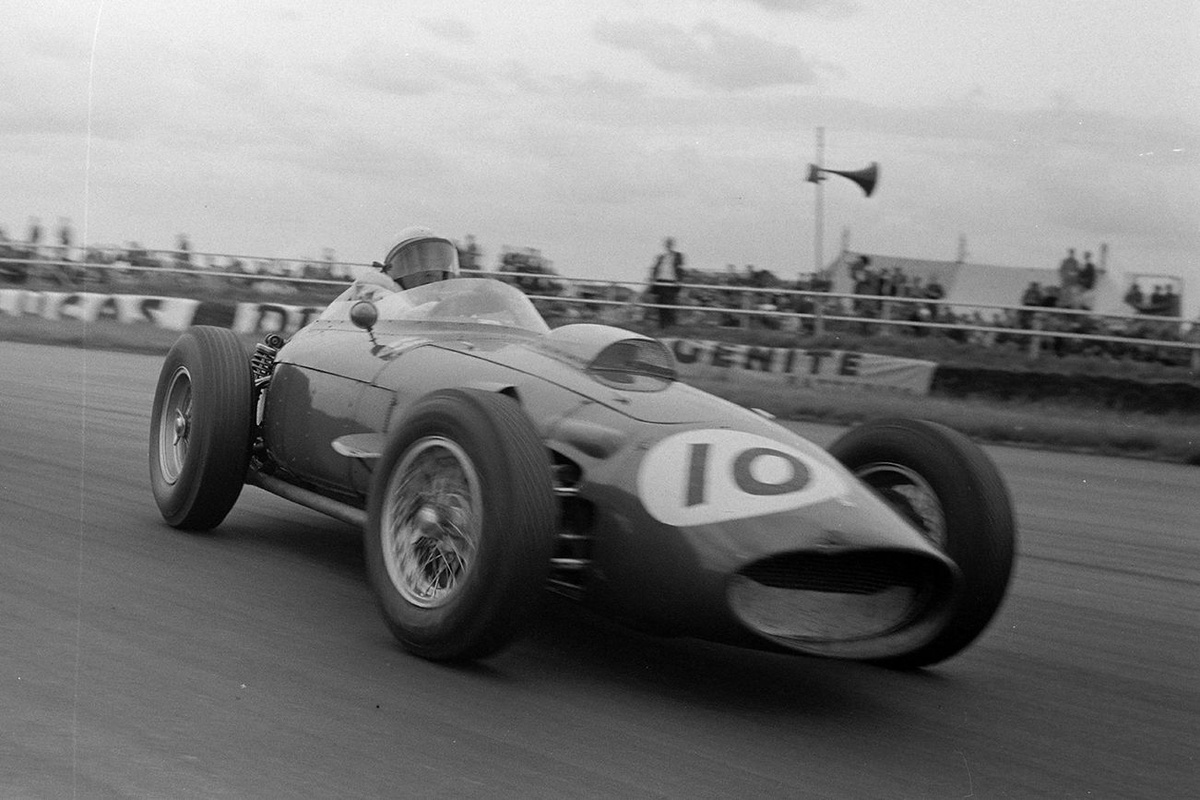
Ferrari had endured a pretty terrible 1957 Formula 1 season. Having won the drivers’ crown with Juan Manuel Fangio the year before, largely thanks to a design inherited from Lancia, the squad was thrashed by Vanwall and Maserati, failing to win a single world championship race with the 801.
The Italian team’s 246 Dino not only revived Ferrari’s fortunes in 1958, it would go on to be the last great bastion of the front-engined F1 car.
With few notable exceptions, the first half-century of grand prix racing was dominated by cars with engines in front of the driver. There had, of course, been chassis developments, but key figures such as Enzo Ferrari tended to look to engine power as the key performance differentiator.
But Cooper was to change that in the late-1950s. Having been successful with rear-engined 500cc F3 cars, Cooper expanded. Its early GP efforts, during the world championship’s brief 1952-53 F2 era, were fairly conventional Bristol-powered machines, but soon it employed its rear-engined approach at the sport’s top level. And Ferrari was the toughest traditional name to overcome.
Ferrari revival
The 2.4-litre Ferrari Dino was the work of two engineering legends, Vittorio Jano and Carlo Chiti. The V6 engine, which produced around 270bhp in 1958 form, was a new departure for F1, but the car itself was a well put together traditional design rather than being revolutionary. It arrived just as Cooper’s challenge started to gather momentum.
Cooper’s results had been modest at first, not least because the 1.5-litre and two-litre Coventry Climax engines initially available were underpowered compared to the full 2.5-litre opposition. But the advantages of better weight distribution and lightness were brought into sharp focus at the opening round of 1958.
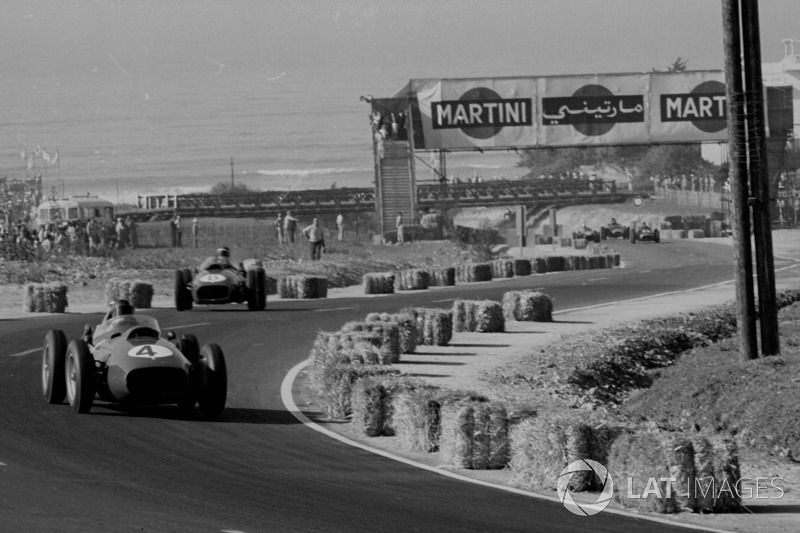
Hill leads Hawthorn at the1958 Moroccan GP before the former allowed his team-mate past
Photo by: Motorsport Images
In Vanwall’s absence, Stirling Moss sensationally won the Argentinian GP in Rob Walker’s privately entered two-litre Cooper T43. Going non-stop in the nimble car, Moss rose from seventh on the grid as the bigger cars pitted. He then kept the wilting rubber alive to beat Luigi Musso’s closing Ferrari by 2.7 seconds.
Stirling Moss’s greatest drives
Any thoughts that this was just a one-off Moss special were dispelled next time out at Monaco. Maurice Trintignant took the same car to victory, albeit assisted by unreliability for the traditional frontrunners.
Thereafter, the Ferrari-Vanwall battle became the main focus of 1958. Vanwall’s Moss and Tony Brooks won more battles, three apiece, to the single victories for Hawthorn (his French GP success being the first for a V6 in the world championship) and Peter Collins, and took the inaugural constructors’ title. But Hawthorn won the war, team-mate Phil Hill moving aside in the Moroccan GP finale to hand him the second place he needed to beat Moss to the drivers’ crown by one point.
Ferrari was back, but the Dino’s biggest challenge was yet to come.
The final chance
Vanwall had gone by 1959, leaving the revised Dino to lead the front-engined charge. As it was, the season would provide the last opportunity for the old way of doing things to win the championship.
That was because Cooper now had a full 2.5-litre Coventry Climax motor for its improved T51. The Ferrari still produced 50-60bhp more but was around 100kg heavier. With Jack Brabham leading the works team and Moss in Walker’s entry, the Coopers were competitive at almost every circuit.
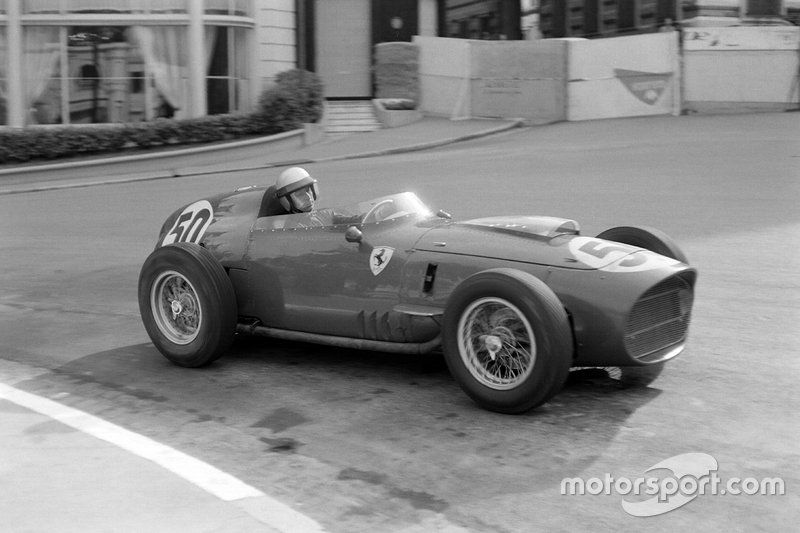
Shortened nose for Monaco messed up the airflow, directing fumes into the cockpit; a nauseous Brooks still salvaged second
Photo by: Motorsport Images
In response, Ferrari made improvements. Disc brakes had replaced drums at the end of 1958, encouraged by Hawthorn, who had retired and then been killed in a road accident. For the new campaign, the Dino had improved rear suspension, new bodywork, a longer wheelbase and five-speed gearbox. It also had Brooks, one of F1’s top-liners.
The season opener in Monaco proved difficult but provided a decent result. Brooks made a cautious start and began inhaling fumes, due to the shortened noses for Monaco changing the airflow around the cockpit. He was sick in the car during the closing laps but still took second to Brabham’s Cooper after runaway leader Moss retired.
Zandvoort was worse. “The combination of fast and successive alternating left and right bends at the back of the circuit really challenged the balance of the car and the Ferrari simply seemed unable to cope,” wrote Brooks in his 2012 autobiography, Poetry in Motion.
After qualifying eighth, four spots behind team-mate Jean Behra, Brooks suffered a split oil pipe in the race, coating the rear of the car in oil and forcing his retirement. But Jo Bonnier’s BRM showed front-engined racers could still get the job done by beating Brabham into second place.
The next race should have been at Spa. Brooks had majestically beaten Hawthorn’s Ferrari around the fast Belgian swoops the year before and would surely have been one of the favourites, but the race was cancelled due to financial issues. It would be one of three crucial blows to Brooks’s title hopes.
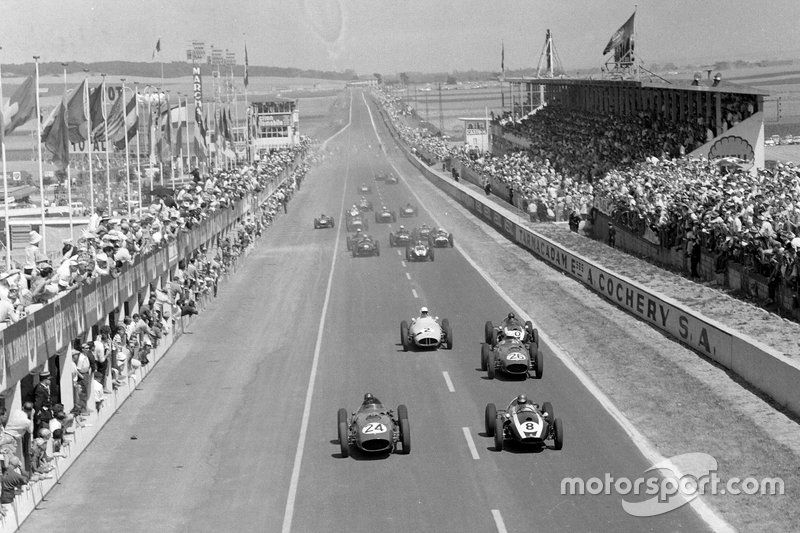
Brooks battles with Brabham at the start of the French GP before leaving the Cooper for dust
Photo by: Motorsport Images
The high-speed Reims circuit, where the fastest cars topped 180mph, was therefore the first ‘Ferrari’ circuit of the year. Brooks qualified on pole, 2.3s faster than Hawthorn had in the 1958 Dino, and Brabham’s second-placed Cooper was the only rear-engined car in the top six.
In blisteringly hot conditions, Brooks led the whole way, headed a Ferrari 1-2 and beat Brabham by over a minute and a half. He was now second in the standings, five points behind Brabham at a time when eight were rewarded for victory.
A strike in Italy meant Ferrari missed the British GP at Aintree. Brabham extended his points lead with victory to 13 and now started to believe… “It was only after winning the British Grand Prix that I thought I might stand a chance,” said Brabham in his autobiography When the Flag Drops.
But that year’s German GP was held at Avus, essentially two long straights with a hairpin at one end and a high banked corner at the other. Although Brooks had won the 1958 German GP at the Nurburgring, the change of venue helped Ferrari as it put an emphasis on power.
Brooks led a Ferrari 1-2-3, but the Coopers had proved surprisingly competitive while they lasted. The drivers’ title already looked a two-horse race between Brooks and Brabham, old-school versus the new wave. Brabham was on 27 points, Brooks 23.
The twists of Monsanto in Portugal did not suit the Ferraris. “A Cooper benefit, the characteristics of the car being ideally suited to the variety of twists and turns,” wrote Brooks, who finished ninth. “It was the most unpleasant race of my career.”
Moss’s uprated Cooper duly won, but Brabham crashed out of second, so Brooks lost no ground in the championship.
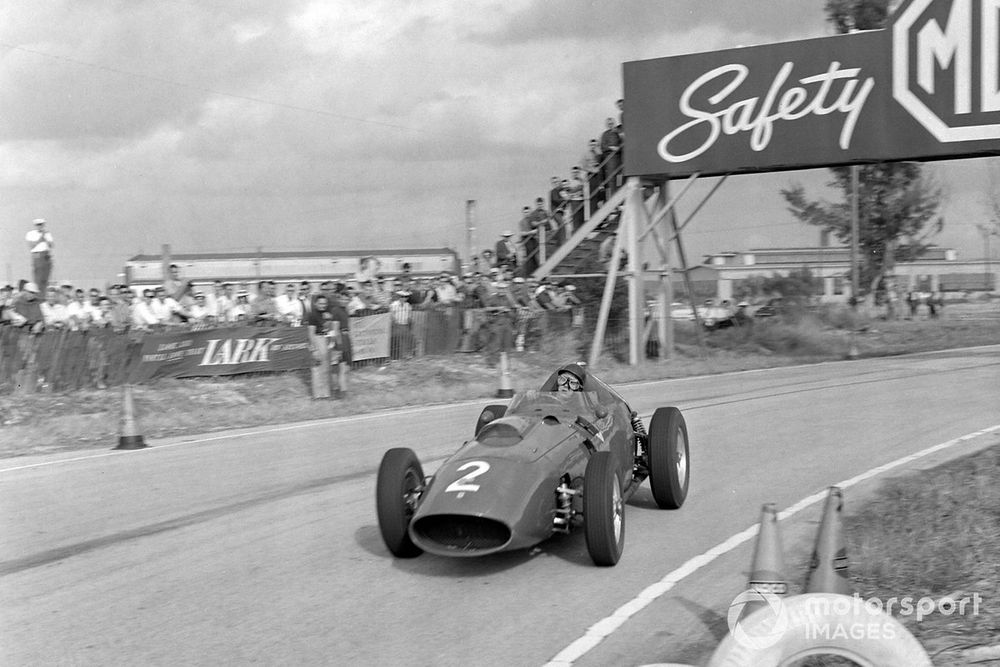
Brooks could finish no higher than third in 1959 Sebring season finale and was denied the title by Brabham
Photo by: Motorsport Images
On Ferrari’s home turf at Monza, Brooks qualified second to Moss, with Brabham also on the three-wide front row. But a potential battle between the top men – and F1’s diametrically opposed approaches – failed to materialise as the Ferrari’s clutch failed off the line.
Moss won to bring himself into championship contention for the finale at Sebring. It was a massive missed opportunity for Brooks – Hill’s Ferrari beat Brabham to second.
Cooper had already clinched the constructors’ title, but Brooks could still take the drivers’ crown in the United States GP if he won, depending on where Moss and Brabham finished.
Brooks qualified third, but the Ferrari was well off the pace of Moss and Brabham. Even worse, Harry Schell’s Cooper was allowed to start third despite his best time apparently being set after cutting part of the track. Brooks was thus pushed back to fourth, contributing to him being rammed on the first lap by new team-mate Wolfgang von Trips.
A conservative Brooks decided to pit for the Dino’s rear suspension to be checked. He resumed and ended up third after Moss retired and Brabham ran out of fuel, pushing his Cooper home fourth. It meant Brabham beat Brooks to the title by four points and the front-engined grand prix car’s last chance to take the world championship had gone.
“Ferrari’s failure to attend the British GP, the cancellation of the Belgian GP at Spa and the defective clutch at the start of the Italian GP were all lost opportunities for points,” believed Brooks. “Of the eight GPs, only three – the French, German and Italian – were run on circuits where the front-engined Ferrari was not disadvantaged compared to the rear-engined cars.”
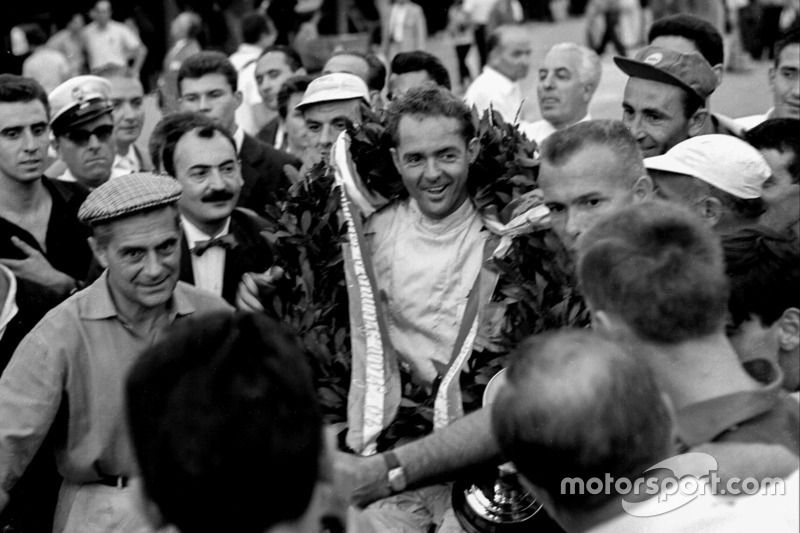
In the absence of the British teams, Hill led home a Ferrari 1-2-3 at Monza in a front-engined last hurrah
Photo by: Motorsport Images
To be fair to Brabham, he could point to his transmission failure in Germany and fuel problem in America as points lost, though he was perhaps fortunate to escape a serious crash in Portugal, which he put down to an errant backmarker.
Ferrari was simply uncompetitive in 1960 as Cooper’s T53 and the Lotus 18 moved the goalposts. As even Ferrari’s focus switched to the development of a ‘pusher’ racer for the new-for-1961 1.5-litre regulations, the Dino lost its best exponent as Brooks moved on.
Cliff Allison and Hill scored podiums in the opening two races, but thereafter Ferrari was outclassed. Fittingly, Monza offered a last hurrah.
Despite the objections of the British teams, the Milan Automobile Club insisted its Italian GP would use the bumpy banking as well as the road course. The result was a boycott, a field filled by F2 cars and Ferrari as the only works team.
Predictably, the Dinos romped home, Hill leading Richie Ginther and Willy Mairesse in a 1-2-3 to score the final success for a front-engined car in a world championship grand prix.
Too little too late
Aside from the Ferrari, there were a number of other front-engined machines that tried to stave off the Cooper revolution, but most fell well short.
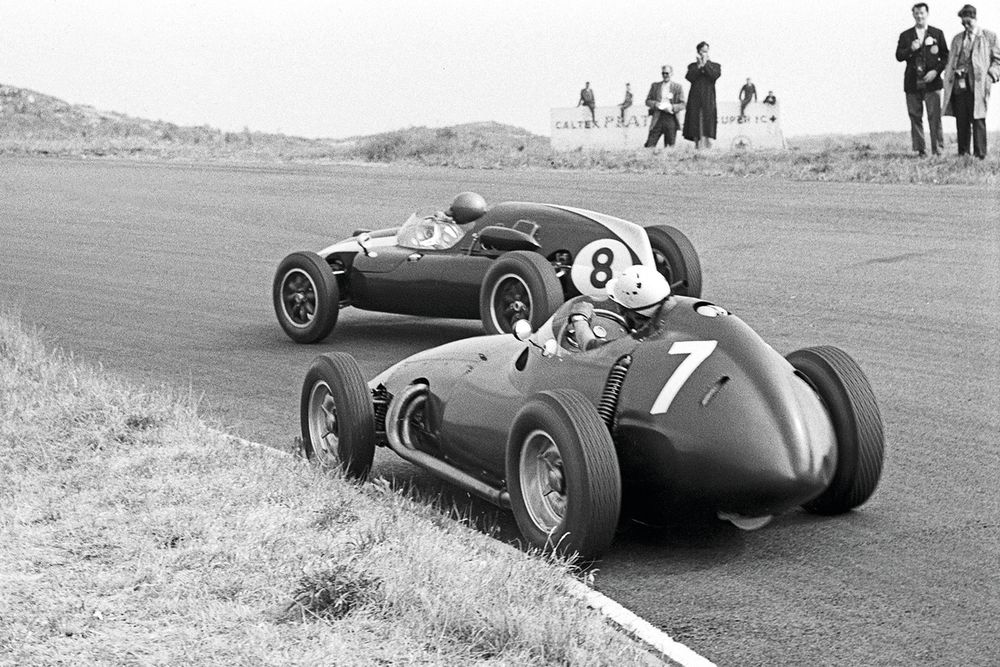
Bonnier’s BRM P25 dices with Jack Brabham (Cooper-Climax T51) en route to victory in the 1959 Dutch GP
Photo by: Bernard Cahier / Getty Images
Ready to race by the end of 1957, the Aston Martin DBR4 had to wait until 1959 before making its F1 debut as David Brown’s company concentrated on its (ultimately successful) world sportscar campaign.
The delay was crucial. Although it was second on its first outing in the BRDC International Trophy at Silverstone, it was soon left behind. “A basically good car that missed the boat,” reckoned Brooks.
BRM’s second attempt at a grand prix car took a long time to become a winner. The P25 first appeared at the end of 1955 and took its single world championship success, after many developments, in the 1959 Dutch GP.
It was one of the best-balanced racers of its era and power was good, but reliability was not, brake failure being a worrying issue throughout the car’s life.
With more development and funding, the four-wheel-drive Ferguson P99 could have delayed the rear-engined switch a little. Moss used its great traction to take the only F1 win for a 4WD car in a damp 1961 International Gold Cup at Oulton Park, making the 1500cc Ferguson the last front-engined car to win a contemporary F1 event, but the rear-engined revolution had taken hold.
Lotus designer Colin Chapman’s approach to lightweight racers meant the Lotus 16 was probably the closest thing to a front-engined Cooper. Its pace over many years in historic racing shows it had potential, but the car was woefully unreliable in period. So bad was Graham Hill’s 1959 finishing record, it was a key reason for his switch to BRM the following year.
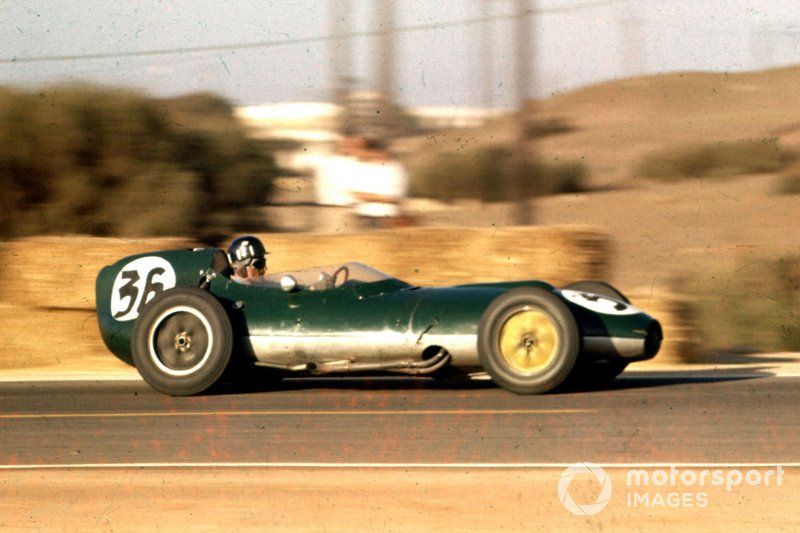
Hill eventually lost patience with the Lotus 16, pictured here at the 1958 Moroccan GP
Photo by: Motorsport Images
Lance Reventlow’s American firm had built successful sportscars, but Scarab’s move into F1 was a disaster. The programme came too late and, from five 1960 starts, engine issues meant all Scarab had to show for its efforts was a 10th place in the US GP with Chuck Daigh.
As with several cars mentioned here, in the right hands and with problems solved, the Scarab is a frontrunner in historic competition.
The Maserati 250F is often cited as the classic front-engined grand prix car, but the design – which originally appeared in 1954 – had run out of steam by 1958. Former Maserati designer Valerio Colotti founded Studio Tecnica Meccanica and produced a lighter, updated version. The Tec-Mec F415 retired from its only grand prix – the 1959 US GP – but has since proved itself in historic events.
Why the Maserati 250F is a different kind of F1 legend
And so, it is the Ferrari Dino that forever stands as the last truly successful front-engine grand prix car. With a little more fortune, Brooks could have taken it to a world title, but the cards just didn’t fall Ferrari’s way.
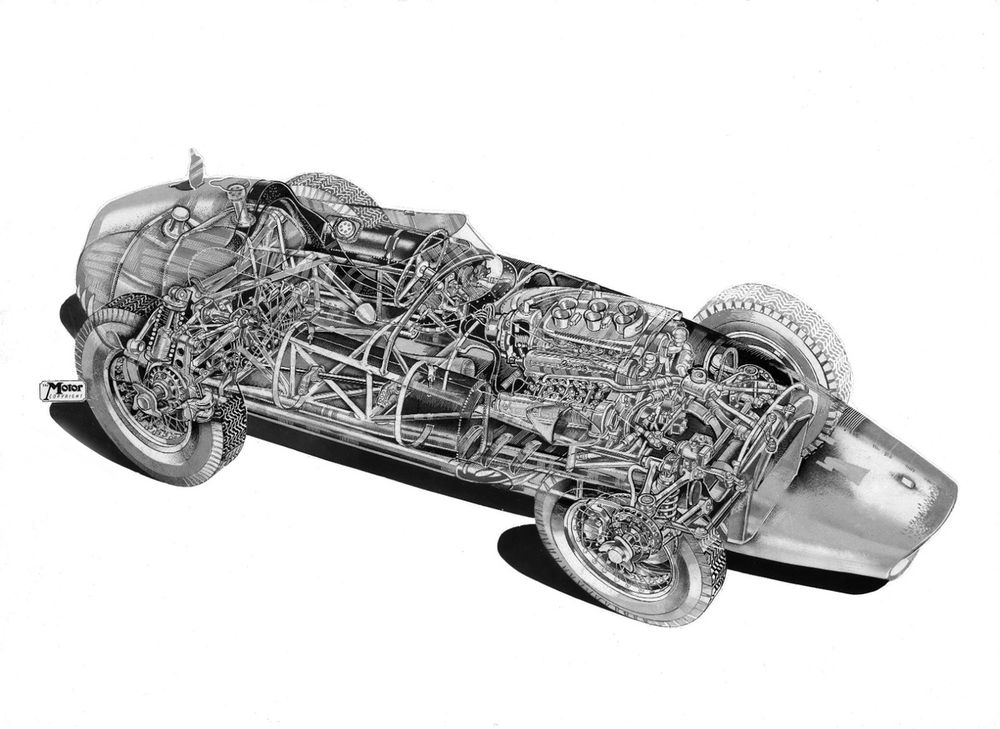
Ferrari 246 Dino proved its worth as the last great bastion of the front-engined Formula 1 car
We want to hear from you!
Let us know what you would like to see from us in the future.
– The Autosport.com Team