
Nope. Nothing to see here.
The “Apollo 11 moonlanding was faked” conspiracy is back all over social media.
Thanks to reality television performer, cosmetics saleswoman and influence peddler Kim Kardashian.
“There’s no gravity on the Moon. Why is the flag blowing?” the 45-year-old commentator exclaimed.
“The shoes that they have in the museum that they wore on the Moon is a different print in the photos. Why are there no stars? They’re gonna say I’m crazy no matter what, but like, go to TikTok. See for yourself …”

The November outburst prompted an immediate response from the Trump Administration’s temporary NASA administrator, Sean Duffy.
“Yes, we’ve been to the Moon before … six times!” Duffy posted to social media.
And even better: NASA Artemis is going back under the leadership of POTUS. We won the last space race, and we will win this one too.”
But the attention-economy empress had already got what she wanted: attention.
And social-media desktop detectives set out once again, determined to conclusively prove that the landings were filmed in Hollywood.
After all, the original Apollo 11 files were “lost”, right?
Kardashian’s rehashed argument has a few obvious flaws.
Gravity doesn’t cause flags to flap. Impact from gas and dust particles does.
You can see stars from the Moon. But cameras must adjust to the bright light in front of them.
And the spacesuit shoes in the museum were worn beneath bulky overshoes designed for the dusty Lunar surface.
Now it’s degenerated into the celebrity-versus-celebrity stage.
YouTube and social media influencer Tim Dodd (better known as Everyday Astronaut) has stepped up to the plate in the defence of Apollo 11 astronauts Neil Armstrong and Buzz Aldrin.
(Not that Buzz needs a hand. In 2002, the former combat pilot unhesitatingly punched a conspiracy theorist who questioned his moonwalk in the face.)
But is the fact that hundreds of Moon landing tapes have vanished evidence of a conspiracy?
“That one is so misconstrued,” Dodd told host Danny Jones.
“The only data that was lost ever, from anything, is the original transmission of Apollo 11.”
And that must go down as one of the biggest bureaucratic blunders in history.
For all mankind: Live
“As Neil Armstrong descended from the ladder to take that historic first step, hundreds of millions of viewers watched spellbound as the drama unfolded. NASA had given them something they had never seen before: a man walking on the Moon via live television,” NASA explains.
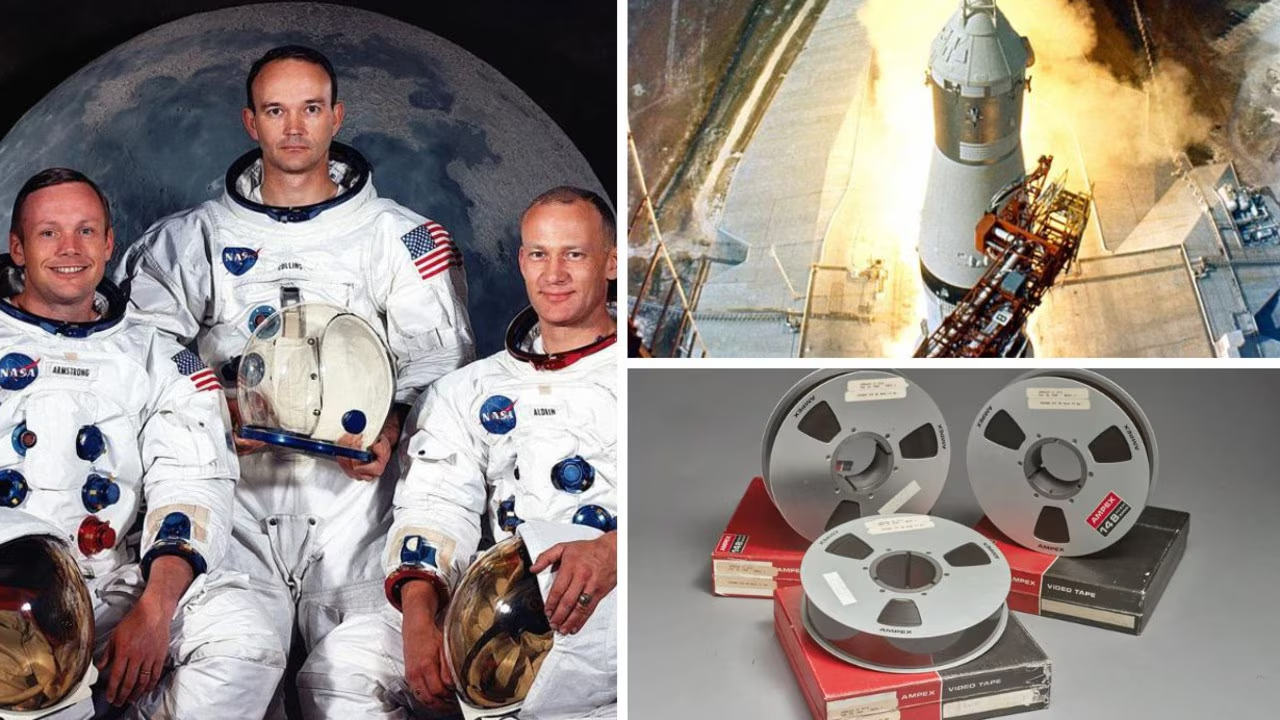
But NASA admits it lost 700 boxes of industrial-grade spindle tape recordings of the event.
Not the footage: that had already been downscaled and converted for global media broadcasts.
Not the 70mm (IMAX) film tapes. Those were brought back aboard the Columbia return vehicle.
It’s technical.
The high-resolution cameras built to operate in the dusty, near-vacuum of the Lunar surface were a compromise. Their analogue technology had to be the smallest and lightest possible for the 1.53 million-kilometre round trip. But also the best possible quality for the primitive radio bandwidth back to Earth.
NASA chose a slow-scan (10 frames per second) camera because it worked. Not for compatibility with commercial television standards.
Its raw signal was relayed to Earth-based receiving stations. One was in California’s Mojave Desert. Another was the Honeysuckle Creek Tracking Station and Parkes radio telescope near Canberra.
The astronomers and engineers here had unique front-row seats.
They got to see crisp, clear – if stuttering – video on scientific-grade television monitors capable of interpreting the direct transmission.
This signal was immediately split into two feeds.
One was sent to Mission Control in Houston.
The other was recorded direct to high-grade magnetic tape. As a backup. In case the transmission to Houston failed.
But the original 10fps camera transmission frame rate was too slow for the television broadcasts of the era. And its resolution too high.
So, Mission Control had a commercial-grade NTSC television camera placed in front of a screen displaying the live feed. It was blurry. But it was ‘good enough’, says Dodd.
NASA admits as much.
“Although NASA engineers knew that the scan converter would degrade the original picture quality, they viewed it as an engineering trade-off,” an official inquiry found. “NASA wanted live television and the only way to provide it at the time was with scan-conversion technology, despite the degradation.”
That re-recorded footage is what the world saw from their living rooms on July 20, 1969.
For all mankind: The cost-cut.

The excitement quickly faded. The Moon program was abandoned early, after Apollo 17 in 1972.
Falling ratings simply couldn’t justify the expense.
And the Apollo 11 backup tapes were quietly boxed up and sent into storage.
“These tapes that, the backup tapes, you know, the raw data tapes weren’t considered like this, like holy, you know, grail: ‘We have to hold on to these cuz these are so, they had everything,” Dodd says. “They had all the video.”
Put simply: Nobody in the 1980s saw any value in keeping the clean, original live-broadcast recordings.
NASA still has copies of all the telemetry and data recordings, totalling thousands of hours. And all the footage.
The Houston live landing rebroadcast was already a matter of the public record. And that hadn’t experienced any blackouts.
So the backups had already proven to be unnecessary.
‘They didn’t imagine a world where we could take and re-scan and up, you know, up-res the hell out of that footage as well because it would have been a lot cleaner in that raw format,” Dodd adds.
In 2006, NASA admitted to deliberately deleting the Apollo 11 backups.
Not to conceal their contents.
But to cut costs.
The 700 boxes of recorded transmissions fell foul of a 1980s project to wipe and reuse 200,000 unwanted magnetic tapes.
NASA’s technology, by then, was getting old. These cassettes were no longer being manufactured. And reusing old stock meant that replacing dated equipment could be put off a little longer …
Demand had also soared.
Not for recording Moon landings. But for capturing signals from the growing number of military, government and research satellites.
“We’re all saddened that they’re not there. We all wish we had 20-20 hindsight,” NASA engineer and investigator Richard Nafzger told media of his hunt for the missing backups.
“I don’t think anyone in the NASA organisation did anything wrong. I think it slipped through the cracks, and nobody’s happy about it.”
Occam’s razor v. Kardashian’s cannon
The simplest explanation is usually correct. So says Occam.
Unless you want to exploit social media algorithms to win an audience. So says Kardashian.
Let’s try explaining what happened – again. So says Dodd.
Reusing old tapes is about as mundane as it gets. As is the bureaucratic penny-pinching that leads to stupid mistakes.
“An intensive search of archives and records concluded that the most likely scenario was that the program managers determined there was no longer a need to keep the tapes — since all the video was recorded elsewhere — and they were erased and reused,” NASA officials said in a now-deleted 2022 statement.
We can relate to that.
But the fact that the original of this, and other, Moon-tape statements have been deleted under the Trump Administration is itself fuelling the flames of doubt.
The idea of a multibillion-dollar, multi-generational, all-spanning conspiracy to fool the world into thinking the United States successfully put the Eagle lander on the Moon’s surface sells.
It sells books. It sells documentaries. It sells social media.
And it *could* be true.
“People come to believe in flat Earth, spirits and microchipped vaccines for the same reasons they come to believe in anything else: Their experiences lead them to think those beliefs are true,” says evolutionary anthropologist Eli Elster.
“The Earth looks flat when you’re standing on it,” he writes. “Of course, scientific evidence clearly shows that the Earth is round; but it’s not surprising that some people prefer to trust what their eyes are telling them.”
It’s easier to see what’s served up on a social media influence peddler’s feed than it is to find original, detailed, accurate (and often technical) evidence.
It is enticing. It is scandalous. It is inspiring.
“The truth is under attack,” a group of researchers recently asserted in the science journal Experimental Psychology.
The Moon landing. Chemtrails. Vaccines. Superfoods. Tai Chi.
Knowledge drives behaviour. False knowledge directs behaviour.
“From ‘spin stories’ to falsehoods, we’re bombarded with misinformation on a daily basis,” explains Professor Mike Tipton.
“You can challenge and interrogate what you come across online, in the media, and even over the dinner table with friends and family.
“At the very least, the next time you hear phrases like ‘they say this is great’ or ‘this is scientifically proven’, start by asking ‘who are they?’ and ‘which scientists, using which methods?’ Be cautious and questioning; snake oil and its vendors still exist, and they come in many guises.”
Jamie Seidel is a freelance writer | @jamieseidel.bsky.social