

February 24, 2026 — 5:00pm
Save
You have reached your maximum number of saved items.
Remove items from your saved list to add more.
Save this article for later
Add articles to your saved list and come back to them anytime.
Got it
AAA
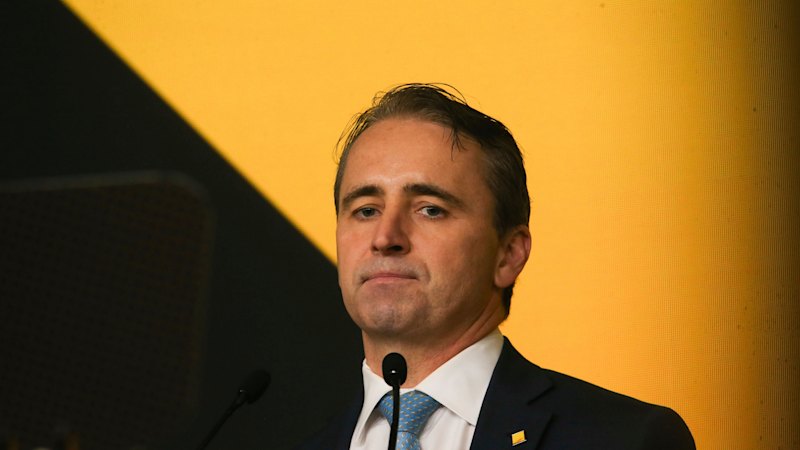
The Commonwealth Bank is scrapping 300 jobs across its retail banking, institutional and human resources divisions, with technology workers bearing the brunt of the cuts, in the latest round of lay-offs by a major Australian bank.
The job cuts come as the banking giant is also rolling out a program aimed at preparing workers for what CBA boss Matt Comyn warns will be an accelerating AI-driven shift in the workplace over the next five years.
On Tuesday, the Finance Sector Union slammed the 300 cuts as “totally unacceptable” after the bank’s recent $5.4 billion profit, and demanded the bank use its newly announced program to help workers affected by the job cuts find other positions inside the banking group.
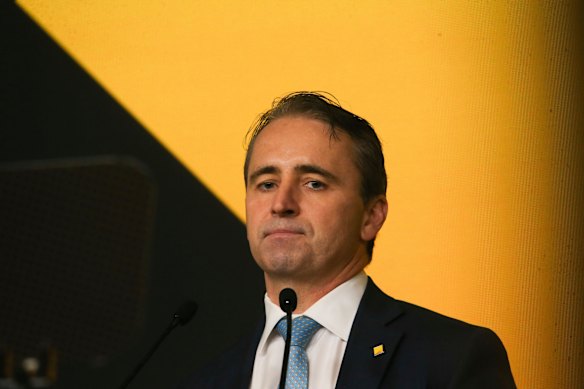 CBA chief executive Matt Comyn said roles would shift more rapidly over the next five years.Glenn Campbell
A CBA spokesperson said the bank regularly reviewed the skills it needed, and signalled it had consolidated technology roles. They said the latest job cuts were not the result of AI, but that the technology “reshape how work is done across CBA and the broader economy.”
“AI is changing how some tasks are performed, but it is not the driver of these role changes,” they said.
In an interview with this masthead ahead of the job cuts, Comyn said the impacts of AI would be felt unevenly across various roles over the next few years, but that the bank wanted to give employees who could be affected by these changes more time to adjust.
Related Article
“One of our points of reflection last year was, ‘how do we replace the traditional approach to workforce change, which is engaging with employees when their role is impacted?’” Comyn said. “Just about every role inside the bank today can be done more effectively using some of the technology and tools today. But we’re certainly not signalling that there’s an imminent sort of inflection point for us.”
The bank last year backtracked on its decision to axe 45 roles, apologising after finding the customer service roles it had initially planned to cut were not redundant after it introduced an AI-powered “voice-bot”.
CBA’s key rivals also cut staff last year, with ANZ Bank slashing 3500 jobs and National Australia Bank announcing 410 staff would be made redundant in September. It was also reported last year that Westpac chief Anthony Miller had asked managers to consider how they could cut staff numbers by 5 per cent.
While Comyn expects a continued increase in automation and uptake of technology, he said the direct impact of AI on the bank’s workforce was modest “at the moment”, noting the bank had increased its number of employees over the last calendar year.
Comyn flagged increased demand for jobs in financial crime and cybersecurity as well as specialist roles in engineering, as well as skills such as customer engagement, critical thinking, problem-solving and empathy which he said would be important over the longer term.
“What we want is to be able to build pathways for people to move into higher value roles,” he said, pointing to the bank’s new skills program, funded through a $90 million investment over three years.
The program is aimed at providing greater transparency about the skills required for various positions within the organisation, opportunity for employees to undertake placements in different areas of the business, and improved ability to identify transferable skills across jobs and participate in training programs.
That includes AI-focused training, with the bank already having rolled out a suite of AI tools over the past year.
Finance Sector Union National Secretary Julia Angrisano said the bank needed to use its newly announced program to support workers affected by the most recent job cuts including providing them with genuine redeployment and retraining opportunities and the option to remain with CBA should they choose.
Related Article
“At a time when CBA has just posted over $5 billion in half-yearly profit, cutting the jobs of 300 workers is totally unacceptable,” she said. “These are the very workers who helped generate CBA’s massive profits.”
A union survey of 1700 employees at CBA found job security was a concern for 72 per cent of staff, 74 per cent said their workloads had increased in the past year, and half said they had considered leaving.
Despite concerns about AI wiping out entry-level jobs, Comyn said the bank’s preference was to continue running a significant graduate program, noting that a higher proportion of graduate roles were now in technology.
The Business Briefing newsletter delivers major stories, exclusive coverage and expert opinion. Sign up to get it every weekday morning.
Save
You have reached your maximum number of saved items.
Remove items from your saved list to add more.
 Millie Muroi is the economics writer at The Sydney Morning Herald and The Age. She was formerly an economics correspondent based in Canberra’s Press Gallery and the banking writer based in Sydney.Connect via X or email.From our partners