
The 2026 Formula 1 regulations pose major challenges for teams in terms of energy management, and one of the most striking examples occurs in qualifying. At Bahrain pre-season testing, drivers were seen to accelerate less coming out of the final corner and as paradoxical as it may seem, here’s why that yields faster lap times.
Energy management is the key issue in the 2026 regulations, given the threefold increase in MGU-K power but with a battery that has remained essentially unchanged. In this scenario, it becomes crucial to understand where and how to distribute the 8.5 MJ per lap, an aspect on which the Bahrain tests have provided crucial insights for manufacturers.
And one particularly interesting element emerged. When launching a fast lap, drivers are already having to compromise, opening the throttle to 100% only a few metres before the finish line so as not to waste energy in the preparation phase.
Taking Bahrain as a reference, in the past, when drivers came out of the last corner to launch themselves onto the long straight, they immediately pushed the accelerator to 100% to maximise their top speed at the end of the straight.
The old units had a much smaller MGU-K, at 120 kW, which meant that the battery charge was depleted more slowly. Added to this was the energy contribution of the MGU-H, further reducing the risk of running out of electricity. But with the 2026 specifications, the scenario changes radically as there is now 350 kW to manage and the battery tends to drain much faster.
That’s why a different approach to exiting the last corner was seen in the two test sessions. Drivers began to partially accelerate between 60 and 70% up to a certain point, only to reach 100 just before the start-finish line. This is a compromise as cars might not cross the line at the highest possible speed and by not fully accelerating, drivers aren’t wasting energy on the prep lap as they are able to delay the derating phase when they run out of electric power. Conserving energy pays off later on the lap, as in Bahrain there is only one braking zone between the start of the lap and Turn 4 to recharge the battery.
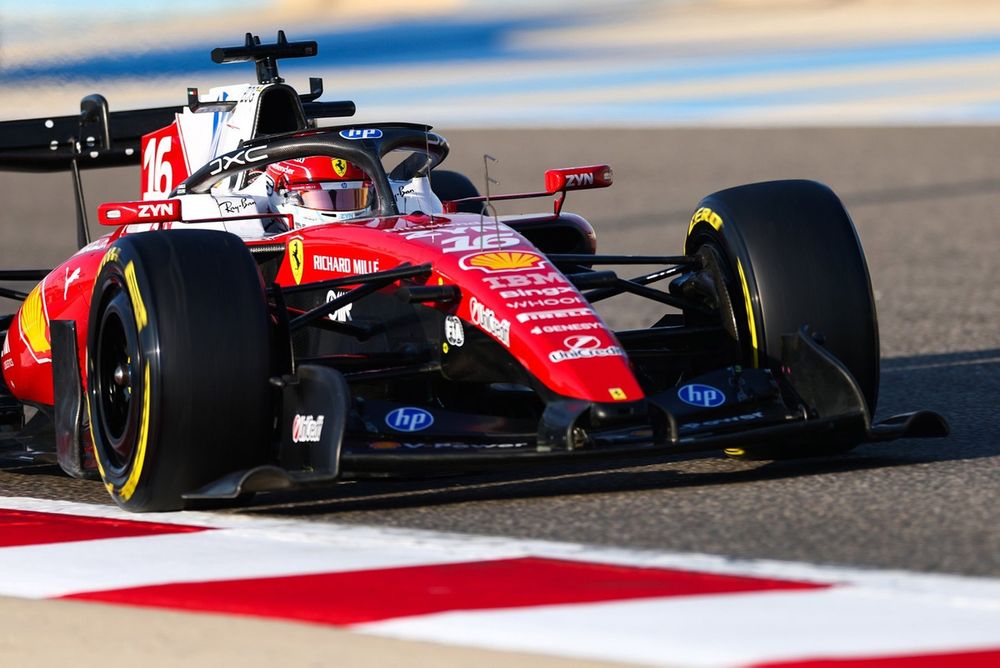
Charles Leclerc, Ferrari
Photo by: Sam Bloxham / LAT Images via Getty Images
Taking Charles Leclerc’s fastest lap in Bahrain as a reference, it is clear why this compromise still yields a net benefit despite looking so counterintuitive. Overlaying his best laps in 2025 and 2026, it is apparent that the Ferrari driver crosses the finish line at around 300 km/h, about 10 more than last year, when drivers were already flooring the accelerator as they exited the last corner. This is partially due to the lower drag of the 2026 cars, especially in straightline mode.
What really changes is the profile with which that speed increases. While the 2025 cars reached their peak speed just before braking, with minimal derating, the 2026 cars reach their maximum speed earlier, because the support from the MGU-K gradually tends to drop to zero, leaving only the combustion engine to shoulder all the work. From the moment Leclerc reaches 328 km/h to the moment he lifts his foot off the accelerator, he loses about 25 km/h, precisely because there is no longer an electric motor-generator to provide support.
If drivers were to open the throttle 100% as soon as they exit the last corner this year, with the current state of the power units, they would risk reaching peak speed right at the finish line, triggering the derating phase way earlier. This would penalise lap times not only on the main straight, but also on the next straight leading to Turn 4, where super-clipping was seen during testing, i.e. when the combustion engine is used to recharge the battery while at full throttle.
Of course, Bahrain is just one of 24 circuits on the 2026 calendar, with some tracks not requiring this technique and others even more critical for energy harvesting. That’s all part of the more complicated energy puzzle engineering teams now have to solve, adding to the number of question marks hanging over the early part of 2026.
Read Also:
We want to hear from you!
Let us know what you would like to see from us in the future.
– The Autosport.com Team