

Asian nations need to adapt quickly to survive as women’s football is evolving fast, according to China’s head coach.
Australian-born Ante Milicic, guided Australia’s women’s team, the Matildas, to the last 16 at the 2019 FIFA World Cup and took over the reins of China’s national team in 2024. He said the key to improving Asian football was exposure to the best.
“Japan has over 40 players [competing] in Europe and the US [leagues],” he said.
“That gets them out of their comfort zone.
“They’ve got to learn another language, play in different conditions, different coaching, leagues, styles. There are bigger crowds, different stadiums.
“You look at the Australian girls, they’re winning Champions Leagues. They’re at a different level now.”
Milicic said Japan and Australia, along with South Korea, would be the favourites at the Asian Cup which kicks off this weekend and will be staged across Perth, Sydney and the Gold Coast.
“The Matildas are a massive threat,” he said.
“[They’re] very experienced and being at home, and their players … I think they’re at their prime to achieve something special.”
 Ante Milicic and Australia’s Sam Kerr celebrate after beating Brazil at the 2019 World Cup in France. Australia is one of the best teams in Asia.(Eric Gaillard, Reuters)China’s struggle to keep up
Despite a record nine titles and being reigning AFC champions, China has struggled since it lifted the trophy in 2022.
The team has misfired in major tournaments — exiting in the group stage at the 2023 Women’s World Cup then missing out completely on the Paris Olympics.
The low point was a humbling 8-0 thrashing by England in a friendly at Wembley Stadium last November.
“Whenever you lose a game by that scoreline, there’s a lot to take in,” Milicic said.
He said the result probably was a one-off but the team would learn from it.
 Alessia Russo scores England’s eighth goal in their demolition of China in last November’s friendly at Wembley Stadium.(John Sibley, Action Images via Reuters)
“It was just the 90 minutes of football that we played that day. We weren’t at a level to compete against such a strong opponent in front of that crowd at that stadium.”
It was also an important indicator of where China stands in the international order.
“There are reasons there that China hasn’t kept up the pace,” Milicic said.
Get the latest:
Stay across the all the action from the 2026 Women’s Asian Cup in Australia with ABC Sport.
Overseas experience
But exposing China’s best talent to leagues in Europe or the US poses its own challenges.
Contractual structures and cultural factors make overseas moves more complex for China’s players.
Milicic pointed to Yuan Cong and Wang Ying, who signed for Western Sydney Wanderers in Australia’s A-League Women last September, as examples of what can happen.
“It’s great, and they’re enjoying themselves, and I think the girls are a lot more open to that,” he said.
“But as a national team coach, and in China, I can’t … steer them in that direction, or influence that.”
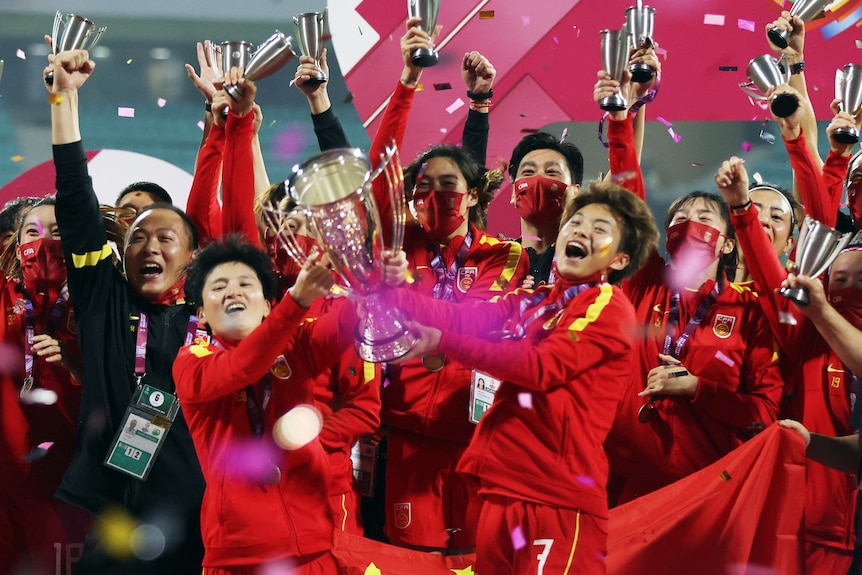 China won their ninth AFC Women’s Asian Cup in 2022 in India but face a far sterner test in this year’s finals in Australia.(Francis Mascarenhas, Reuters)
Milicic’s immediate focus is on preparing the Steel Roses for their group matches against Bangladesh, Uzbekistan and North Korea.
Each opponent will be tough, he said. “Everyone these days is getting fitter and more organised.”
North Korea, in particular, could pose a threat.
“[They are] so incredibly strong in those youth age groups, so it’ll be interesting to see how they transfer that to the senior team.”
But Milicic was at pains to point out he and his team will be taking it one match at a time.
“You have to respect your first opponent, Bangladesh, it’s the first time they’ve ever been to an Asian Cup.”
Gearing up for the Asian Cup
To prepare, the squad has spent five weeks in camp, with a short break for Lunar New Year celebrations.
Milicic said being together for such an extended period gives him an opportunity to get the players to the level needed physically, work a lot on the tactical side, and control every part of preparation.
“They’re very resilient, they’ve got an appetite to work hard, they’re taking in the information,” he said.
“Their attitude to work is excellent, and they’re so resilient. They’re here to get on with the job.”