
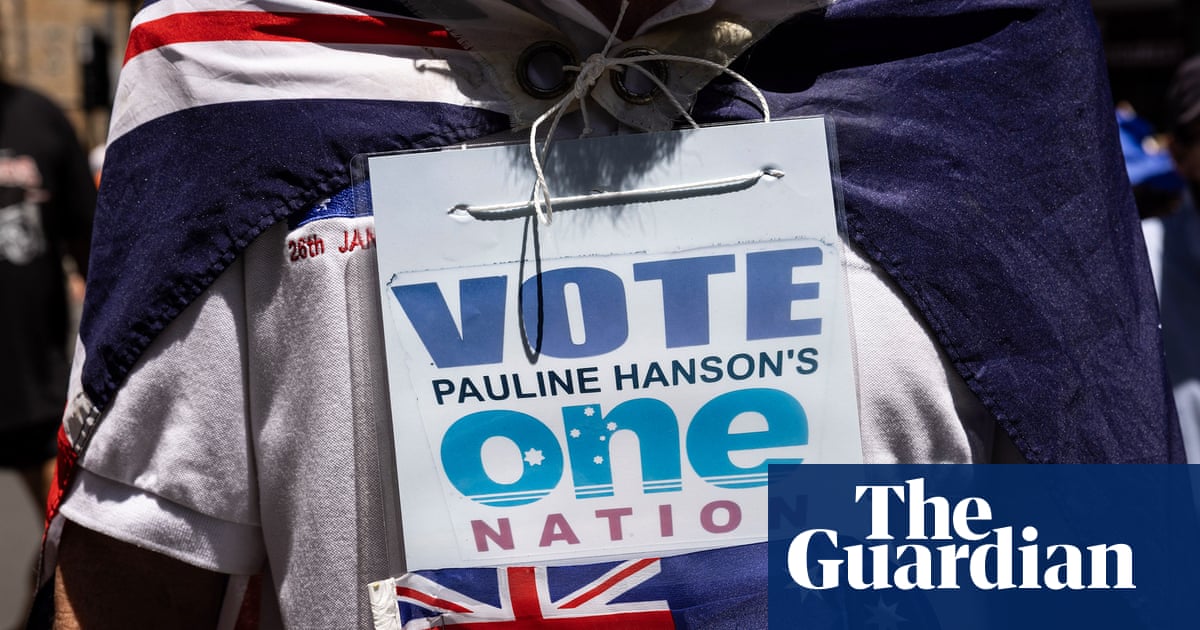
Nearly 60% of Australians would be open to voting for One Nation at the next federal election, including nearly half of those currently backing Labor, according to the latest Guardian Essential poll.
The results will ring alarm bells for both the government and Coalition about the march of the rightwing populist party and its leader, Pauline Hanson.
Meanwhile, Angus Taylor’s appointment as Liberal leader has done little to boost the opposition’s electoral fortunes so far, with its primary vote virtually unchanged and voters split about whether his spill of Sussan Ley would make them more or less likely to vote for the Coalition.
The poll of 1,002 Australians last week, found a largely unchanged primary vote federally. Labor recorded a 30% primary, one point down from January, while the Coalition ticked up one point to 26%.
One Nation’s primary vote was unchanged on 22%, with the Greens on 11% and 7% voting for independent or other groups, with 4% undecided.
Despite mounting controversies over One Nation – including Hanson’s inflammatory comments about Muslims, her stunt of wearing a burqa in the Senate, and scrutiny about transparency and her relationship with billionaire Gina Rinehart – the Essential poll has continued to show rising support for the party since at least October.
In the same week Hanson refused to apologise for telling Sky News “how can you tell me there are good Muslims?”, 58% of respondents to the Essential poll said they either would vote for One Nation, or were open to voting for them, at the next election due by 2028.
Sign up: AU Breaking News email
Among all respondents, 25% said they would “definitely” back the rightwing populist party at the next election, with 33% saying they’re “open” to it. Only 28% said they would “never vote for One Nation”, with 14% unsure.
One Nation’s primary vote, surging from 6.4% of the lower house vote at the May 2025 election to nearly a quarter of voters in various published polls today, has worried the major parties – particularly the Coalition, with January’s split by the Nationals and the opposition’s rightward lurch being partly attributed to concerns about the rise of Hanson’s party.
But February’s Essential poll finds a substantial number of Labor voters are also open to One Nation.
Among respondents who said they voted for the Coalition, 17% said they would definitely vote One Nation next time, with a startling 51% saying they were open to doing so. Among Labor voters, 12% said they’d definitely vote One Nation, with 33% saying they’d be open to it.
The polling period coincided with Angus Taylor’s first full week as Liberal leader, after ousting former opposition leader Sussan Ley in a party room coup the previous week.
Asked how Taylor’s elevation would influence votes, 12% said they would be much more likely to vote Liberal, while 14% said “somewhat more likely”; conversely, 12% said they’d be much less likely and 7% somewhat less likely to vote Liberal.
Overall, 26% said they’d be more likely and 19% less likely to vote for the Liberals under Taylor, with 14% replying “don’t know”.
Peter Lewis, executive director of Essential Media, said the major parties could not ignore the rise of Hanson’s party.
“The approach for 30 years has been to isolate One Nation. These numbers suggest that is no longer a viable strategy for either side of politics,” Lewis said.
“With populists gaining traction around the globe, rather than cancelling her we need to understand what is driving her surging popularity.”
One Nation’s surge comes despite the lack of a workable policy agenda, including vague plans to deport 75,000 “illegal immigrants” and slash student and skilled work visas, to allow “citizens initiated referenda” for constitutional change, and abolish the federal department of climate change, the National Indigenous Australians Agency and the Therapeutic Goods Administration.
Anthony Albanese, appearing on Karl Stefanovic’s podcast on Tuesday, said One Nation’s vote was increasing in polls as former Coalition voters looked for alternatives to the opposition, describing it as “people expressing frustration with the system they think isn’t working for them”.
Albanese said his Labor government was focused on providing cost-of-living support, and said One Nation had opposed key government policies like legislating penalty rates.
“That’s the difference I have with a group like One Nation … they’ll identify grievance but never come up with a single cost-of-living support, and indeed oppose all of those things.”
In December, former federal Labor president Wayne Swan warned of the potential “for our primary vote to drop down below 30%, in a preferential voting system, for a Nigel Farage-type [rightwing] coalition to come along and sweep up the conservative parties and engage in a full-throated contest.”
Swan also said Labor needed to be better at “engaging with people and talking with them, and not at them”.
Last September, Swan warned Labor had “failed to secure strong support from lower-income, lower-educated Australians”, and said it needed to focus on an agenda around basic services like housing, health and tax. He described Labor’s victory at the 2025 election as “wide but shallow”, raising concerns about a drop in the primary vote.