
SINGAPORE: As the rocket rose into the sky over the Malaysian state of Perak, Simon Gwozdz felt something close to disbelief. It was the first time his firm had successfully test-launched a prototype rocket, and Southeast Asia’s first commercially developed one.
The 2020 launch was the culmination of months of preparation and troubleshooting by the Singapore firm, Equatorial Space Systems. It was the first of many more over the years, as the team pursues its goal of becoming a launch service provider that takes clients’ satellites to space.
“Each launch sears into your memory like a hot iron, and I frankly can’t imagine doing anything else,” said Mr Gwozdz.
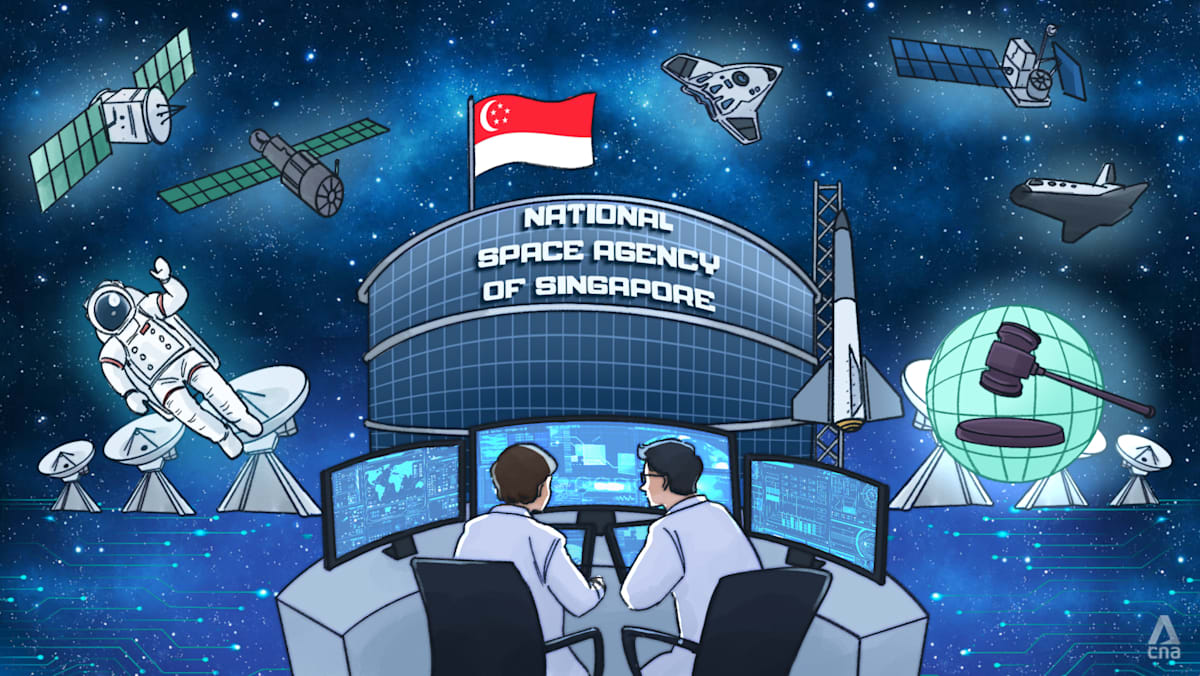
His firm is among the space players in Singapore watching closely as the country establishes the National Space Agency of Singapore (NSAS) on Apr 1.
The announcement was made by Minister-in-charge of Energy and Science and Technology Tan See Leng at the inaugural Space Summit earlier this month.
The new agency will build on the work of the existing Office for Space Technology and Industry (OSTIn), but with a broader mandate and stronger institutional footing, said Dr Tan, who is also manpower minister.
Deputy Prime Minister Gan Kim Yong said in a written parliamentary reply on Tuesday (Feb 24), that the agency will progressively ramp up its workforce over the next five years, recruiting across a range of fields.
This includes space technology and operations, geospatial analytics, project management, industry development, as well as policy, regulations and international relations.
As Singapore’s space ambitions lift off, observers and industry players point to various challenges that need to be overcome.
There is no ready blueprint for crafting domestic space legislation, something which Dr Tan had announced would be part of the new agency’s mandate.
The space sector remains unfamiliar to much of Singapore’s workforce, and talent has to be groomed and sought from an already tight labour market, said observers.
The country also needs to carve out a clear niche in a crowded global arena dominated by traditional spacefaring giants, they added.
While Singapore’s space ambitions have since 2019 been led by OSTin, the establishment of a formal agency elevates the status of the country’s space pursuits on the national agenda.
“The establishment of a national space agency can be a major asset. Beyond its role in coordinating domestic space activities, a space agency provides a clear and identified representation at space-related institutions,” said Dr Numa Isnard, founder of French law firm Spaceavocat, which caters exclusively to space activities.
This is especially as government-to-government discussions are shaping the future balance of power and rules of conduct in space, said Ms Michelle Khoo, who leads the Deloitte Center for the Edge Southeast Asia.
The NSAS will be operating in a domain that is becoming increasingly important to national security, economic resilience and global governance, all of which have to factor into the new agency’s considerations.