
Save
You have reached your maximum number of saved items.
Remove items from your saved list to add more.
AAA
Think you can make someone go out and order a juicy burger at the mere suggestion of your voice? Maybe you’ve thought about who’s behind the “unexpected item in the bagging area” message at the automated checkout at the supermarket? Love the idea of a tenor so commanding that you could convince someone to buy, well, just about anything?
Having a voice that sizzles and drips, growls and grumbles or brightly coerces is one thing, but making a go of being a voice-over artist can be as challenging as getting a job in any sector of the performing arts. And to top it off, it’s a fast-paced hustle in an industry increasingly threatened by AI.
It can be a lonely existence for people used to routine and water-cooler chat, but wonderful for people with high freedom needs and a low tolerance for boredom. You could be reading an audiobook in the morning and advertising massage products in the afternoon.
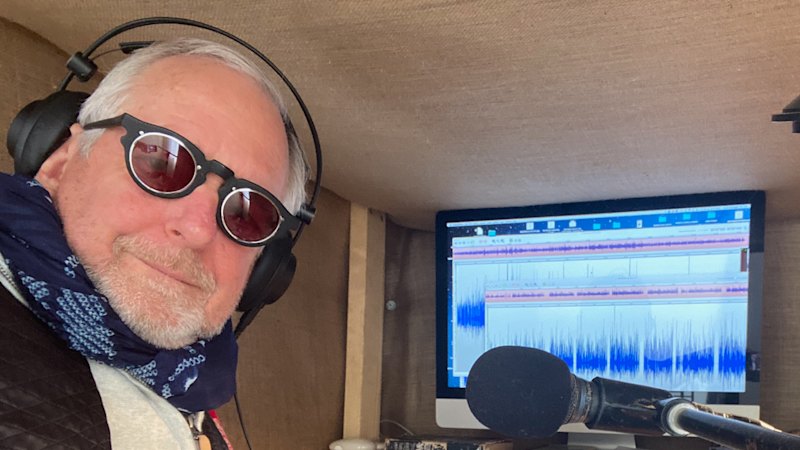
“You’re driving from one studio to another and your only interaction is with the client or the agency. But it’s mainly the engineer,” says voice actor/artist Aimee Horne, a current promo voice on SBS On Demand. “You’re there for an hour and then that’s it. Off you go, back into the wild.”
Related Article
Because of the nature of the industry, where the voice-over is the very last piece of the production, actors and artists will have little to no preparation time and might record from their homes. Jobs flow in hour to hour, and a flexible calendar with the ability to swing from one job to the next is a prerequisite.
“Part of the job is sight-reading, ” says voice actor and artist Nikos Andronicos. (He’s the current safety voice of Sydney Ferries. If you hear someone cheerily suggest you pop on a life jacket in case of emergency, that’ll be him.) “It’s like being a session musician. If you’re doing a long-form thing, like an audiobook, they give you the book ahead of time. But personally, I like living the book as I’m reading it,” he says. “I think your performance is better, because you’re not preempting. So everything is just in
the moment.”
Much like any freelance work, it comes in sporadically – drought for weeks, monsoon for months. “You’ll have good years, and you’ll have bad years, and you sort of have to take it with a grain of salt,” says Horne. “Sometimes it’ll be amazing, and you feel vital and that’s a lovely feeling to have. Then it gets balanced out pretty quickly with feeling like you’ll never work again,” she says. “It took a long time for me to get comfortable with that.”
There’s a difference between voice-over artists and voice-over actors, too. Think of an artist as the voice you might hear on a movie promo or an acne wash commercial. An actor might do the voices in an animation, audiobook or video game. Many voice-over professionals will take on both styles of work.
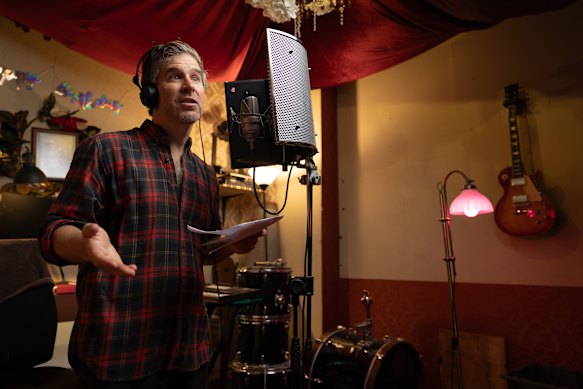 Voice actor Nikos Andronicos says the job is “like being a session musician”.Wolter Peeters
Actors and artists are booked for the certain qualities their voices have. Andronicos, for instance, has a brightness and pace to his – a certain quality that takes the listener along for the ride. Among other things, he writes and directs his own animation series and has worked in the voice-over industry most of his life. Some readers may even remember one of his ads from the ’90s – he was the kid’s voice from the 1994 campaign for bananas, Make Those Bodies Sing.
Aimee Horne has a voice that’s all at once vivacious, energetic, commanding and wry. She has a series of voice-acting credits to her name (she voices Cotton-Tail in the 2021 animated feature, Peter Rabbit 2: The Runaway), as well as a full roster of voice artistry. For her, it was a gradual transition from stage and screen acting. After graduating from NIDA, she started with an agent who also had a voice-over (VO) department. “That gave me an idea of what the VO world was about,” she says.
“It was so exciting,” says Horne. “I really loved the speed of it, the variation of what you were going into. And the relative anonymity of the job as well. So, you were a mystery and it was a mystery. The more that I did the work, I realised I preferred it.”
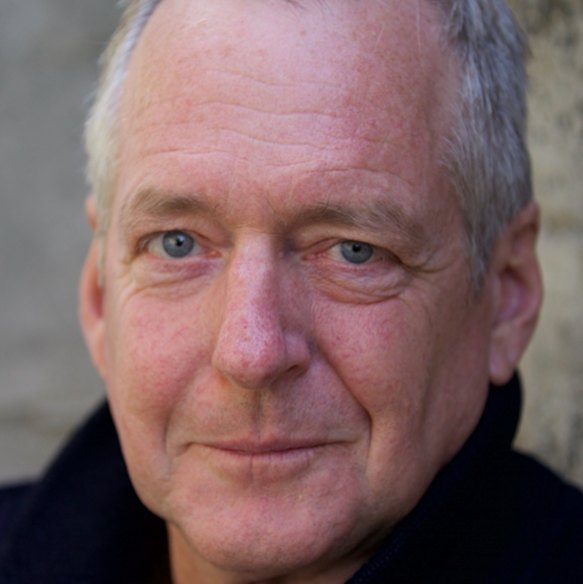 “I would only have to say three words and the cab driver would go, ‘You’re the SBS guy!’” says Robbie McGregor. “It was just amazing.”
Robbie McGregor is considered a living legend in the field, with a deep, rich, commanding throttle and a sort of mirth behind every sentence. An actor who has worked on the Aussie screen since the early ’70s, Baz Luhrmann once called him “the voice Australia trusts”. His first voice-over job was for Mercedes-Benz. At the time, he was reluctant to do it – back in the ′70s and ’80s, serious actors didn’t do ads – but a pile of unpaid bills pushed him over the line.
Since then, he’s become something of a cult celebrity for his work as narrator for SBS from 1989 to 2006 (hearing “SBS advises the following program has been classified M. It contains violence, sexual references, adult themes and nudity” always heralded something salacious, if you were watching during McGregor’s tenure) and a two-decade voice gig as “King Wally Otto in the Soundproof Booth” with Roy and HG on This Sporting Life, which ran from 1986 to 2008. He also voiced the countdown for the Triple J Hottest 100 until this year.
“When I was with SBS, I would get into a cab and I would only have to say three words and the cab driver would go, ‘You’re the SBS guy!’ It was just amazing,” says McGregor. “You know, it was a very multicultural station. And very multicultural drivers in Sydney town as well. And then, the number of times I’d be at a party and people would be like, ‘Oh, go on, go on. Just say it, just say nudity.’ And you’d think, ‘Oh, god, how much innuendo do I have to come out with?’ ”
The threat of generative AI dangles over the heads of a lot of people working in creative industries, but it’s particularly critical for voice-over artists working on what might be considered to be lower-end promos. For some professional voice actors who rely on that work to pay the bills, it may cut their income drastically.
Simon Kennedy, president of The Australian Association of Voice Actors (AAVA), says the risks include “a lack of authenticity and trust when the voice delivering your information isn’t human”.
There are benefits to AI for businesses, when it comes to large-scale jobs with a next-to-instant turnaround such as visual descriptions. An AI program is able to quickly and cheaply describe what might be happening on screen down to costuming, props and lighting.
“But it is important to know when it is appropriate to use it and when it isn’t,” says Kennedy. “Right now we are in a phase of blind adoption, with no consideration for whether or not this technology is improving our lives or causing harm. In the case of voice actors or voice-over artists, our voices are potentially used to create a system that competes with us, with zero permission or compensation.”
The legalities are pretty vague right now, according to Kennedy, who says the AAVA is pushing for laws to protect people’s voice, image and likeness along with mandating the labelling of AI-generated content. “Everyone deserves to know when the content they are consuming is not human.”
So, it’s an industry that’s both threatened and far from easy to break into. Agencies such as RMK Management – leaders in the field of voice-over
representation – aren’t taking on clients unless they bring some serious business along with them. “We’re not generally on the lookout for new artists,” says managing director Luke Downs. “We’re lucky to be at the top end of the market in voice representation. So usually we have people coming to us who are already established.”
Just like any industry, there are trends in the voice-over world, too. The most significant in the past decade is a shift from the traditional, pushy/shouty hard sell of “but that’s not all! And you’ll get a free set of steak knives!” to a more inclusive, laid-back, conversational vibe. And that’s thanks to actor-turned-postie Samuel Johnson (his big break was in the early-noughties TV hit The Secret Life of Us). “Sam would do this kind of stripped-back, relaxed-style read,” says Downs. “All the voices that we already managed had to adapt to be able to do [it too]. And then, because everyone’s doing that natural style, in order to get the cut-through, you need to add some more energy. And then we ended up, sort of, at this kind of hybrid. It’s quite interesting to see how it all evolves.”
Related Article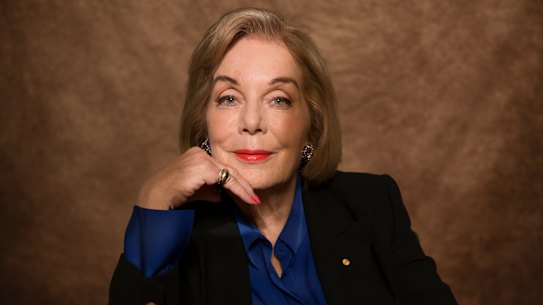
“Your voice is as distinctive as your fingerprint,” says author and media personality Russel Howcroft. “[At the] high end of production, you will think long and hard about the appropriate voice, and you may well hire someone because you know that they have a distinctive voice.”
Howcroft, a regular panellist on ABC’s Gruen, a show focused on advertising in Australian media, says part of the trick is increasing the engagement with the commercial by being very deliberate in your voice casting. “The very best advertisers and agencies spend as much time getting the voice right as they will getting the scriptwriters and set right. It’s a really key ingredient.”
Really, what everyone is looking for are the tools to make somebody pause long enough to invest in the message. “The enemy of advertising is the remote control,” says Howcroft. “The button on the radio, the scroll, the flick, right? And you’re always trying to fight that enemy.”
Get the best of Good Weekend delivered to your inbox every Saturday morning. Sign up for our newsletter.