

Never miss an important update on your stock portfolio and cut through the noise. Over 7 million investors trust Simply Wall St to stay informed where it matters for FREE.
UiPath (NYSE:PATH) introduced new AI tools for healthcare at the ViVE 2026 conference.
The offerings include medical records summarization, claim denial prevention, and prior authorization support.
These products were developed with partners such as Genzeon to address healthcare administrative workloads.
UiPath is pushing deeper into healthcare with AI driven automation that targets high friction administrative tasks. The move comes as the stock trades around $10.17, with returns of a 10.2% decline over the past week, a 31.3% decline over the past month, and a 36.0% decline year to date. For investors watching NYSE:PATH, this sector specific push adds a fresh angle to a story that has recently been defined by weaker share price momentum.
What matters for you is how quickly healthcare providers and payers choose to adopt these new tools and embed them into workflows. Adoption trends, the size and quality of new customer wins, and any evidence that healthcare use cases support stickier, higher value contracts could become important markers to watch in upcoming quarters.
Stay updated on the most important news stories for UiPath by adding it to your watchlist or portfolio. Alternatively, explore our Community to discover new perspectives on UiPath.
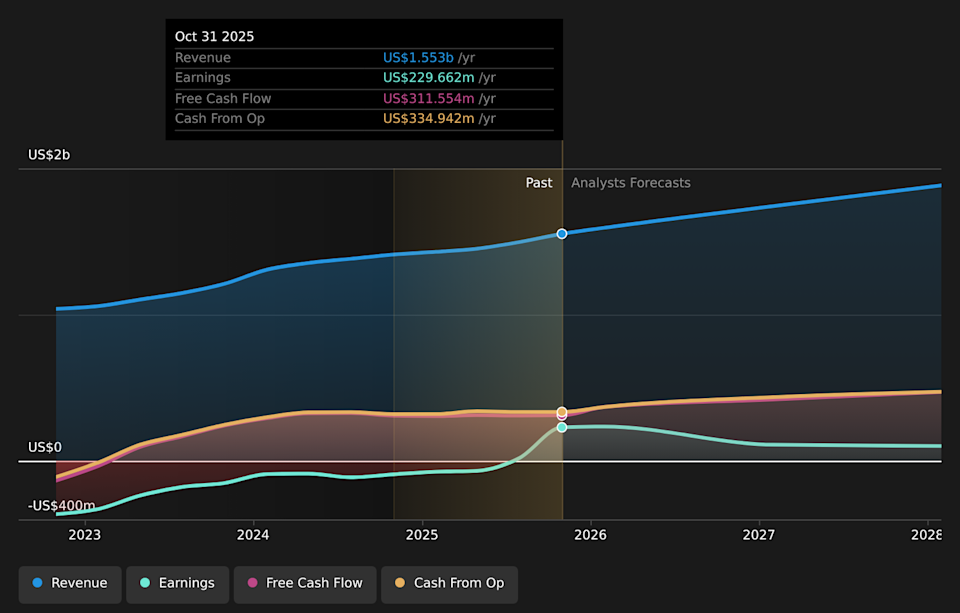 NYSE:PATH Earnings & Revenue Growth as at Feb 2026
We’ve flagged 2 risks for UiPath. See which could impact your investment.
For UiPath, this healthcare launch puts more substance behind its AI story. Medical records summarization, claim denial prevention and prior authorization all sit in areas where US providers and insurers face heavy manual workloads and revenue cycle friction. If UiPath’s agentic AI tools shorten processing times or reduce errors, that can speak directly to budget holders who are measured on cash collection and administrative cost. The partnership model, with firms like Genzeon providing healthcare domain expertise, also matters because it can help UiPath compete against broader automation platforms from Microsoft, ServiceNow and Salesforce that are pushing into similar workflows. For you as an investor, the key question is whether these healthcare solutions can shift UiPath from being a general automation vendor to a partner with deeper, higher value use cases in regulated industries.
This launch lines up with the narrative that deeper customer relationships and sector focused automation can support growth by expanding use cases inside existing enterprises.
It may also test the narrative’s assumption that new agentic products contribute mostly over the longer term if healthcare customers move more slowly than hoped on deployment.
The specific focus on revenue cycle and clinical documentation in healthcare is not fully covered in the narrative, which focuses more on broad partnerships and index inclusion than on vertical products.
Knowing what a company is worth starts with understanding its story. Check out one of the top narratives in the Simply Wall St Community for UiPath to help decide what it’s worth to you.
⚠️ Analysts have flagged that earnings are forecast to decline by an average of 43.2% per year over the next 3 years, so new products like this may not translate into near term profit support.
⚠️ Healthcare IT buyers often face slow procurement cycles and regulatory constraints, which can delay automation projects and make revenue from these tools less predictable.
🎁 UiPath has recently become profitable and is trading at a level described as 44.5% below one fair value estimate, so successful uptake of healthcare AI tools could be a supportive factor for the longer term story.
🎁 Analysts are in good agreement that the stock price could rise, and deeper adoption in healthcare may help underpin the view that UiPath’s platform has room to grow across multiple sectors.
From here, keep an eye on whether UiPath starts naming healthcare providers and payers as reference customers for these agentic AI tools, and if management begins breaking out healthcare wins or use cases on earnings calls around the March 11, 2026 report and beyond. Watch for commentary on attach rates, expansion within existing healthcare accounts and any indication that these solutions contribute to larger, multi product contracts. It is also worth tracking how often management frames healthcare alongside banking and other regulated industries when talking about growth priorities, because that can signal where sales resources and product focus are heading.
To ensure you’re always in the loop on how the latest news impacts the investment narrative for UiPath, head to the community page for UiPath to never miss an update on the top community narratives.
This article by Simply Wall St is general in nature. We provide commentary based on historical data and analyst forecasts only using an unbiased methodology and our articles are not intended to be financial advice. It does not constitute a recommendation to buy or sell any stock, and does not take account of your objectives, or your financial situation. We aim to bring you long-term focused analysis driven by fundamental data. Note that our analysis may not factor in the latest price-sensitive company announcements or qualitative material. Simply Wall St has no position in any stocks mentioned.
Companies discussed in this article include PATH.
Have feedback on this article? Concerned about the content? Get in touch with us directly. Alternatively, email editorial-team@simplywallst.com