
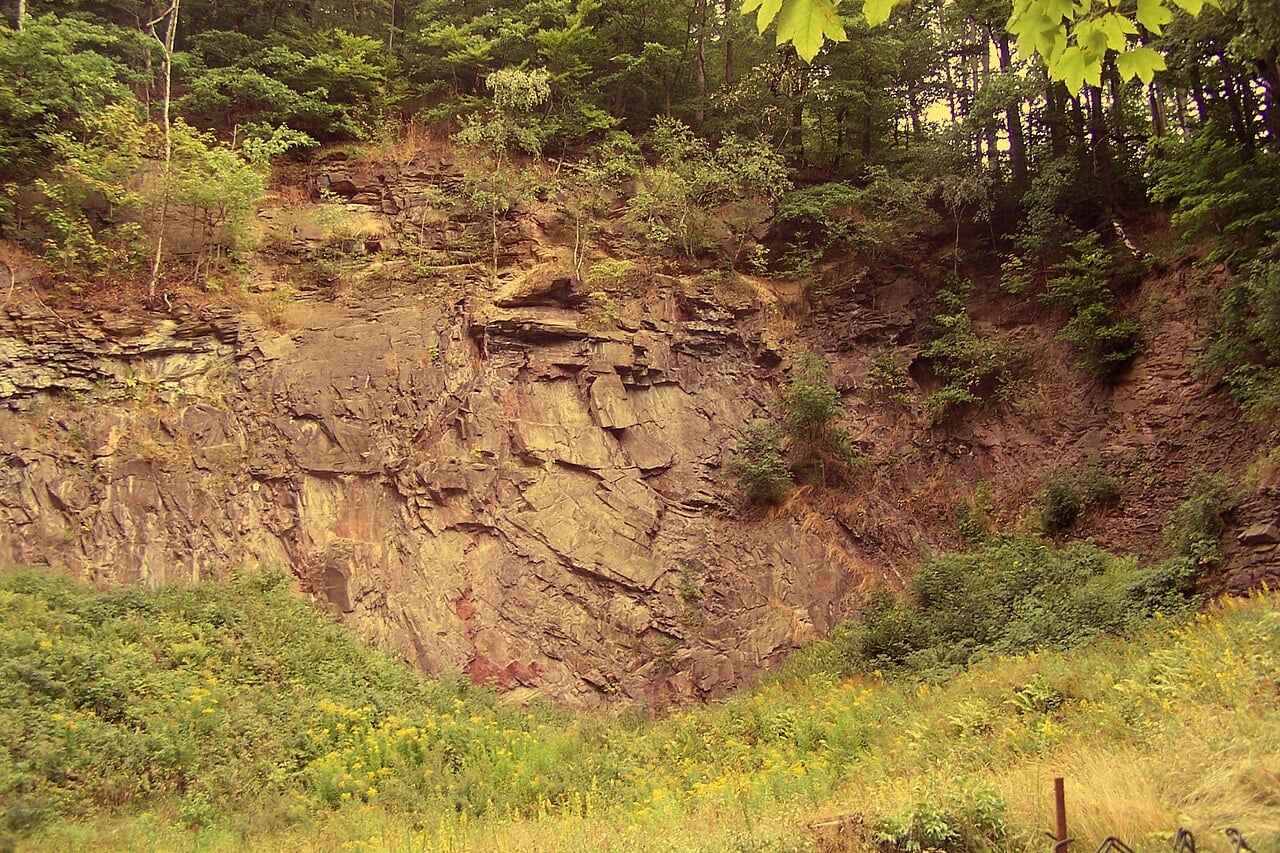
Abandoned quarry at the former train station in the Thuringian Forest. Credit: Metilsteiner / Wikimedia Commons / CC BY 3.0
Researchers have identified the oldest known impressions of reptile skin ever recorded, preserved in rock from central Germany and dating back nearly 300 million years to the early Permian period. The discovery provides the earliest direct evidence of skin structure in the ancestors of modern reptiles, offering a rare window into how early land animals adapted to life outside the water.
The fossils were found in the Thuringian Forest and studied by an international research team led by Lorenzo Marchetti of the Museum für Naturkunde Berlin. The study was published in the scientific journal Current Biology.
Fossils preserved as detailed surface impressions
Unlike rare cases where soft tissue survives as organic material, the German finds were preserved as surface impressions in fine-grained sediment. Despite this, the level of detail is unusually high. The impressions reveal clear and organized scale patterns arranged in rows, showing that key reptile skin traits were already established by the early Permian.
The fossils date to about 298 to 299 million years ago, a time when reptiles were beginning to spread across increasingly dry landscapes. Tough, scaly skin played a critical role in reducing water loss and supporting life on land.
Goldlauter Formation yields rare traces
The skin impressions were discovered within the Goldlauter Formation, a geological unit known for preserving delicate surface features. The material comes from two sites: the Cabarz quarry near Tabarz and the area of Floh-Seligenthal.
At both locations, the skin impressions were found alongside fossil resting traces and footprints left by early reptiles. This close association links the preserved skin directly to the animals that made the tracks, strengthening interpretations of anatomy and behavior.
Researchers were able to determine the age of the fossils with high precision. Volcanic ash layers embedded in the rock were dated using modern radiometric methods, confirming that these are the oldest direct examples of reptile skin known to date.
Resting traces reveal early reptile anatomy
The newly identified resting traces have been formally named Cabarzichnus pulchrus. They capture the outline of an early reptile resting against soft ground, preserving details of body contact rarely seen in the fossil record.
Researchers have identified the oldest known reptile skin impressions, preserved in rock from Germany’s Thuringian Forest. Dated to the early Permian period, the fossils reveal detailed scale patterns and may even preserve a rare cloacal opening. pic.twitter.com/DmTaOmWndB
— Tom Marvolo Riddle (@tom_riddle2025) February 24, 2026
Footprints associated with the traces show proportions similar to bolosaurians, an early reptile group belonging to the stem lineage that later gave rise to modern lizards. The trackways suggest a small, ground-dwelling animal already well adapted to terrestrial life.
The preserved scale patterns vary in shape. Some are diamond-shaped, while others are hexagonal or pointed along the sides. Researchers say these forms closely resemble skin structures seen in later land-dwelling vertebrates, indicating that complex reptile skin evolved earlier than previously confirmed.
Possible cloaca impression marks an exceptional find
One skin impression stands out as particularly extraordinary. Near the base of the tail, researchers identified a narrow, slit-like mark that may represent a cloacal opening.
Most terrestrial vertebrates possess a cloaca, a single opening used for both reproduction and waste removal. Only placental mammals evolved separate openings. Because the cloaca is soft tissue, it is rarely preserved in the fossil record.
If confirmed, the feature would be one of the clearest examples of a cloaca preserved as an external skin impression. Its shape and orientation differ from those seen in dinosaurs and crocodiles and more closely resemble those found in turtles, lizards, and snakes today.
“Such soft tissue structures are extremely rare in the fossil record,” Marchetti said. “The further back we look in Earth’s history, the more exceptional they become.”
Trace fossils highlight evolutionary insights
The research was conducted as part of the BROMACKER project, which was funded by the German Federal Ministry of Research, Technology, and Space. The findings underscore the importance of trace fossils for evolutionary research.
Unlike skeletal remains, which often preserve only fragments of anatomy, trace fossils can record posture, movement, and skin details that would otherwise be lost. Researchers say the combination of footprints, resting traces, and skin impressions provides a rare and detailed picture of early reptile life.
Together, the discoveries fill a major gap in understanding how reptiles developed some of their defining traits during a key moment in the history of life on land.