
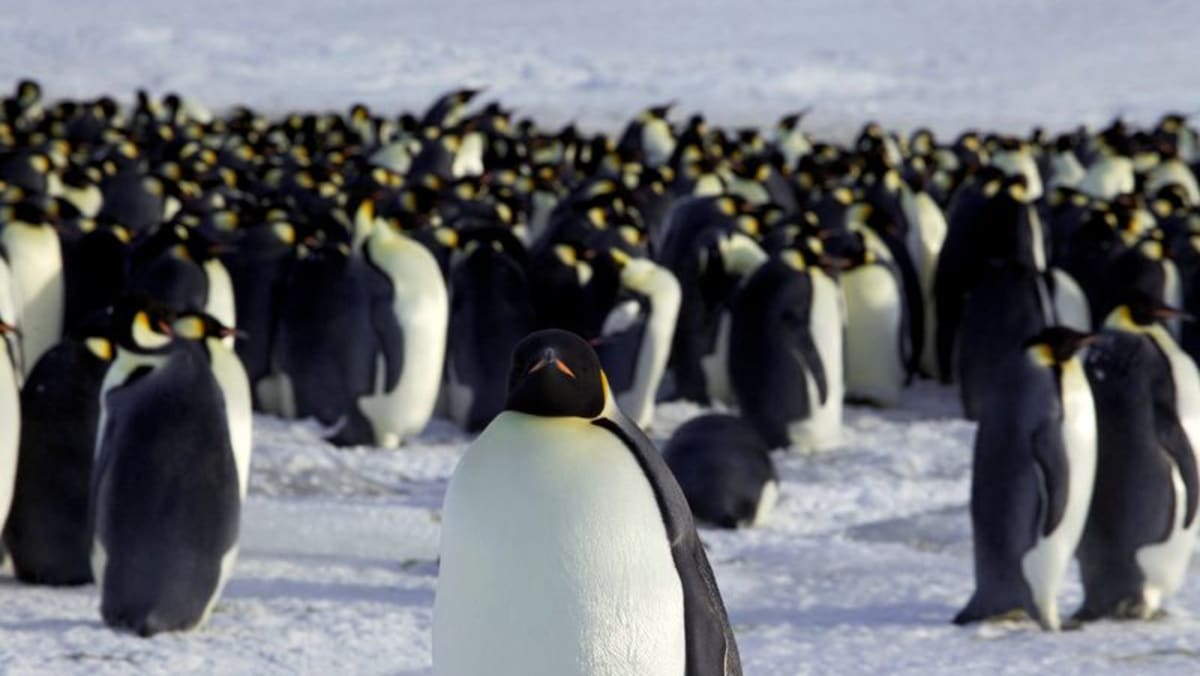
PARIS: Emperor penguins shed all their feathers once a year, a precarious ritual that may have become deadly as climate change pushes them into shrinking patches of Antarctic sea ice, researchers said Wednesday (Feb 25).
The flightless birds moult during summer, relying on stored fat to survive for several weeks until their waterproof coat grows back so they can swim and hunt in icy waters again.
Researchers from the British Antarctic Survey, analysing seven years of satellite images, accidentally discovered several moulting colonies along the extremely remote coastline of an area known as Marie Byrd Land.
As sea ice melted, the penguins were forced onto smaller spaces in increasingly large and tightly packed groups, the UK polar research organisation said in a statement.
In 2025, only 25 small groups of penguins were visible in the satellite images, it said. Prior to 2022, more than 100 groups had been spotted in the same region.
“While we don’t know for sure what happened to those penguins, we know they can find new suitable breeding sites after ice loss, so it’s possible they have established new moulting sites elsewhere,” said Peter Fretwell, lead author and mapping expert at the British Antarctic Survey.
“But also it’s possible that huge numbers of penguins perished after entering the Southern Ocean before they had replaced their waterproof feathers,” Fretwell said.
“If this has happened, the situation for emperors as a species is even worse than we thought.”
The researchers said that if emperor penguins are forced into the ocean before their feathers are replaced, they face exhaustion from increased energy use, hypothermia and increased risk from predators.