
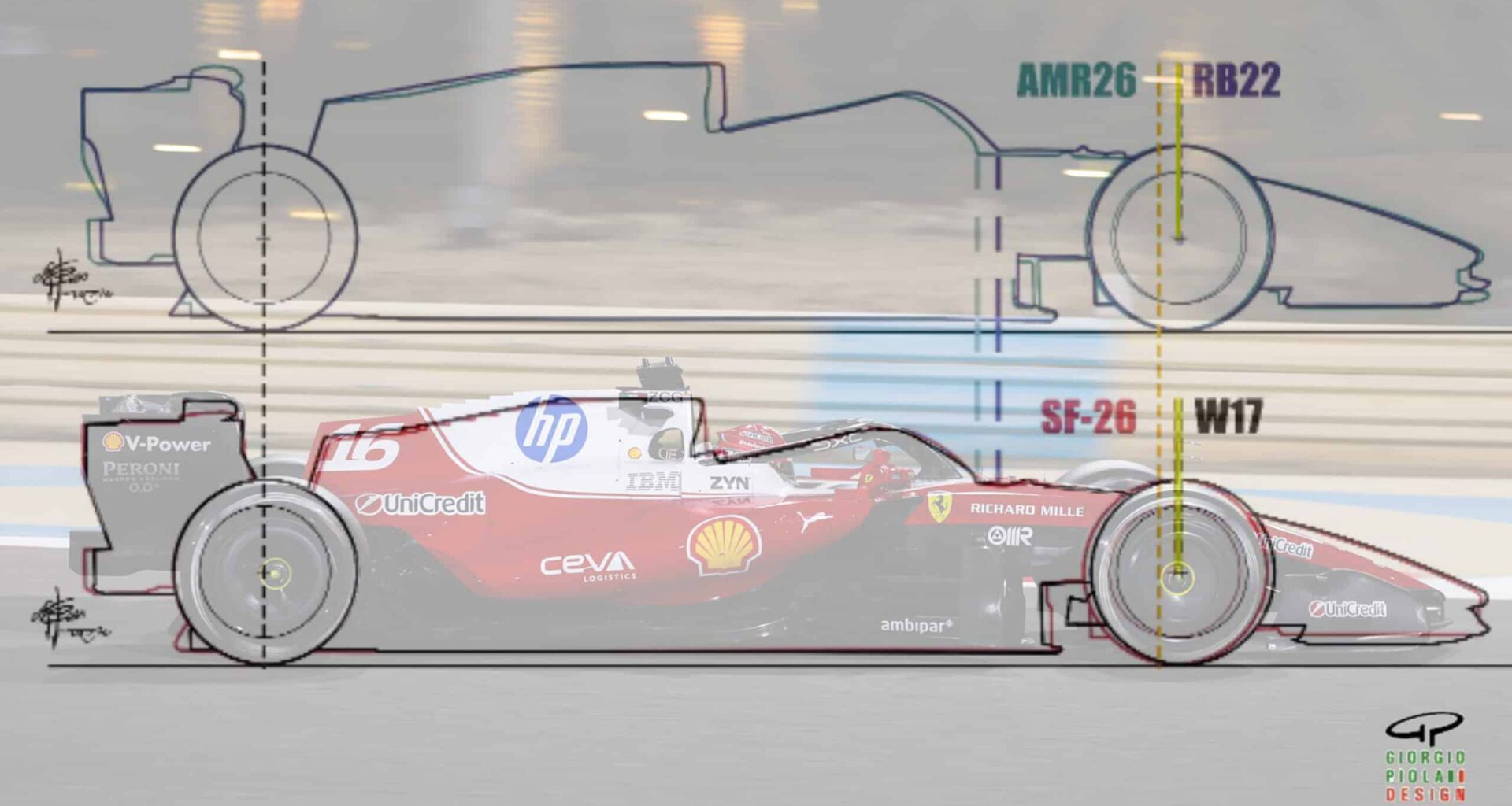
Although the placement of the diffuser’s trailing edge is defined by regulation, Ferrari has found a way of having bodywork aft of there and shaped it in a way which continues the diffuser’s expansion ramp. Even if technically, the diffuser ends where the regulations say it must and the bodywork comes after that, the air sees the combined thing as just a bigger diffuser. Dimensional boxes determine where that bodywork can be and this is where Ferrari has spotted a loophole; the differential must be sited +/- 60mm of the rear axle line. Ferrari has chosen to mount it the full 60mm behind the axle — and then used steeply angled driveshafts connecting the diff to the wheels. Bodywork can extend 60mm behind the inboard end of the driveshaft (i.e., where it feeds into the diff).
On cars with a conventionally-sited differential with less angled driveshafts, 60mm behind the diff is still within the diffuser area. But on the Ferrari, it opens out some volume behind the end of the diffuser — and it’s here that Ferrari has inserted that diffuser-extending bodywork.
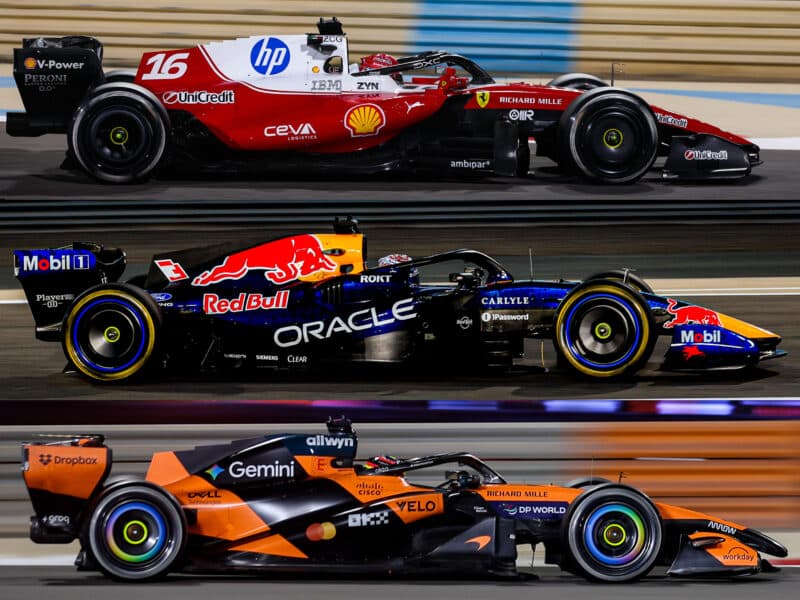
Ferrari has taken full advantage of a loophole, allowing it to extend bodywork further rearwards than rivals
DPPI
On Wednesday of last week, Ferrari then added to this bodywork what it terms a ‘flow turning device’, a vane, roughly square in section, aligning behind the two wing pillars, behind the exhaust and angled steeply upwards. This would help to further accelerate the airflow exiting the diffuser — the faster the flow, the greater the downforce — and possibly help some exhaust-aided airflow to feed the underside of the rear wing and thereby increase the wing’s downforce too.
As if that were not innovative enough, Ferrari then tried a rear wing which — in straightline mode — completely swivelled upside down rather than simply opening flat. The greater space this created between the two elements would, in theory, reduce drag further. But the endplate actuators apparently carry a weight penalty over the conventional central actuator.
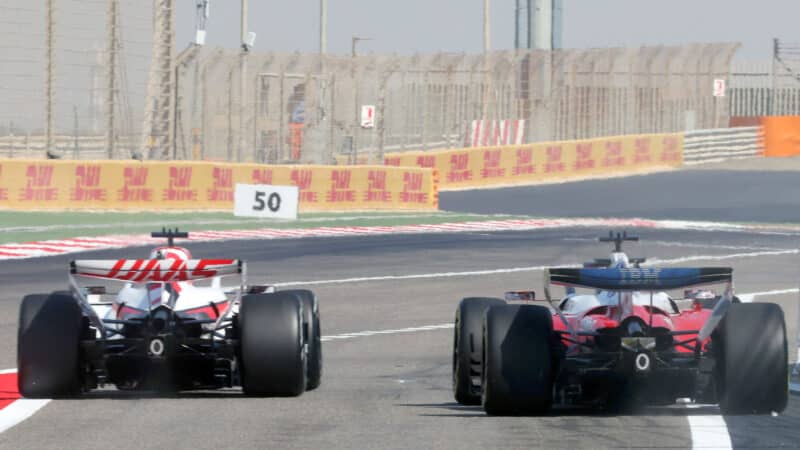
Ferrari’s flow turning device, behind the exhaust, marked it out from other cars, such as the Haas (left)
Grand Prix Photo
Power unit performance — and the differences between the five PUs — are far more dominant than before. Not only because of the bigger spread resulting in moving from an established PU formula to a new one, but also because the active aero regs mean that any power and/or deployment advantage is worth way more lap time than before because drag is no longer such a powerful dampener.
What we could observe from Bahrain testing was that the Mercedes was able to generate terrific acceleration out of the turns. George Russell and Kimi Antonelli were typically braking much earlier than the Red Bull and — especially — the Ferrari, harvesting some electrical energy which was then used to devastating effect out of the corners. The Red Bull deployment advantage Toto Wolff referred to in the previous week’s test was no longer evident as the others ran their PUs in a more aggressive mode. The implication is that Mercedes was running its internal combustion engine more conservatively the week before, and therefore not harvesting electrical energy as efficiently.