
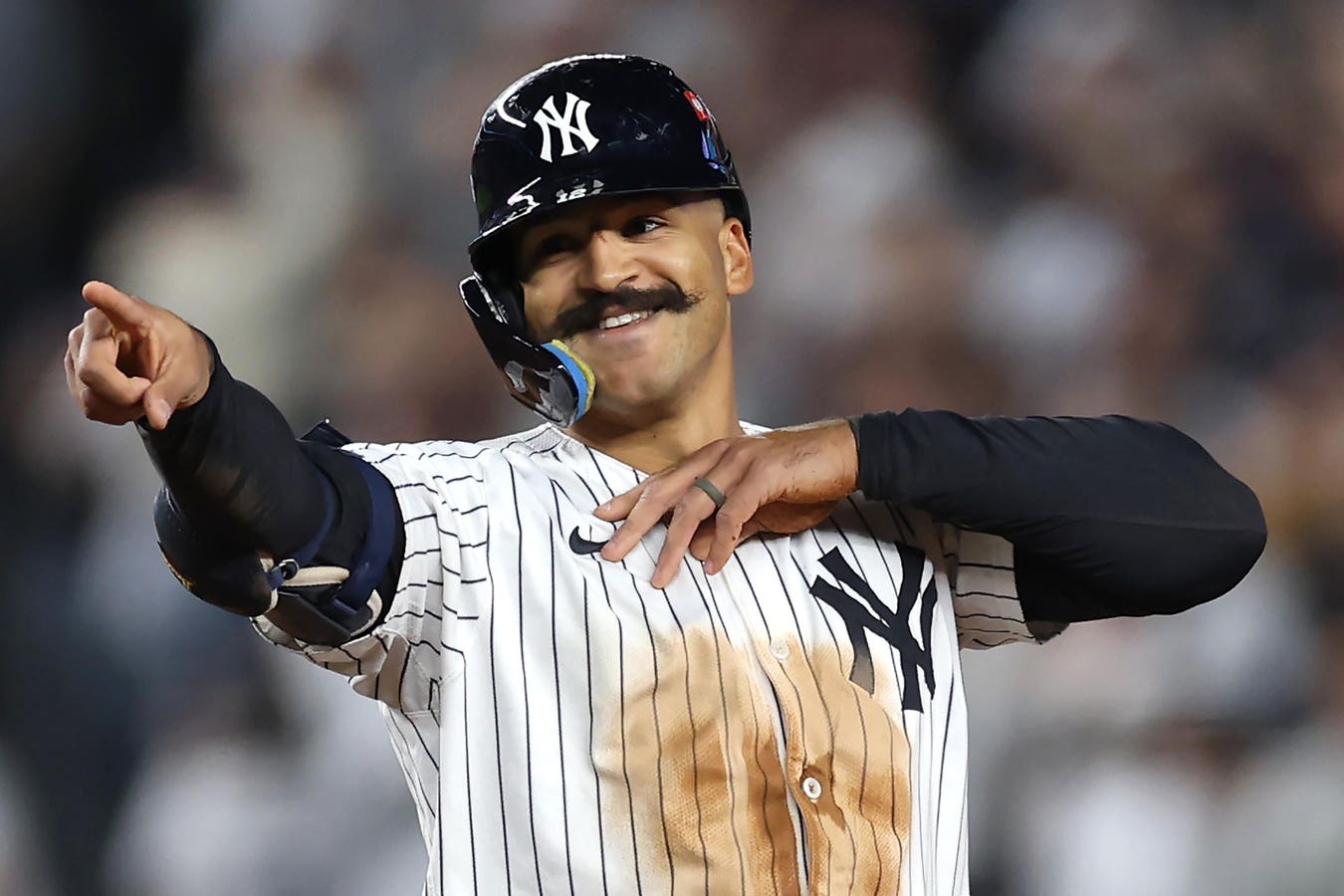
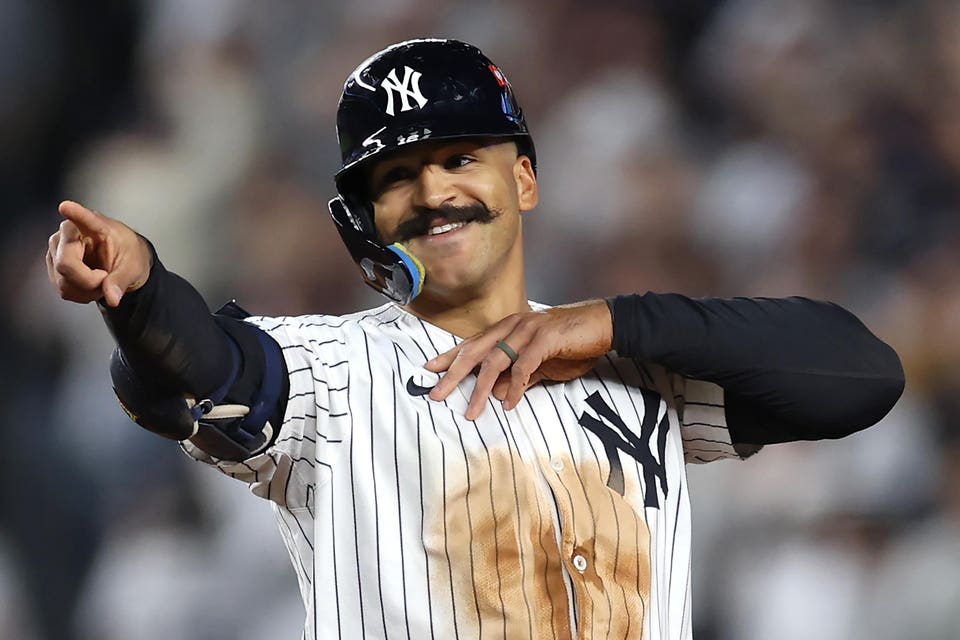
Many were surprised that the Yankees made Trent Grisham a qualifying offer, fewer were surprised that he accepted it, making him one of four players to do so this off-season. (Photo by Ishika Samant/Getty Images)
Getty Images
Major League Baseball introduced the concept of the “qualifying offer” (QO) back in 2012. Since that time, teams have extended one to 157 players. In the first fifteen years, only 14 accepted. It did take four years for the seal to be broken, with three players accepting in 2015: Brett Anderson (Dodgers); Colby Rasmus (Astros); and Matt Wieters (Orioles). But this off-season, that total number jumped to 18, with four players accepting the $22.025 million qualifying offer.
First, a primer. A player is eligible to be proffered a QO if (1) he has never received one previously (this was a change implemented in the 2017 CBA) and (2) he was with the club for the entire season. So, if a player goes from Team A to Team B at the trade deadline, that player is free of the shackles of a qualifying offer.
The QO is calculated as the mean salary of MLB’s top 125 highest-paid players. For context, in 2012, that penciled out to $13.3 million.
Qualifying Offers In Practice
If a player is offered a QO, rejects the same, and then signs with another organization, the team losing the player is granted a draft pick. If that team is a Competitive Balance Tax payor, the pick they receive is after the fourth round. If they are a revenue-sharing recipient, they get a pick between the first round and the Competitive Balance Round A (if the lost player signs for at least $50 million) or a pick after Competitive Balance Round B (if the lost player signs for less than $50 million). For all other teams, the pick received is after Competitive Balance Round B.
The inverse also occurs, which is what oftentimes makes the QO an anchor around a player’s neck. If a player rejects the QO (which occurred more than 90% of the time prior to this year) and signs elsewhere, the signing team forfeits a draft pick (though the team’s highest first-round pick is exempt from forfeiture) as well international bonus pool money (however, revenue-sharing teams are spared this penalty).
With labor uncertainty, with a changing television landscape, with many teams in various forms of rebuilding, and with the qualifying offer being a hefty sum, it is not shocking that four players accepted one this off-season. Here they are:
Brandon Woodruff (Brewers)
Woodruff lost the entirety of the 2024 season to shoulder surgery, and then made just twelve starts last year. His season ended in September with a lat strain. The Brewers declined his $20 million option, paid him his $10 million buyout, and then made him a qualifying offer. Woodruff jumped at the chance to essentially get paid $32 million this year and be a fully unrestricted free agent in 2027.
Brandon Woodruff took the qualifying offer and is hoping for a healthy season. (Photo by Mike Stobe/Getty Images)
Mike StobeShota Imanaga (Cubs)
Possibly the most interesting deal of the off-season, Chicago had the right to exercise a three-year, $57.75 million option on the left-handed pitcher. They declined to do so. Imanaga then had the right to exercise a one-year, $15.25 million option. He declined to do so. So, the Cubs then made the former NPB star a qualifying offer, which he accepted.
Shota Imanaga declined a $15.75M option and accepted a $22.025M qualifying offer. Seems like an easy decision. (Photo by Michael Reaves/Getty Images)
Getty ImagesGleyber Torres (Tigers)
Torres had a “fine” season in 2025, slashing .256/.358/.387, with 16 home runs and 74 RBI, which gave him a 108 OPS+ and 2.9 bWAR. But those numbers belie his falloff in the second half, when a sports hernia slowed his production to a crawl. He hit only .223, with just 13 extra base hits after the All-Star Break, making him less than a hot commodity as he finished his one-year, $15 million contract in Detroit. The QO to Torres was the first time the club has made one since 2014, when they presented one to each of Max Scherzer and Victor Martinez. It was not surprising when Torres accepted it.
Gleyber Torres will spend another season in Detroit, getting a 50% raise by accepting a qualifying offer. (Photo by Gregory Shamus/Getty Images)
Getty ImagesTrent Grisham (Yankees)
Grisham is coming off a career year, with his best home run total (34), best RBI total (74), most walks (82), highest OPS (.811), best OPS+ (125), and most bWAR (3.5). And yet, with Spencer Jones and Jasson Domínguez waiting in the outfield wings, and the club focused on re-signing Cody Bellinger, there were many dropped jaws among Yankee fans when the club opened themselves up to a $22 million commitment to a player who may have peaked the season before. For Grisham, it is possible that multi-year deals were available, but not at that average annual value. So, he elected to take the bird in the hand rather than risk the open market. If and when the players get locked out next December, and Grisham finds himself a 30-year old free agent in a frenzied market where teams will be rushing to make roster and financial decisions, it will be interesting to see if he regrets this decision.
Next CBA
There has been much talk about again reforming (or eliminating) the qualifying offer in the next CBA so that signing teams don’t pay such a penalty and so that players have more freedom of movement. Under the current system, whereas historically less than 10% of players have accepted the QO, this year more than 30% did so (4 of 13). Is this a harbinger of change or a one-off fluke or the last of a dying system? Only time will tell.